EN/
EN/ Romana
Hoya nicholsoniae 'New Guinea Ghost' Ø8cm
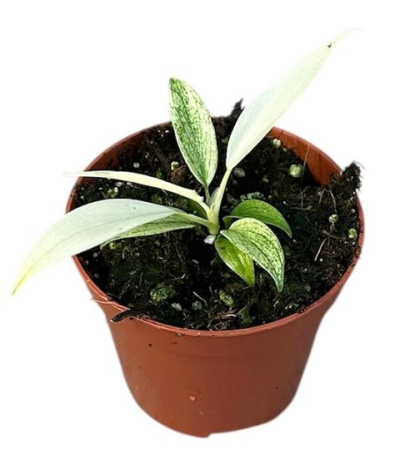
![Hoya nicholsoniae New Guinea Ghost - rare plant with large translucent leaves and ghost effect [1]](https://gomagcdn.ro/domains2/eufloria.ro/files/product/original/hoya-nicholsoniae-new-guinea-ghost-d7-893007.png "Hoya nicholsoniae New Guinea Ghost - rare plant with large translucent leaves and ghost effect [1]")
Hoya nicholsoniae 'New Guinea Ghost' is a rare variety from the Apocynaceae family, native to New Guinea, remarkable for its large, fleshy leaves with translucent zones that allow light to pass through, creating a fascinating "ghost" effect. Produces umbels of waxy flowers intensely fragrant with notes of honey and vanilla. A centrepiece for any rare plant collection.
Approx height (including pot): 15 cm
Flowering state: No flowers
Country of origin: Netherlands
Pot diameter: 7 cm
- Description
- Characteristics
- Reviews (0)
- FAQ
🌿 The Ghost of New Guinea — Translucent Elegance in Spectacular Foliage
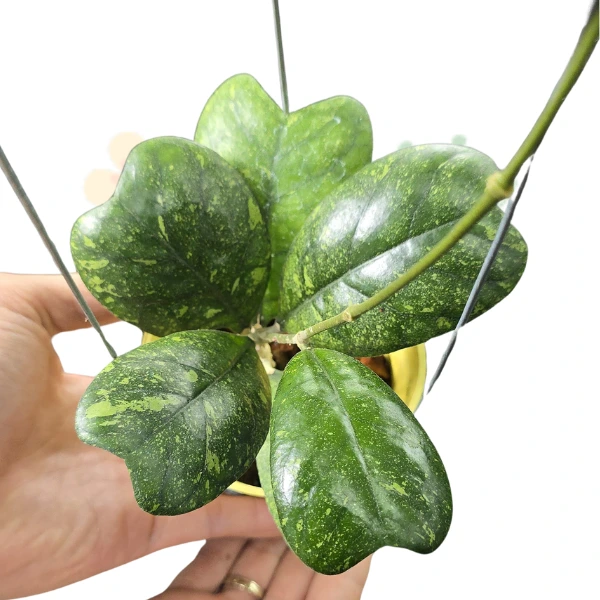
Hoya nicholsoniae 'New Guinea Ghost' is an extraordinary variety within the Hoya genus, a plant that seems to belong to a parallel universe where light and foliage merge into a symphony of translucencies and ethereal tones. The name "Ghost" is no coincidence: the leaves of this plant possess an almost supernatural quality, with translucent zones that allow light to pass through them like stained glass in an ancient cathedral, creating a mesmerising visual effect that captivates anyone who sees it for the first time.
This spectacular variety belongs to the species Hoya nicholsoniae, one of the most impressive in the Hoya genus, and is distinguished by the generous dimensions of its leaves — considerably larger than most other Hoya species — as well as the unique quality of their texture: thick, fleshy, with a waxy surface that reflects light in fascinating ways. The combination of impressive size, unique texture, and the "ghost" effect of the foliage makes this plant a centrepiece in any rare plant collection.
It is a plant that transforms the space it inhabits — placed near a bright window, its leaves capture and filter natural light, creating an interplay of shadows and translucencies that shifts throughout the day. For collectors, 'New Guinea Ghost' represents one of the most coveted Hoya varieties, combining rarity with an absolutely memorable visual presence.
🌍 Origin and Botanical History
Hoya nicholsoniae was first described by botanist Ferdinand von Mueller in 1871, named in honour of Henry Alleyne Nicholson, an eminent naturalist of the Victorian era. The species belongs to the family Apocynaceae (subfamily Asclepiadoideae), within the genus Hoya, which numbers over 500 species distributed from tropical Asia to Australia and the Pacific Islands.
Hoya nicholsoniae is native to New Guinea, the Bismarck Archipelago, and neighbouring tropical regions of Oceania, where it grows as an epiphyte or semi-epiphyte in humid tropical forests, at altitudes ranging from sea level to approximately 1,500 metres. In its natural habitat, the plant colonises the trunks and branches of large canopy trees, benefiting from the filtered light that penetrates through the dense tropical forest foliage.
The variety 'New Guinea Ghost' represents a form with special variegation, characterised by zones of foliar tissue with reduced chlorophyll that give the distinctive translucent appearance. This natural mutation has been selected and propagated by horticulturists for its exceptional ornamental qualities, rapidly becoming one of the most sought-after forms within the species.
🌱 The Foliage
The leaves constitute the central element of attraction for this variety and are, without exaggeration, among the most spectacular in the entire Hoya genus. Each leaf is oval-elliptical, with impressive dimensions of 8-15 cm in length and 5-8 cm in width — considerably larger than most Hoya species. The texture is thick, succulent, with a waxy surface that imparts a subtle sheen when viewed from the right angle.
What makes the 'New Guinea Ghost' variety truly remarkable is its variegation pattern: extensive zones of foliar tissue lacking chlorophyll or with reduced chlorophyll, appearing as translucent sections of very light green or near white-green, interspersed with areas of normal dark green. When natural light passes through these translucent zones, the effect is almost magical — the leaf appears to glow from within, like a living stained glass window. The intensity of the "ghost" effect varies from leaf to leaf and is influenced by light conditions: the more strong indirect light the plant receives, the more dramatic the contrast between green and translucent zones becomes.
Leaf margins are entire, slightly undulate, and the central vein is prominent on the lower surface, creating an elegant structural line. New leaves emerge with a subtle pinkish-bronze tint before fully developing their definitive colouration, adding an extra element of visual interest during active growth.
🌸 The Flowers
Hoya nicholsoniae produces some of the largest and most impressive flowers in the Hoya genus. The inflorescences are pendant umbels, bearing large flowers — each approximately 2-3 cm in diameter — significantly larger than most other Hoya species. The flowers have a perfect star shape, with thick, waxy petals in creamy white to pale yellow, with a deeper centre in shades of golden yellow or amber.
The fragrance is one of the most notable aspects of this species — intense, sweet, with notes of honey and vanilla, capable of filling an entire room during the evening hours when Hoya plants release their strongest scent to attract nocturnal pollinators. The nectar produced by the flowers is abundant and can be seen as glossy, transparent droplets on the flower surface, adding an extra layer of visual charm.
Each umbel can contain between 15 and 30 flowers, and a mature plant can produce multiple umbels simultaneously, creating an impressive floral and olfactory spectacle. As with all Hoya species, flower peduncles are permanent and should never be cut after wilting — the plant will reflower on the same peduncles in subsequent seasons. Flowering in cultivation requires strong indirect light and sufficient maturity (usually 2-4 years).
🌱 Growth Habit and Development
Hoya nicholsoniae 'New Guinea Ghost' exhibits a vigorous growth habit, with long, robust branches that can be trained on a support, trellis, or left to cascade from a hanging basket. Compared to many other Hoya species, nicholsoniae is a relatively fast grower, capable of producing multiple sets of large leaves throughout an active growing season. Branches become woody at the base as the plant matures, providing additional structural stability.
Aerial roots develop at nodes along the stem, facilitating adherence to supports and absorption of moisture from the air. The plant can reach considerable dimensions in cultivation, with branches exceeding 2-3 metres in length within a few years, making it spectacular both on vertical support and as a suspended specimen in large baskets.
- Light: Bright, indirect light — essential for maximum expression of the "ghost" effect in the leaves. An east or west-facing window is ideal. A few hours of direct morning sun are tolerated and can intensify leaf contrast. Insufficient light will reduce the translucent zones and make leaves more uniformly green.
- Temperature: 18-28°C optimal, minimum 15°C. The species tolerates tropical warmth well but cannot withstand cold draughts or temperatures below 12°C. In winter, maintaining 18-20°C is ideal.
- Watering: Allow the substrate to partially dry between waterings. The thick, fleshy leaves store water efficiently, making the plant resistant to short drought periods. Overwatering is the greatest risk — roots can rot quickly in permanently wet substrate.
- Humidity: 60-80% ideal. Benefits significantly from high humidity, which stimulates the development of large, healthy leaves. Regular misting or a humidifier recommended.
- Substrate: Very well-draining mix: 40% pine bark, 30% perlite, 20% coconut coir, 10% activated charcoal. Pot with plenty of drainage holes. Orchid or epiphyte substrate works excellently.
- Fertilisation: Balanced liquid fertiliser diluted to half strength, once monthly during the active period (April-September). Potassium-rich fertiliser may stimulate flowering.
- Propagation: Through stem cuttings with 2-3 nodes, in water or perlite-sphagnum mix. Rooting takes 4-8 weeks. Optimal period: spring-summer.
Lungime: 8 cm
Greutate (kg): 0.25 Kg
Denumire: Hoya
Diametru: 8 cm
Cerințe lumină: Strong, indirect light
Tip plantă: Decorative
Utilizare: Interior
Tip suport: Ghiveci
Material Suport: Plastic
Is Hoya nicholsoniae 'New Guinea Ghost' toxic to pets?
No, Hoya nicholsoniae is not toxic to cats, dogs, or other household pets. The ASPCA confirms that Hoya plants are non-toxic. The milky sap may cause minor irritation in sensitive individuals, but the plant is safe for pet-friendly households.
What does the Hoya nicholsoniae 'New Guinea Ghost' fragrance smell like?
The fragrance is described as sweet, floral, and tropical – a rich combination reminiscent of exotic jungle flowers. The scent is strong and intensifies significantly in the evening and at night, when the plant attracts its natural pollinators. Some collectors compare it to a complex floral perfume with notes of jasmine and frangipani. A single flowering plant can perfume an entire room. If you're sensitive to strong fragrances, consider placing the plant in a well-ventilated room.
How big does Hoya nicholsoniae 'New Guinea Ghost' get?
Hoya nicholsoniae is one of the more vigorous Hoya species. The leaves are large – 8-15 cm long – and stems can grow to lengths exceeding 2 metres over time. It's a plant that needs space to develop to its full potential. It can be grown in large hanging baskets or trained on a climbing support. Growth rate is moderate to fast under optimal conditions (good light, high humidity, warm temperature). Moderate pruning keeps it compact if needed.
How often should I water Hoya nicholsoniae?
Water when the top 2-3 cm of substrate are dry – usually every 7-10 days during the growing season and less frequently in winter. Hoya nicholsoniae is more tolerant of watering than small-leaved species thanks to its large, fleshy leaves that store water. When watering, water thoroughly and let it drain completely. Never leave the plant sitting in standing water. Overwatering remains the main risk – constantly wet soil leads to root rot. Better slightly dry than too wet.
Why is it called 'New Guinea Ghost'?
The name 'New Guinea Ghost' reflects two aspects of this plant: its origin from New Guinea and the ghostly appearance of its flowers. The flowers have a particularly pale white-green colour with a translucent, waxy appearance that in twilight seems almost to glow – like delicate ghosts floating in the air. The combination of spectral colour and intense nocturnal fragrance creates a mysterious and fascinating atmosphere that inspired this variety's poetic name.
Ai nevoie și de un ghiveci decorativ?