EN/
EN/ Romana
Syngonium 'New Dew' Ø5,5cm
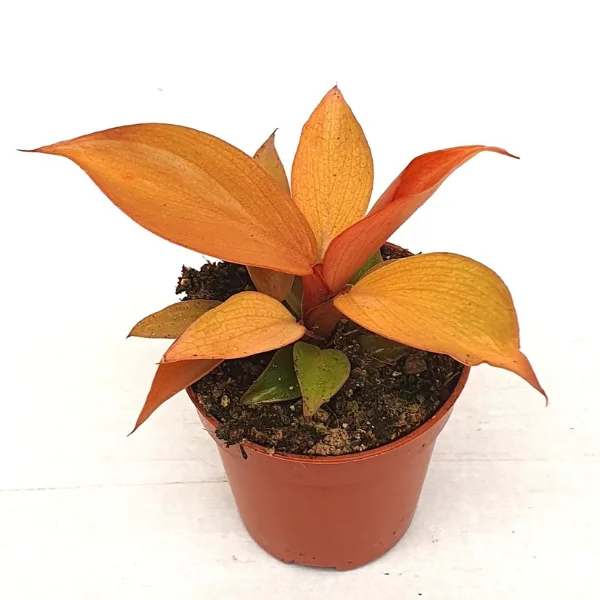
![Syngonium New Dew - tropical plant with arrowhead leaves in pastel salmon-pink and green tones [1]](https://gomagcdn.ro/domains2/eufloria.ro/files/product/original/syngonium-new-dew-d5-5-264947.webp "Syngonium New Dew - tropical plant with arrowhead leaves in pastel salmon-pink and green tones [1]")
Syngonium ‘New Dew’ is a modern cultivar from the Araceae family, distinguished by its sagittate leaves in pastel shades of salmon-pink, cream, and pale green that shift as the leaf matures. Compact and easy to care for, this tropical plant brings a touch of delicacy and freshness to any indoor space.
Approx height (including pot): 10 cm
Country of origin: Netherlands
Pot diameter: 5.5 cm
- Description
- Characteristics
- Reviews (0)
- FAQ
🌿 Syngonium ‘New Dew’ — morning dew captured in leaves
There are plants that carry in their leaves the light of the day’s first hours, that ephemeral glow of dew that the sun transforms into diamonds before wiping it away. Syngonium ‘New Dew’ is one such plant — a modern cultivar that captures the essence of morning freshness in a palette of delicate salmon-pink, pale green, and cream, colours that blend across each leaf’s surface like a watercolour that has not yet dried on paper. It is a plant that seems to emerge from a pastel dream, so delicate and luminous that you wonder whether its colour is truly real.
The genus Syngonium has experienced a true renaissance in the last decade, with dozens of new cultivars exploring the chromatic limits of this remarkably versatile plant. ‘New Dew’ belongs to the wave of pastel-toned varieties that have conquered Asian and European markets — plants selected not for size or vigour, but for the subtlety and refinement of their colour range. Each new leaf is a surprise, as the proportion of pink, green, and cream varies with light, temperature, and leaf age, making every plant a unique specimen with its own chromatic portrait.
For Syngonium collectors and all those seeking a plant with an ethereal, almost dreamlike presence, ‘New Dew’ is an inspired choice: compact, easy to care for, with a remarkable ability to brighten any corner of the home with its pastel hues. It is the plant that proves beauty lies not in size, but in subtlety.
🌍 Origin and Botanical History
The genus Syngonium belongs to the family Araceae, the same vast family that includes Philodendron, Monstera, and Anthurium. It comprises approximately 30–36 species native to the tropical regions of Central and South America, from southern Mexico to Bolivia and Brazil. The generic name derives from Greek: “syn” (“together”) + “gone” (“reproductive organs”), referring to the fused ovaries of the flowers. Plants of this genus were first described by Heinrich Wilhelm Schott in 1829.
The base species for most ornamental cultivars, including ‘New Dew,’ is Syngonium podophyllum, native to the moist tropical forests from Mexico to Brazil, where it grows as a hemiepiphyte — rooting in the soil but climbing tree trunks with aerial roots, following the filtered light of the canopy. In its natural habitat, plants can reach heights of 10–20 m on tree trunks, with leaves that transform dramatically with age — from the simple sagittate form of juvenile plants to compound, palmately lobed leaves with 5–11 segments in mature plants.
The cultivar ‘New Dew’ is a relatively recent creation, resulting from intensive selection and hybridisation programmes in Asian nurseries (Thailand, Indonesia) that have produced dozens of new varieties in the last decade. Selection focused on stabilising mutations that produce pastel foliage with distinctive salmon-pink tones while maintaining the vigour and resilience of the parent species.
🌱 The Foliage
The leaves of Syngonium ‘New Dew’ are the jewels that justify this cultivar’s entire existence — small masterpieces of colour and form that appear painted with a watercolourist’s fine brush. Each leaf has the sagittate (arrowhead) shape classic to juvenile Syngonium, with two pronounced basal lobes and a pointed tip. Dimensions vary between 6–12 cm in length and 4–8 cm in width, on petioles of 8–15 cm that hold the leaves elegantly raised above the substrate.
Colouration is the defining element: young leaves unfurl in a delicate salmon-pink, almost translucent, with a darker central vein and margins that may display cream or very pale green tones. As the leaf matures, the pink gradually fades, giving way to a pale green with silvery reflections and residual zones of pink-cream. This chromatic transition means the plant simultaneously bears leaves at different stages of maturation, creating a pastel gradient effect that is simply enchanting.
The leaf texture is smooth, with a matte-satin appearance that diffuses light in a delicate manner. Veins are slightly depressed on the upper surface, creating a subtle relief that adds dimensionality to each leaf. The underside is lighter in colour, with silvery-green tones. To the touch, the leaves are firm yet flexible, with that fleshy consistency characteristic of Araceae that store moisture in their tissues.
🌸 The Flowers
Like all Araceae, Syngonium produces inflorescences consisting of a spathe (modified bract) surrounding a spadix (central floral axis). In indoor culture, flowering is extremely rare, especially in compact cultivars maintained in the juvenile stage such as ‘New Dew.’ The flowers, when they appear, are small and inconspicuous — a greenish-white spathe of 5–8 cm with no significant ornamental value. Growers typically prefer to remove any inflorescences to redirect the plant’s energy toward producing new leaves, which are the true spectacle of this plant.
The ornamental value of Syngonium ‘New Dew’ resides entirely in its pastel foliage, and the absence of flowers in culture does not diminish the plant’s attractiveness in the slightest. On the contrary — energy not directed toward flowering translates into continuous production of new leaves, each a small chromatic work of art.
🌱 Growth Habit and Development
Syngonium ‘New Dew’ has a compact growth habit in the juvenile stage, forming a dense rosette of leaves on short to medium petioles. With age, the plant begins to send out longer stems with a climbing tendency, which can be trained on a moss pole or allowed to trail freely. On a vertical support, the leaves tend to grow larger and begin the transition to the mature lobed form — a fascinating process to observe. To maintain the compact habit and arrowhead-shaped leaves, the elongating stems can be periodically trimmed.
Growth rate is moderate — slower than classic green cultivars (such as Syngonium ‘White Butterfly’), because the variegated areas contain less chlorophyll and photosynthesise less efficiently. A plant in good conditions produces one to two new leaves per month during the growing season. Branching is natural and can be encouraged by pinching growing tips, resulting in a bushier, more compact plant.
- Light: Bright indirect light. Direct sun scorches the delicate leaves and bleaches the pastel tones. Insufficient light dramatically reduces the pink colouration, turning leaves green. An east or north-facing window is ideal.
- Temperature: 18–25°C optimal. Minimum 13°C — below this, growth stops and leaves may suffer. Does not tolerate cold draughts.
- Watering: Keep the substrate consistently moist but not waterlogged. Water when the top 2–3 cm have dried. Summer: twice weekly; winter: once weekly. Avoid standing water in the saucer.
- Humidity: 60–80% ideal. Adapts to 40–50% but grows better with higher humidity. Foliar misting or a pebble tray helps.
- Substrate: Well-draining, aerated mix: peat (40%) + perlite (30%) + pine bark (20%) + activated charcoal (10%). Alternatively, aroid-specific substrate.
- Fertilisation: Monthly during the growing season (April–September) with balanced liquid fertiliser (NPK 20-20-20) diluted to half strength. Do not fertilise in winter.
- Propagation: By stem cuttings with a node and aerial root, placed in water or moist substrate. Water rooting takes 2–3 weeks. Best period: spring to summer.
Lungime: 5.5 cm
Greutate (kg): 0.15 Kg
Denumire: Syngonium
Diametru: 5.5 cm
Cerințe lumină: Strong, indirect light
Tip plantă: Decorative
Utilizare: Interior
Tip suport: Ghiveci
Material Suport: Plastic
What type of light does Syngonium 'New Dew' prefer?
Syngonium 'New Dew' prefers medium to bright indirect light. The salmon-pink leaf colours are most intense in good light. Avoid direct sunlight which can scorch the delicate foliage, but also too low light where the plant loses its colouring and becomes predominantly green.
How do you water Syngonium 'New Dew' correctly?
Water when the top 2-3 cm of substrate have dried out. Syngonium 'New Dew' does not tolerate excess water which can cause root rot. In the warm season, water 1-2 times per week, and reduce frequency in winter. Make sure the pot has drainage holes and do not let water sit in the saucer.
Is Syngonium 'New Dew' toxic to pets?
Yes, Syngonium 'New Dew' contains calcium oxalate crystals that are toxic if ingested by both cats and dogs, as well as humans. Contact with the sap can cause skin irritation. It is recommended to place the plant in locations inaccessible to pets and small children.
Does Syngonium 'New Dew' need high humidity?
Syngonium 'New Dew' appreciates higher humidity, ideally between 50-70%. It adapts to normal household humidity, but leaf tips may become dry in very dry air. Mist the leaves regularly or use a humidifier, especially during the heating season.
How can Syngonium 'New Dew' be propagated?
Syngonium 'New Dew' propagates easily through stem cuttings with at least one node. Cut below a node and place the cutting in water or directly in moist substrate. Roots appear within 2-4 weeks. Spring and summer are the best periods for propagation, when the plant is actively growing.
Ai nevoie și de un ghiveci decorativ?