EN/
EN/ Romana
Begonia Magic Colours Red Kiss Ø6cm
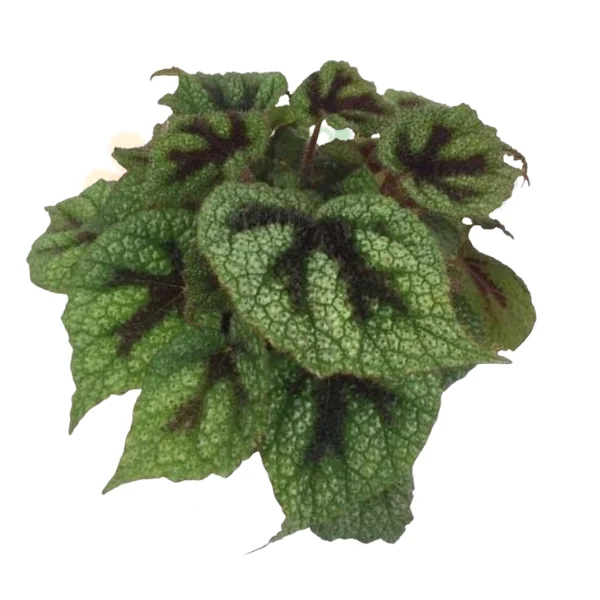
![Begonia Red Kiss - decorative begonia with intense red-burgundy foliage and metallic black margins [1]](https://gomagcdn.ro/domains2/eufloria.ro/files/product/original/begonia-magic-colours-red-kiss-d6-325363.jpg "Begonia Red Kiss - decorative begonia with intense red-burgundy foliage and metallic black margins [1]")
Begonia 'Red Kiss' from the MAGIC COLOURS series is a rex-cultorum begonia with dramatic foliage, dominated by intense red-burgundy and metallic black tones creating a striking contrast. The rounded leaves, with a deeply pigmented central spiral and near-black margins, make this one of the most expressive plants in the entire series. Available in 6 cm pots, Red Kiss is a compact botanical jewel, perfect for collections and high-impact indoor arrangements.
Approx height (including pot): 10 cm
Pot diameter: 6 cm
- Description
- Characteristics
- Reviews (0)
- FAQ
🌿 The Red Kiss of the Jungle
In the gallery of cultivars from the MAGIC COLOURS series — one of Europe's most celebrated lines of rex-cultorum hybrid begonias — 'Red Kiss' occupies a special place through its almost unreal chromatic intensity. The name, evoking a passionate kiss, perfectly captures the spirit of this plant: its leaves are an explosion of deep red-burgundy, framed by margins so dark they appear black, creating a dramatic contrast that mesmerises from the very first glance.
The MAGIC COLOURS series was developed through selective hybridisation programmes in Dutch and Belgian nurseries, harnessing the vast genetic heritage of the rex-cultorum group. Among all the series' cultivars, 'Red Kiss' is perhaps the boldest — while its siblings play with shades of silver, green, and pink, this cultivar dedicates itself entirely to drama, building upon its leaves a tableau dominated by the most intense and profound colours of the botanical palette.
It is a plant that never goes unnoticed. Placed on a white shelf or a light wood table, its red-black leaves create an irresistible focal point, drawing the eye and inviting contemplation. Under different lights, the colours transform subtly — in the morning, the red tones are warmer, almost ruby; in the evening, under artificial light, the burgundy deepens toward wine shades, and the margins acquire an almost-black metallic sheen reminiscent of the silk of an evening gown.
🌍 Origin and Botanical History
The genus Begonia, described by Charles Plumier in 1700 and formalised by Carl Linnaeus in 1753, bears the name of Michel Bégon, the French governor of Saint-Domingue. With over 2,000 recognised species, it is one of the largest flowering plant genera in the world, belonging to the family Begoniaceae. The genus's centre of diversity lies in the tropical forests of Central and South America, Southeast Asia, and sub-Saharan Africa.
The rex-cultorum group originates from Begonia rex, discovered in Assam, India, in 1856. Since then, over 160 years of hybridisation have produced thousands of ornamental foliage cultivars. 'Red Kiss' represents a modern achievement of this tradition, combining extreme pigmentation with vigour and resilience to domestic conditions.
Like other MAGIC COLOURS cultivars, 'Red Kiss' is propagated through tissue culture in specialised laboratories, ensuring the uniformity of each specimen and faithful maintenance of the intense colours that define this cultivar.
🌱 The Foliage
The leaves are the heart and soul of 'Red Kiss'. Each leaf emerges on a short petiole from the creeping rhizome, unfurling in the spiral that is a hallmark of rex begonias. Mature leaves reach 10 to 15 centimetres, with the rounded, asymmetric form typical of the genus — one half slightly larger than the other.
The dominant colour is an intense, saturated red-burgundy that covers most of the leaf surface. This red is not flat but complex: viewed from different angles, it reveals metallic reflections varying from ruby to Bordeaux wine. The leaf margins are covered by a broad band of pigment so dark it appears black — a night-green so profound it absorbs light, creating a "dark frame" effect that further highlights the red centre.
The central spiral is the point of maximum chromatic intensity, where the red-burgundy concentrates in almost phosphorescent tones. The leaf texture is slightly velvety, with a pleasant tactile quality that invites touching. Young leaves are particularly spectacular, with red tones at their peak, before maturing slightly toward deeper hues. The undersurface completes the spectacle with a uniform wine-red and prominent venation.
🌸 The Flowers
'Red Kiss' can produce flowers, like all begonias, though these pale in comparison to the foliage drama. The inflorescences appear on slender peduncles above the leaf canopy, bearing small clusters of delicate pale pink blooms, 1 to 1.5 centimetres across. The translucent petals and golden-yellow stamens offer a subtle contrast to the dominant red of the foliage.
Most growers remove flower stalks to keep energy focused on new leaf production. If left to develop, the flowers do not negatively affect the plant and may appear sporadically from late spring to early autumn.
🌱 Growth Habit and Care
'Red Kiss' develops as a compact, dense mound, with the rhizome advancing slowly across the substrate surface. The mature plant reaches 20–30 centimetres in diameter with a height of 15–20 centimetres. The compact habit and modest size make it perfect for desks, shelves, plant vitrines, and group arrangements with other begonias or tropical plants.
Growth rate is moderate, and the plant maintains its natural form without pruning or restructuring. Compared to more demanding rex begonias, 'Red Kiss' shows appreciable resilience, adapting well to standard European domestic conditions.
- Light: Bright indirect light. East or northeast windows are optimal. Direct light scorches leaves; insufficient light fades the red colours and produces leggy growth.
- Temperature: 18–24°C optimal. Do not go below 15°C. Protect from cold draughts.
- Watering: Top 2–3 cm of substrate must dry between waterings. Water at the base, never wet the leaves. Reduced frequency in winter.
- Humidity: 50–70%. Pebble tray, plant grouping, or humidifier during heating season. No direct misting on leaves.
- Substrate: Light, well-draining mix: peat/coco + perlite + orchid bark. Rhizome never sits in water.
- Fertilisation: Liquid fertiliser diluted to half strength every 2–3 weeks spring–autumn. Pause in winter.
- Propagation: By rhizome division or leaf cuttings on moist substrate with cuts across main veins.
🌸 Begonia Red Kiss in your collection — pairings and recommendations
For collectors starting out with rare begonias, Red Kiss makes a spectacular entrance, yet pairs beautifully with other cultivars from the Begonia genus — each offering distinct leaf textures, colours, and shapes. The arrangement becomes truly impressive when you place Red Kiss next to a begonia with silvery or jade-green foliage: the chromatic contrast highlights the deep burgundy tones.
For healthy roots, we recommend an airy, well-draining substrate enriched with specialised potting mix for indoor plants. Add perlite at 20-30% for optimal aeration — the rex begonia rhizome does not tolerate waterlogged substrate. A ceramic pot with drainage holes maintains balanced moisture and adds an aesthetic touch to interior decor.
Red Kiss thrives in a workspace with consistent diffused light, making it an excellent choice from the category of office plants. Compact and discreet, yet visually impossible to ignore, it becomes a subtle focal point on the desk of any indoor plant enthusiast.
Care reminders for long-term beauty
Like all members of the Begonia rex-cultorum group, Red Kiss rewards patience over haste. Give it months — not weeks — to settle into its new environment. The leaves may temporarily lose some of their depth of colour during the acclimatisation period, but proper light, humidity, and minimal watering will bring back the dramatic burgundy intensity that makes this cultivar so desirable.
Avoid moving the plant frequently once it has found its preferred spot — begonias are sensitive to environmental changes, particularly in light direction and humidity levels. A stable position near an east-facing window, combined with a humidity tray or grouping with other tropical foliage plants, creates an ideal microclimate where Red Kiss can fully express its botanical charisma.
Lungime: 6 cm
Greutate (kg): 0.15 Kg
Denumire: Begonia
Diametru: 6 cm
Cerințe lumină: Strong, indirect light
Tip plantă: Decorative
Utilizare: Interior
Tip suport: Ghiveci
Material Suport: Plastic
How do I care for Begonia Magic Colours Red Kiss?
How do I care for Begonia?
How often should I water Begonia?
Is Begonia toxic to pets?
How do I propagate Begonia?
What temperature does Begonia prefer?
What type of plant is Begonia Red Kiss?
What light conditions does Begonia Red Kiss prefer?
How should I water Begonia Red Kiss?
Is Begonia Red Kiss toxic to pets?
How do I maintain the intense leaf colour of Begonia Red Kiss?
Recommendations
Ai nevoie și de un ghiveci decorativ?