EN/
EN/ Romana
Syngonium erythrophyllum 'Red Arrow' Ø12cm
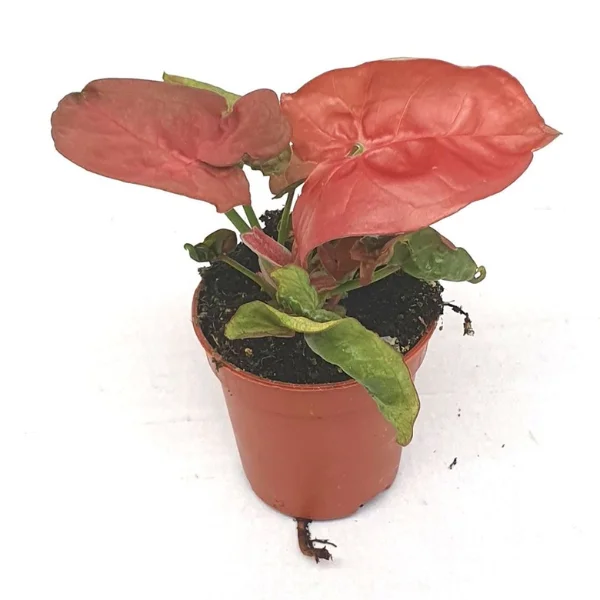
![Syngonium 'Red Arrow' — sagittate green leaves with burgundy-red underside, Ø12cm pot Eufloria [1]](https://gomagcdn.ro/domains2/eufloria.ro/files/product/original/syngonium-erythrophyllum-red-arrow-926873.png "Syngonium 'Red Arrow' — sagittate green leaves with burgundy-red underside, Ø12cm pot Eufloria [1]")
Syngonium erythrophyllum 'Red Arrow' — Syngonium with sagittate leaves green above and burgundy-red below. Reddish petioles. Climbing plant for moss pole. Humidity 60-80%, indirect light, 18-28°C.
Approx height (including pot): 25 cm
Pot diameter: 12 cm
- Description
- Characteristics
- Reviews (0)
- FAQ
🌿 Green Arrows With Wine-Coloured Backs — Two-Faced Foliage With Dramatic Character
Syngonium erythrophyllum 'Red Arrow' is a plant with a beautiful secret: at first glance it greets you with elegant arrow-shaped leaves of a velvety dark green, but as soon as a leaf twists slightly or is lifted by a breeze, it reveals an underside of intense wine-red, like a hidden velvet lining. This chromatic duality — green on the front, wine on the back — gives the plant a dramatic character and a depth that clearly sets it apart from ordinary syngoniums.
Even its name gives it away: "erythrophyllum" means, in ancient Greek, "with red leaves", a direct reference to the warm tones that colour both the underside of the leaves and the petioles and stems. It is a plant for those who love deep tones, subtle contrasts and foliage that changes its appearance depending on the angle and the light — a small living surprise, always ready to show its other face.
Offered in a 12 cm pot, it is a well-developed plant ready to continue its growth. Versatile by nature, it can be left to spill gracefully over the edge of a pot, as a trailing plant, or trained on a support, climbing and developing ever larger, more expressive leaves.
For the plant lover seeking elegance, chromatic depth and foliage with personality, 'Red Arrow' is a refined choice — a plant that is discreet at first sight but full of character for those who look closely.
🌍 Origin and Botanical History
Syngonium erythrophyllum belongs to the Araceae family, the great aroid family that includes philodendrons, monstera and anthurium. The species is native to the tropical forests of Central and South America, where it grows as a climbing vine, ascending tree trunks with the help of aerial roots, in search of light filtered through the dense canopy.
The genus name "Syngonium" comes from the Greek "syn" (together) and "gone" (seed, reproductive organ), a reference to the united ovaries of the flowers. The epithet "erythrophyllum" translates literally as "with red leaves", from the Greek "erythros" (red) and "phyllon" (leaf), perfectly describing the most distinctive feature of this species — the reddish pigmentation of the leaf undersides.
Unlike the much more common Syngonium podophyllum, this species is less often encountered and more prized by collectors precisely because of its special colouring. Popularly, all plants of the genus are known as "arrowhead plants", because of the characteristic shape of their young leaves, which recall an arrowhead or an elongated heart.
Its origin as a tropical forest vine explains all the plant's needs: a preference for constant warmth, high humidity, indirect light and a support to climb, imitating the tree trunk of its natural habitat.
🌱 The Foliage
The foliage is, without doubt, the great attraction of this plant. The leaves have a clear arrowhead or elongated heart shape, carried on thin, coloured petioles that lift them elegantly. The upper face of the leaf is a deep, velvety dark green, often with a lighter central vein that structures its surface.
The great surprise, however, comes from the underside: the lower part of the leaf is an intense wine-red, a warm shade of wine or plum that contrasts spectacularly with the green above. This coloured underside shows whenever the leaf tilts, twists or is seen from the side, giving the plant a permanent play of colour. The petioles and stems also carry the same reddish tones, completing the plant's warm palette.
Young leaves emerge rolled from a central bud and unfurl gradually, often with a stronger reddish tint at first, then maturing into a balance of green and wine. The mature leaves, as the plant climbs, can become larger and more lobed, slightly changing shape over the plant's life — a fascinating feature of the whole Syngonium genus.
Carried on a supple, climbing stem, the leaves orient themselves toward the light and create, over time, a cascade or living column of green-and-wine arrows, bringing depth and a refined air wherever the plant is placed.
🌸 The Flowers
Like all aroids, Syngonium erythrophyllum can produce, at maturity, the family's typical inflorescence: a central spadix in the shape of a small cob, wrapped in a greenish-cream spathe. In apartment culture, however, flowering is extremely rare, appearing only on very mature, well-established specimens in near-tropical conditions.
For the plant lover, flowering is by no means the goal — this plant is grown exclusively for its two-faced foliage and its distinct arrowhead shape, which offer a permanent spectacle regardless of the season. The flowers, when they appear, remain a botanical curiosity, a sign of an especially happy plant.
The entire ornamental value of this plant therefore lies in its green-and-wine leaves, which do not fade or pass but multiply ceaselessly, each new leaf adding a new chromatic accent to the plant's silhouette.
🌱 Growth and Development
Syngonium erythrophyllum 'Red Arrow' is a versatile climbing vine, with moderate growth in good conditions. It can be grown in two ways: left to spill gracefully over the edge of a hanging pot or shelf, as a trailing plant, or trained on a moss pole, in which case the leaves become larger as the plant climbs. Regular pinching keeps it dense and encourages branching.
It is a grateful, friendly plant, suitable both for beginners and for collectors, as long as it is given warmth, humidity and the right light. The reddish colouring of the leaves is best maintained in bright but filtered light. With consistent care, it rewards you with healthy growth and ever richer foliage.
- Light: bright, indirect light; the wine-red colouring of the underside is best maintained in generous light, but shield the plant from strong direct sun, which can scorch its leaves.
- Temperature: prefers 18–27 °C and constant warmth; keep it away from cold below 15 °C and from cold draughts.
- Watering: water when the top layer (2–3 cm) of substrate has dried, maintaining balanced moisture; avoid both complete drying and standing water at the roots.
- Humidity: enjoys high humidity; misting, grouping with other plants or a humidifier keep its foliage healthy and encourage larger leaves.
- Substrate: an airy, well-draining aroid mix with bark, perlite and coco fibre, imitating the loose soil of the tropical forest.
- Fertilising: feed monthly in the warm growing season with a balanced, diluted foliage-plant fertiliser; reduce in winter.
- Propagation: very easy from stem cuttings that include a node, rooted in water or directly in warm, moist substrate.
Thanks to its warm colouring and distinct shape, 'Red Arrow' looks superb alongside other aroids and foliage plants with similar needs, which set off its wine tones by contrast.
Lungime: 20 cm
Greutate (kg): 1 Kg
Denumire: Syngonium
Cerințe lumină: Partial umbra
Tip plantă: Decorative
Utilizare: Interior
Tip suport: Ghiveci
Material Suport: Plastic
Why 'erythrophyllum'?
How to water?
What light?
Is it toxic?
How to propagate?
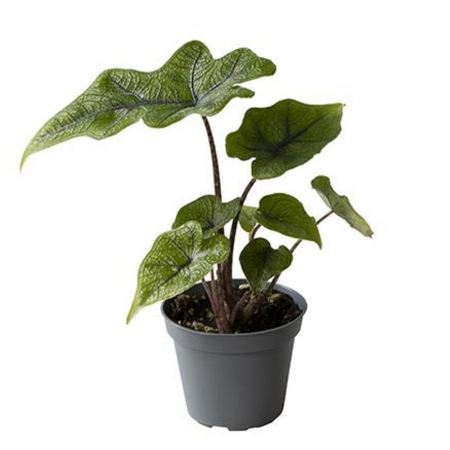
Ai nevoie și de un ghiveci decorativ?