EN/
EN/ Romana
Sansevieria 'Pyramid' D8
![Sansevieria 'Pyramid' — Architectural Snake Plant with Stacked Leaves [0]](https://gomagcdn.ro/domains2/eufloria.ro/files/product/medium/sansevieria-pyramid-d8-505926.webp "Sansevieria 'Pyramid' — Architectural Snake Plant with Stacked Leaves [0]")
![Sansevieria 'Pyramid' — Architectural Snake Plant with Stacked Leaves [1]](https://gomagcdn.ro/domains2/eufloria.ro/files/product/medium/sansevieria-pyramid-d8-437967.webp "Sansevieria 'Pyramid' — Architectural Snake Plant with Stacked Leaves [1]")
![Sansevieria 'Pyramid' — Architectural Snake Plant with Stacked Leaves [2]](https://gomagcdn.ro/domains2/eufloria.ro/files/product/medium/sansevieria-pyramid-d8-339969.webp "Sansevieria 'Pyramid' — Architectural Snake Plant with Stacked Leaves [2]")
![Sansevieria 'Pyramid' — Architectural Snake Plant with Stacked Leaves [1]](https://gomagcdn.ro/domains2/eufloria.ro/files/product/original/sansevieria-pyramid-d8-505926.webp "Sansevieria 'Pyramid' — Architectural Snake Plant with Stacked Leaves [1]")
![Sansevieria 'Pyramid' — Architectural Snake Plant with Stacked Leaves [2]](https://gomagcdn.ro/domains2/eufloria.ro/files/product/original/sansevieria-pyramid-d8-437967.webp "Sansevieria 'Pyramid' — Architectural Snake Plant with Stacked Leaves [2]")
![Sansevieria 'Pyramid' — Architectural Snake Plant with Stacked Leaves [3]](https://gomagcdn.ro/domains2/eufloria.ro/files/product/original/sansevieria-pyramid-d8-339969.webp "Sansevieria 'Pyramid' — Architectural Snake Plant with Stacked Leaves [3]")
Approx height (including pot): 10 cm
Pot diameter: 8 cm
- Description
- Characteristics
- Reviews (0)
- FAQ
🔺 Geometric Elegance in Living Form
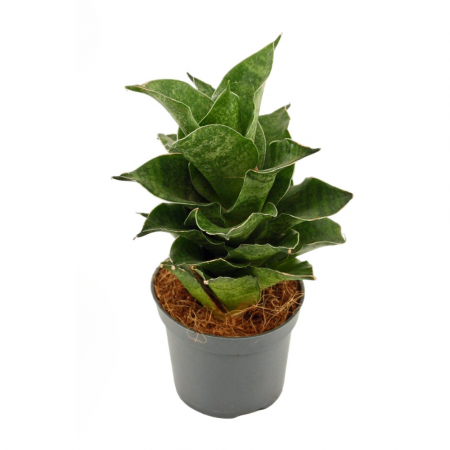
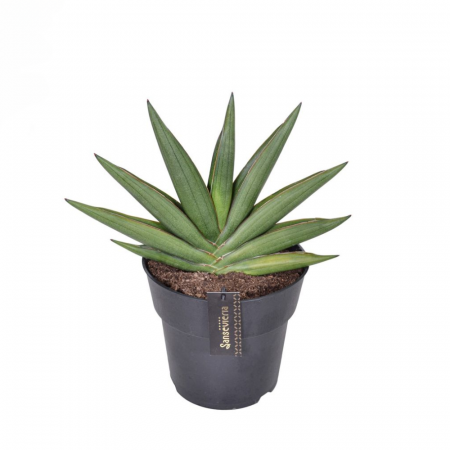
Sansevieria 'Pyramid', also known as 'Pyramid Crown', is a striking architectural variety of snake plant that transforms the concept of minimalist design into living sculpture. JOMO Studio describes it as "a striking architectural variety of snake plant with a compact, geometric form" where "thick, upright leaves are semi-flattened cylinders in deep green with subtle striping or lighter edging, stacked in neat, overlapping layers that resemble a living pyramid or crown." Unlike the tall, sword-like leaves of traditional Sansevierias, this cultivar grows in a compact, symmetrical form — its foliage arranged in elegant overlapping layers that create a shape reminiscent of both an ancient pyramid and a royal crown. For collectors seeking a snake plant that transcends the ordinary, the Pyramid offers a bold, modern accent that feels simultaneously timeless and contemporary.
🌏 Origins & Botanical Background
Sansevieria 'Pyramid' is a cultivated variety with parent species native to Africa and Asia — the same regions that gave us the genus's remarkable diversity of forms. The genus Sansevieria (now reclassified into Dracaena following molecular phylogenetic studies) encompasses over 70 species, ranging from the familiar tall, sword-leaved forms to compact rosettes, cylindrical types, and now geometric marvels like the Pyramid. While the specific breeding history of this cultivar isn't widely documented, it belongs to the tradition of selecting and cultivating Sansevierias for their architectural qualities — a tradition that has produced varieties as diverse as the 'Bird's Nest' types (S. trifasciata 'Hahnii'), the cylindrical 'African Spear' (S. cylindrica), and various compact fan-shaped forms. The Pyramid cultivar represents this ongoing horticultural refinement, selected for its distinctive growth pattern that creates the characteristic stacked, geometric appearance. Portland Nursery notes that "the range of species can be dizzying" within Sansevieria, reflecting the genus's remarkable morphological diversity that has captivated collectors for centuries.
🍃 Foliage — Stacked, Geometric & Polished
The leaves of Sansevieria 'Pyramid' are the plant's defining feature. JOMO Studio describes them as "thick, upright leaves" that are "semi-flattened cylinders in deep green with subtle striping or lighter edging." The foliage is arranged in "elegant, overlapping layers that resemble a geometric crown" — each leaf stacking upon the next to create the characteristic pyramidal silhouette. The colour is a deep, polished green marked with subtle stripes or lighter edging, giving the plant what JOMO Studio calls "a clean, modern presence that feels both bold and minimalist." Leaf Love adds that the plant features "upright, fan-shaped growth and thick, pointed leaves" with "a neat, architectural form." The leaves are firm, rigid, and vertical — characteristics that give the plant its sculptural quality and structural stability. Unlike more sprawling Sansevieria varieties, the Pyramid maintains a tight, compact habit that adds to its geometric appeal.
🌸 Flowers
Like all Sansevierias, the Pyramid variety can produce flowers under optimal conditions, though flowering indoors is relatively uncommon. When they appear, Sansevieria flowers are typically small, tubular, and fragrant — often described as sweetly scented, with blooms appearing on a slender flower spike. Joyus Garden notes that "the flower of a Snake Plant exhibits a pale whitish to greenish hue and emits a delightful, sweet fragrance." However, most growers cultivate this variety primarily for its exceptional architectural foliage rather than its blooms. The real appeal lies in the plant's year-round sculptural presence.
🌱 Growth Habit & Development
The growth habit is compact, upright, and distinctly pyramidal. JOMO Studio describes the plant as having "a compact, pyramid-shaped habit" with leaves "stacked in neat, overlapping layers that resemble a living pyramid or crown." Growth is slow to moderate, which is typical for the genus — but this slow pace is part of what makes Sansevierias such excellent long-term houseplants. The plant grows from rhizomes (underground stems) and will gradually produce offsets or "pups" around the base of the mother plant, eventually forming a small colony if left undivided. The compact form makes this variety particularly well-suited to small spaces, tabletops, offices, and modern minimalist interiors. Leaf Love notes it is "a perfect choice for modern interiors or small spaces."
Care Requirements:
- Light: Highly adaptable to various light conditions. JOMO Studio advises: "Sansevieria Pyramid should not be in a position to see the sun directly, although early morning or late evening sun is fine. Filtered sunlight through a sheer curtain is best." The plant "will do well in low light, but will grow faster with brighter light." Bright indirect light is ideal for maintaining the best colour and compact growth, but this is one of the few houseplants that genuinely tolerates darker corners — though it will grow more slowly there.
- Water: Allow the soil to dry completely between waterings. JOMO Studio notes: "Sansevieria Pyramid likes the soil to be completely dry before the next watering. This can take up to 4 weeks in an average home environment." Bloomscape confirms: "Water your Sansevieria only when the soil is completely dry. Water until liquid flows through the drainage hole." Overwatering is the most common cause of problems — these plants handle drought far better than wet conditions. Water more frequently in summer, less in winter.
- Soil: Fast-draining, gritty substrate is essential. JOMO Studio recommends using "a gritty, well-draining soil mix to prevent root rot." Cactus and succulent mix works excellently, or standard potting mix amended with perlite, coarse sand, or pumice. Good drainage is non-negotiable — soggy soil leads rapidly to root rot.
- Temperature: Bloomscape gives the range as 55-85°F (13-29°C), noting that "they prefer temperatures on the warmer end of that spectrum." World of Succulents warns that the plant "is damaged at temperatures below 50°F (10°C)." Protect from cold drafts and avoid placing near air conditioning vents or cold windows in winter.
- Humidity: Average household humidity is perfectly adequate. Bloomscape confirms: "Your Sansevieria prefers a dry environment. No need to mist." JOMO Studio adds that the plant "can live in any average home humidity condition and are fairly hardy." This is not a humidity-dependent plant — it actually prefers drier conditions.
- Feeding: Very light feeder. JOMO Studio advises to "fertilize lightly 2-3 times per year during the growing season." Bloomscape suggests feeding "once every six months with a liquid fertilizer for indoor plants." Avoid over-fertilizing, which can cause weak growth or damage roots. No feeding is needed in winter.
Botanical Info: Family: Asparagaceae (subfamily Nolinoideae) | Genus: Sansevieria (now included in Dracaena) | Cultivar: 'Pyramid' / 'Pyramid Crown' | Common Names: Pyramid Snake Plant, Pyramid Crown Snake Plant, Mother-in-Law's Tongue | Type: Succulent Perennial from Rhizomes | Parent Species Native Range: Africa and Asia | Zone: USDA 10-12 (indoor cultivation in temperate climates) | Size: Compact, pyramid-shaped habit | Growth Rate: Slow to Moderate
Lungime: 10 cm
Greutate (kg): 1 Kg
Denumire: Sansevieria
Diametru: 8 cm
Cerințe lumină: Partial umbra
Tip plantă: Decorative
Utilizare: Interior
Tip suport: Ghiveci
Material Suport: Ceramica
Is Sansevieria 'Pyramid' toxic to cats and dogs?
Yes, Sansevieria 'Pyramid' is moderately toxic to cats, dogs, and other household pets. JOMO Studio confirms: "Sansevieria Pyramid is moderately toxic and can cause some adverse reactions when ingested." All Sansevieria species contain saponins, which cause gastrointestinal symptoms including nausea, vomiting, diarrhea, and drooling when ingested. While the toxicity is generally mild to moderate and rarely life-threatening, it causes significant discomfort. If your pet ingests any part of this plant, contact your veterinarian immediately. For households with curious pets, consider pet-safe alternatives like Hoya species, or place the plant well out of reach.
How often should I water Sansevieria 'Pyramid'?
Water only when the soil is completely dry — typically every 2-4 weeks depending on your conditions. JOMO Studio notes: "Sansevieria Pyramid likes the soil to be completely dry before the next watering. This can take up to 4 weeks in an average home environment." Overwatering is the most common cause of problems with Sansevierias, leading to root rot. Greenery Unlimited advises: "Even if your plant is placed in ample bright indirect light, you won't need to water it more than once every 10 days (at most) during the growing season." In winter, water even less frequently. When in doubt, wait longer between waterings — these plants handle drought far better than wet conditions.
Can Sansevieria 'Pyramid' grow in low light?
Yes, Sansevieria 'Pyramid' tolerates low light conditions remarkably well. JOMO Studio confirms: "Sansevieria Pyramid will do well in low light, but will grow faster with brighter light. A low light plant can pretty much survive anyplace inside your home as long as you have a window in the room." While bright indirect light is ideal for optimal growth and colour, this is one of the few houseplants that genuinely thrives in darker corners where most plants would struggle. That said, extremely low light will slow growth considerably and may affect the intensity of the foliage colour. For best results, provide bright filtered light, but know that this plant is forgiving if conditions aren't perfect.
What makes Sansevieria 'Pyramid' different from other snake plants?
Sansevieria 'Pyramid' (also called 'Pyramid Crown') is distinguished by its unique geometric growth habit. While most snake plants have tall, upright sword-like leaves or form flat rosettes, the Pyramid variety grows in a compact, symmetrical form with thick leaves stacked in overlapping layers that create a pyramidal or crown-like shape. JOMO Studio describes it as having "thick, upright leaves" that are "semi-flattened cylinders in deep green with subtle striping or lighter edging, stacked in neat, overlapping layers that resemble a living pyramid or crown." This architectural form gives it a bold, minimalist presence that's different from traditional Sansevierias, making it particularly suited to modern and contemporary interior design.
Does Sansevieria 'Pyramid' purify air?
Yes, like all Sansevierias, the Pyramid variety is known for its air-purifying properties. Planterina notes: "These houseplants are considered the best air purifying plants because they clean formaldehyde from the air and release oxygen at night." NASA research identified Sansevieria species as effective at filtering indoor air pollutants including formaldehyde, benzene, xylene, and trichloroethylene. Unlike most plants which release oxygen only during the day, Sansevierias perform a type of photosynthesis (CAM) that allows them to release oxygen at night, making them popular bedroom plants. While one plant won't transform your air quality dramatically, it does contribute to a healthier indoor environment.
Is Sansevieria now classified as Dracaena?
Yes, molecular phylogenetic studies have led botanists to reclassify Sansevieria as part of the genus Dracaena. Garden Betty explains that "the species name also changed" and the plant "is now officially called Dracaena" although "many sources continue to call it by its old name." However, the name Sansevieria remains widely used in horticulture, nurseries, and among collectors — and most people still refer to these plants as Sansevierias or snake plants. You may encounter this plant labelled as either Sansevieria 'Pyramid' or Dracaena 'Pyramid' depending on the source. The care requirements remain identical regardless of which nomenclature is used.
Toxic?
Yes, mildly toxic dogs/cats.
What soil?
Drained substrate, cactus/succulent + perlite.
Low light?
Yes, very low-light tolerant.
Recommendations
Ai nevoie și de un ghiveci decorativ?