EN/
EN/ Romana
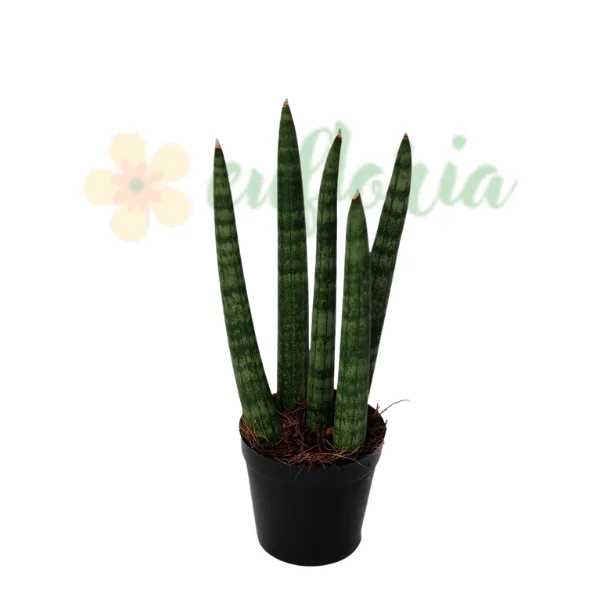
Sansevieria 'Almond Jade' Ø19cm
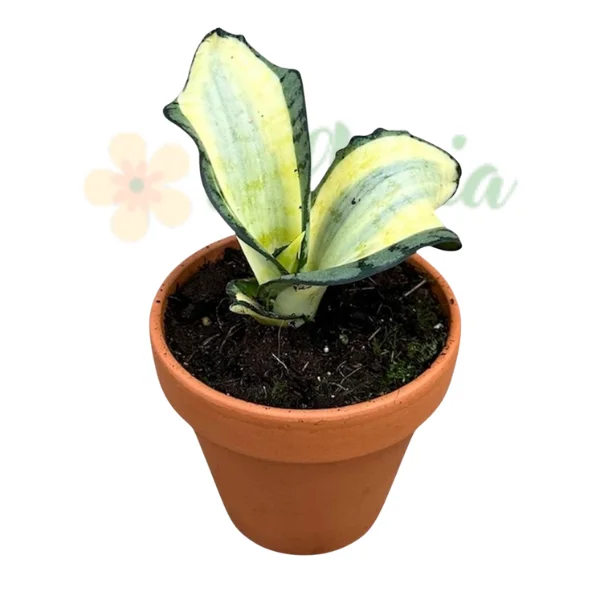
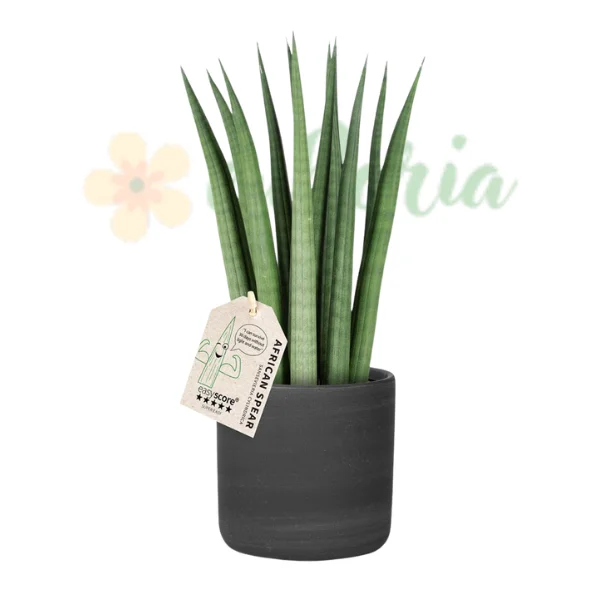
![Sansevieria 'Almond Jade' — thick cylindrical banded jade-green leaves, Ø19cm pot Eufloria [0]](https://gomagcdn.ro/domains2/eufloria.ro/files/product/medium/sansevieria-almond-jade-352149.png "Sansevieria 'Almond Jade' — thick cylindrical banded jade-green leaves, Ø19cm pot Eufloria [0]")
![Sansevieria 'Almond Jade' — thick cylindrical banded jade-green leaves, Ø19cm pot Eufloria [1]](https://gomagcdn.ro/domains2/eufloria.ro/files/product/medium/sansevieria-almond-jade-174222.png "Sansevieria 'Almond Jade' — thick cylindrical banded jade-green leaves, Ø19cm pot Eufloria [1]")
![Sansevieria 'Almond Jade' — thick cylindrical banded jade-green leaves, Ø19cm pot Eufloria [1]](https://gomagcdn.ro/domains2/eufloria.ro/files/product/original/sansevieria-almond-jade-352149.png "Sansevieria 'Almond Jade' — thick cylindrical banded jade-green leaves, Ø19cm pot Eufloria [1]")
![Sansevieria 'Almond Jade' — thick cylindrical banded jade-green leaves, Ø19cm pot Eufloria [2]](https://gomagcdn.ro/domains2/eufloria.ro/files/product/original/sansevieria-almond-jade-174222.png "Sansevieria 'Almond Jade' — thick cylindrical banded jade-green leaves, Ø19cm pot Eufloria [2]")
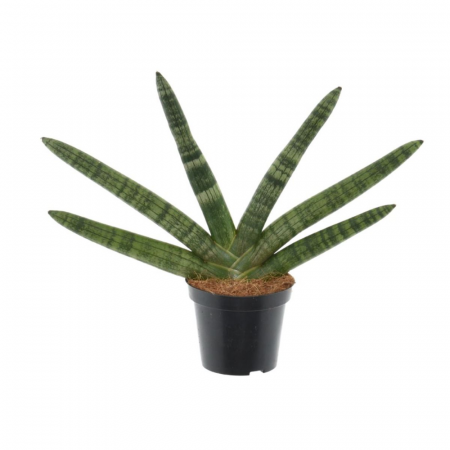
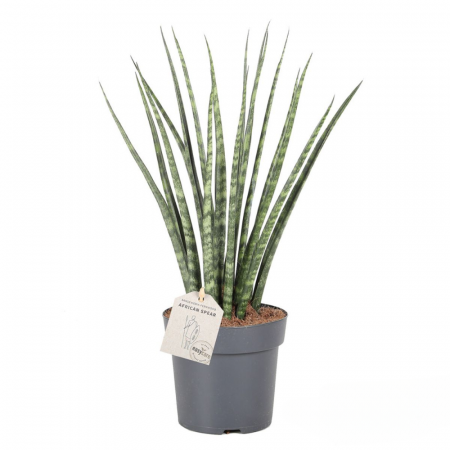
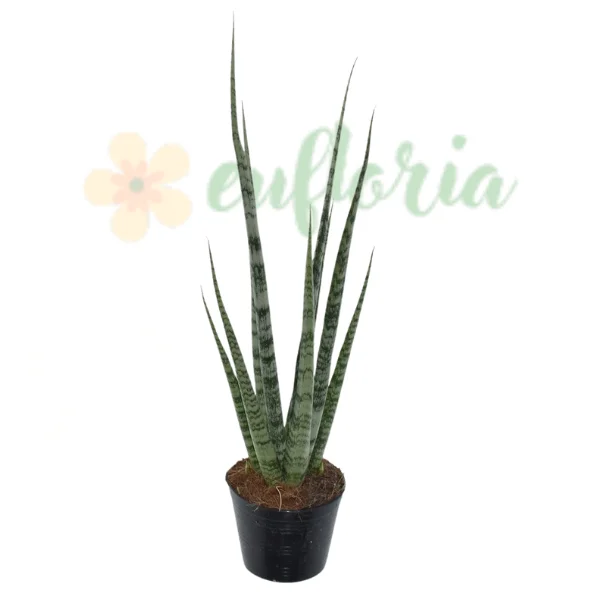
Sansevieria 'Almond Jade' — architectural cultivar of the famous "mother-in-law's tongue" with thick cylindrical jade-green banded leaves. Vertical sculptural form, 80-120 cm at maturity. Extremely resistant, purifies air at night. Any humidity, variable light, 15-30°C. Ideal plant for beginners and offices.
Approx height (including pot): 40 cm
Pot diameter: 19 cm
- Description
- Characteristics
- Reviews (0)
- FAQ
🌿 Sansevieria 'Almond Jade' — the jade almond, architectural sculpture of the modernist desert
Sansevieria 'Almond Jade', scientifically known as Dracaena trifasciata 'Almond Jade' after the recent botanical reclassification, is a refined and elegant cultivar of the famous "mother-in-law's tongue", famous for its thick, cylindrical leaves in deep green with silvery-jade reflections, rising straight up like mineral arrows. The name "Almond Jade" reflects both the characteristic leaf shape — almost almond-shaped when cut transversely — and the spectacular jade-green hue with banded pattern.
This plant is the perfect choice for minimalist and architectural design enthusiasts. Its straight leaves, grouped in a dense vertical rosette, create a unique sculptural silhouette — a visual statement that can transform a banal corner of the home into an architectural focus. Each leaf seems chiseled from a single precious stone, with a smooth and glossy surface that reflects light elegantly.
Like its better-known relatives, 'Almond Jade' is extremely resistant and easy to care for, tolerating a wide range of light conditions and watering regimes. It is NASA-approved for air purification, produces oxygen even at night, and is one of the most efficient plants for indoor spaces with poorer air quality. An excellent choice for bedrooms, offices or anywhere in the home where you want an impressive but non-demanding plant.
🌍 Botanical origin and history
Sansevieria 'Almond Jade' is a cultivar derived from the wild species Sansevieria trifasciata (recently reclassified as Dracaena trifasciata), native to tropical West Africa — mainly Nigeria, Ghana, Cameroon and Congo. In its natural habitat, this species grows in dry and rocky areas of savannas and open forests, adapting to extreme conditions of heat and drought.
The Sansevieria genus (now included in the Dracaena genus) was named in 1794 by Italian botanist Vincenzo Petagna in honor of Raimondo di Sangro, Prince of Sansevero, a Neapolitan nobleman passionate about sciences. Recently, based on molecular genetic studies, the genus has been reorganized and most Sansevieria species are now classified in the Dracaena genus, but the traditional name "Sansevieria" is still widely used in horticulture.
The Asparagaceae family comprises over 2,500 species distributed across all continents. In its African natural habitat, Sansevieria is an extremely resistant plant, with strong rhizomes that allow it to survive prolonged drought periods. This genetic resistance makes 'Almond Jade' one of the easiest-to-care indoor plants.
🌱 The architectural foliage
The foliage of Sansevieria 'Almond Jade' is its distinctive visual signature. The leaves are thick, fleshy, cylindrical to slightly flattened, with length reaching 60-100 cm at maturity. The base color is a deep, rich jade green, with the characteristic banded pattern in lighter tones of silvery-jade green, creating subtle horizontal striations — hence the original botanical name "trifasciata" (three-banded).
The leaf texture is firm, almost woody, with a smooth and glossy surface that reflects light elegantly. The leaf margins are sharp but without spines, and the tip is distinctly sharp, almost like an arrow. Each leaf grows straight up, without bending, creating the characteristic vertical architectural silhouette.
The rhizome (underground horizontal root) is robust and very strong — it can even break weak plastic pots over time. The plant expands by producing offsets from the rhizome, forming dense rosette groups that can progressively fill a larger pot. Mature plant height reaches 80-120 cm, one of the most impressive Sansevierias.
🌸 The flowers and fruits
Sansevieria 'Almond Jade' rarely blooms in indoor culture, only on very mature and stable plants. When it does, it produces elongated, tall flower peduncles bearing umbels of small, cream or yellowish-white, tubular flowers with prominent stamens. The flower fragrance is sweet and intense, especially in the evening, attracting nocturnal pollinators from its natural habitat.
The flowers are considered a rare and beautiful event, and the flower peduncles can also appear in apartment culture if the plant receives sufficient light, is in a tight pot (mild physiological stress) and is mature. Do not force flowering — respect the plant's natural rhythm.
After pollination, in the natural habitat round orange-red berries may appear containing seeds. In apartment culture, propagation is done almost exclusively by division or leaf cuttings, without seeds.
🌱 Growth habit and care
Sansevieria 'Almond Jade' is one of the most resistant indoor plants, ideal for all growers, from beginners to experts. Growth is slow, with new leaves appearing every 6-8 weeks during the growing season. The plant tolerates a very wide range of conditions, but thrives under specific conditions.
Care requirements:
- Light: tolerant — from bright indirect light to low-light locations. Better light accelerates growth and maintains intense jade color. Can also tolerate some gentle direct sun.
- Temperature: 15-30°C; extremely resistant to varied temperatures. Does not tolerate below 10°C.
- Watering: MINIMAL — water only when substrate is COMPLETELY dry. Every 2-3 weeks in summer, every 4-6 weeks in winter. Overwatering is the main cause of death. Better under-watered than over-watered.
- Humidity: tolerates low humidity (30%+). Does not require misting.
- Substrate: VERY well-drained — cactus or succulent substrate + extra perlite (30%). Rhizomes rot easily in dense substrate.
- Fertilization: minimal — every 2-3 months during growing season with cactus fertilizer diluted to a quarter.
- Propagation: by rhizome division or leaf cuttings (classic method for Sansevierias).
🌿 Why choose Sansevieria 'Almond Jade'
It is the ideal choice for anyone who wants a plant with sculptural but non-demanding character. The vertical architectural silhouette fits perfectly in modern, minimalist, Scandinavian, industrial or boho-desert arrangements. Purifies air at night (produces oxygen when most plants consume it), tolerates neglect, survives forgetting, and looks impressive even without careful care. An excellent botanical investment for busy people, beginners or for offices with little attention.
Lungime: 40 cm
Greutate (kg): 1 Kg
Denumire: Sansevieria
Cerințe lumină: Umbra
Tip plantă: Decorative
Utilizare: Interior
Tip suport: Ghiveci
Material Suport: Plastic
Is Sansevieria ’Almond Jade’ toxic to pets?
According to ASPCA, the Sansevieria genus is mildly toxic to dogs and cats. Ingestion may cause nausea, vomiting, and mild diarrhea. Toxicity is minor, but placing in locations inaccessible to pets is recommended.
How often should I water Sansevieria ’Almond Jade’?
Water when the substrate has dried completely: every 10-14 days in summer and 21-30 days in winter. Sansevieria can survive 4-6 weeks without watering. Overwatering is the biggest risk — it causes root rot.
Does Sansevieria ’Almond Jade’ purify the air?
Yes, according to the NASA Clean Air Study (1989), the Sansevieria genus is one of the most effective indoor plants for air purification. It filters formaldehyde, benzene, and trichloroethylene. Additionally, it produces oxygen at night due to CAM metabolism.
What light does Sansevieria ’Almond Jade’ need?
Extremely adaptable: tolerates from low light (1,000 lux) to bright light (20,000+ lux). Grows even in dark corners, though more slowly. Bright indirect light intensifies the silver patterns on the leaves.
Is Sansevieria ’Almond Jade’ suitable for beginners?
Yes, it is one of the most suitable plants for absolute beginners. It tolerates neglect, low light, dry air, and irregular watering. Requires minimal maintenance and looks decorative year-round.
How often to water Sansevieria 'Almond Jade'?
Minimal. Water only when the substrate is completely dry — check with a stick inserted to the bottom of the pot. Every 2-3 weeks in summer, every 4-6 weeks in winter. Sansevierias are succulents and store water in fleshy leaves — overwatering is the main cause of death.
Can Sansevieria survive in low light?
Yes, Sansevieria 'Almond Jade' is extremely tolerant to low light — it can survive in areas with very little light where other plants die. However, in better light it grows faster and maintains the jade color more intense. Only avoid total darkness.
Does Sansevieria purify air at night?
Yes, Sansevieria uses CAM photosynthesis (Crassulacean Acid Metabolism), a rare metabolic process that allows it to absorb CO2 and release O2 even at night. It is NASA-approved for air purification from formaldehyde, xylene and toluene. Ideal for bedrooms.
Is Sansevieria 'Almond Jade' toxic?
Yes, Sansevierias contain mildly toxic saponins to cats, dogs and young children. Ingestion causes oral irritation, drooling, vomiting and diarrhea. Place in an area inaccessible to pets and young children.
How to make a cutting from Sansevieria?
Classic method: cut a healthy leaf into 5-7 cm pieces, mark the tip of each piece (important — must be planted with the bottom in the soil), let scab for 2-3 days, then plant in dry cactus substrate. Roots appear in 6-8 weeks. Note: leaf cuttings from variegated cultivars can produce green plants, not variegated.
Ai nevoie și de un ghiveci decorativ?