
 EN/
EN/ Romana
Sansevieria masoniana 'Whale Fin' Ø8.5cm
![Sansevieria masoniana 'Whale Fin' — unique wide paddle-shaped dark green leaf, Ø8.5cm pot Eufloria [0]](https://gomagcdn.ro/domains2/eufloria.ro/files/product/medium/sansevieria-masoniana-whale-fin-932954.png "Sansevieria masoniana 'Whale Fin' — unique wide paddle-shaped dark green leaf, Ø8.5cm pot Eufloria [0]")
![Sansevieria masoniana 'Whale Fin' — unique wide paddle-shaped dark green leaf, Ø8.5cm pot Eufloria [1]](https://gomagcdn.ro/domains2/eufloria.ro/files/product/medium/planta-naturala-de-interior-sansevieria-masoniana-whale-fin-916096.webp "Sansevieria masoniana 'Whale Fin' — unique wide paddle-shaped dark green leaf, Ø8.5cm pot Eufloria [1]")
![Sansevieria masoniana 'Whale Fin' — unique wide paddle-shaped dark green leaf, Ø8.5cm pot Eufloria [2]](https://gomagcdn.ro/domains2/eufloria.ro/files/product/medium/sansevieria-masoniana-whale-fin-d8-5-344162.webp "Sansevieria masoniana 'Whale Fin' — unique wide paddle-shaped dark green leaf, Ø8.5cm pot Eufloria [2]")
![Sansevieria masoniana 'Whale Fin' — unique wide paddle-shaped dark green leaf, Ø8.5cm pot Eufloria [3]](https://gomagcdn.ro/domains2/eufloria.ro/files/product/medium/sansevieria-masoniana-whale-fin-d8-5-007051.webp "Sansevieria masoniana 'Whale Fin' — unique wide paddle-shaped dark green leaf, Ø8.5cm pot Eufloria [3]")
![Sansevieria masoniana 'Whale Fin' — unique wide paddle-shaped dark green leaf, Ø8.5cm pot Eufloria [4]](https://gomagcdn.ro/domains2/eufloria.ro/files/product/medium/sansevieria-masoniana-whale-fin-d8-5-589659.webp "Sansevieria masoniana 'Whale Fin' — unique wide paddle-shaped dark green leaf, Ø8.5cm pot Eufloria [4]")
![Sansevieria masoniana 'Whale Fin' — unique wide paddle-shaped dark green leaf, Ø8.5cm pot Eufloria [5]](https://gomagcdn.ro/domains2/eufloria.ro/files/product/medium/sansevieria-masoniana-whale-fin-d8-5-226839.webp "Sansevieria masoniana 'Whale Fin' — unique wide paddle-shaped dark green leaf, Ø8.5cm pot Eufloria [5]")
![Sansevieria masoniana 'Whale Fin' — unique wide paddle-shaped dark green leaf, Ø8.5cm pot Eufloria [1]](https://gomagcdn.ro/domains2/eufloria.ro/files/product/original/sansevieria-masoniana-whale-fin-932954.png "Sansevieria masoniana 'Whale Fin' — unique wide paddle-shaped dark green leaf, Ø8.5cm pot Eufloria [1]")
![Sansevieria masoniana 'Whale Fin' — unique wide paddle-shaped dark green leaf, Ø8.5cm pot Eufloria [2]](https://gomagcdn.ro/domains2/eufloria.ro/files/product/original/planta-naturala-de-interior-sansevieria-masoniana-whale-fin-916096.webp "Sansevieria masoniana 'Whale Fin' — unique wide paddle-shaped dark green leaf, Ø8.5cm pot Eufloria [2]")
![Sansevieria masoniana 'Whale Fin' — unique wide paddle-shaped dark green leaf, Ø8.5cm pot Eufloria [3]](https://gomagcdn.ro/domains2/eufloria.ro/files/product/original/sansevieria-masoniana-whale-fin-d8-5-344162.webp "Sansevieria masoniana 'Whale Fin' — unique wide paddle-shaped dark green leaf, Ø8.5cm pot Eufloria [3]")
![Sansevieria masoniana 'Whale Fin' — unique wide paddle-shaped dark green leaf, Ø8.5cm pot Eufloria [4]](https://gomagcdn.ro/domains2/eufloria.ro/files/product/original/sansevieria-masoniana-whale-fin-d8-5-007051.webp "Sansevieria masoniana 'Whale Fin' — unique wide paddle-shaped dark green leaf, Ø8.5cm pot Eufloria [4]")
![Sansevieria masoniana 'Whale Fin' — unique wide paddle-shaped dark green leaf, Ø8.5cm pot Eufloria [5]](https://gomagcdn.ro/domains2/eufloria.ro/files/product/original/sansevieria-masoniana-whale-fin-d8-5-589659.webp "Sansevieria masoniana 'Whale Fin' — unique wide paddle-shaped dark green leaf, Ø8.5cm pot Eufloria [5]")
![Sansevieria masoniana 'Whale Fin' — unique wide paddle-shaped dark green leaf, Ø8.5cm pot Eufloria [6]](https://gomagcdn.ro/domains2/eufloria.ro/files/product/original/sansevieria-masoniana-whale-fin-d8-5-226839.webp "Sansevieria masoniana 'Whale Fin' — unique wide paddle-shaped dark green leaf, Ø8.5cm pot Eufloria [6]")
Sansevieria masoniana 'Whale Fin' — whale fin, African sansevieria with unique paddle-shaped leaf up to 120 cm. Extremely resistant architectural statement plant. Purifies air at night. Light and variable conditions tolerant. 15-30°C, minimal watering.
Approx height (including pot): 20 cm
Pot diameter: 8.5 cm
- Description
- Characteristics
- Reviews (2)
- FAQ
🌿 A Whale's Fin Caught in the Earth — a Single Giant Leaf Full of Drama
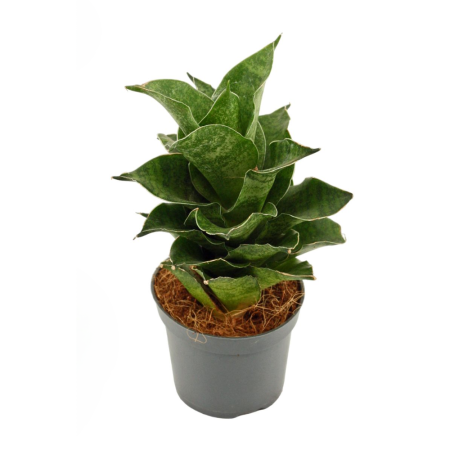
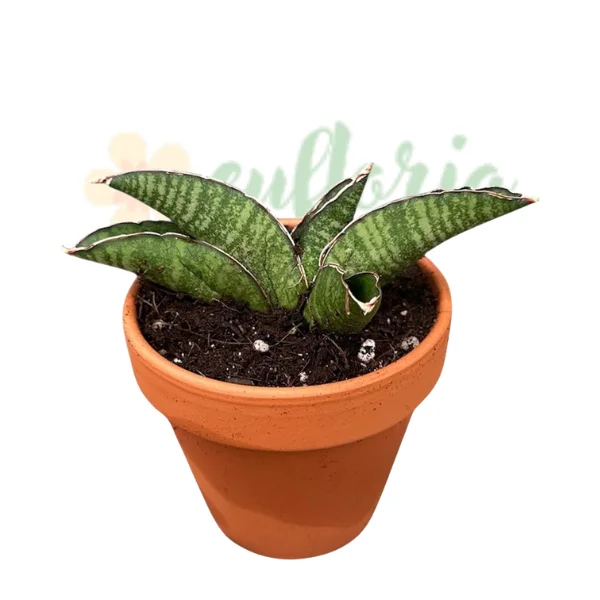
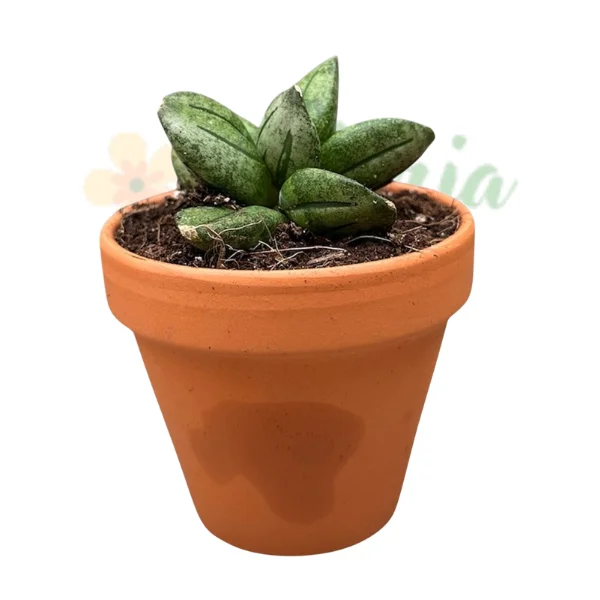
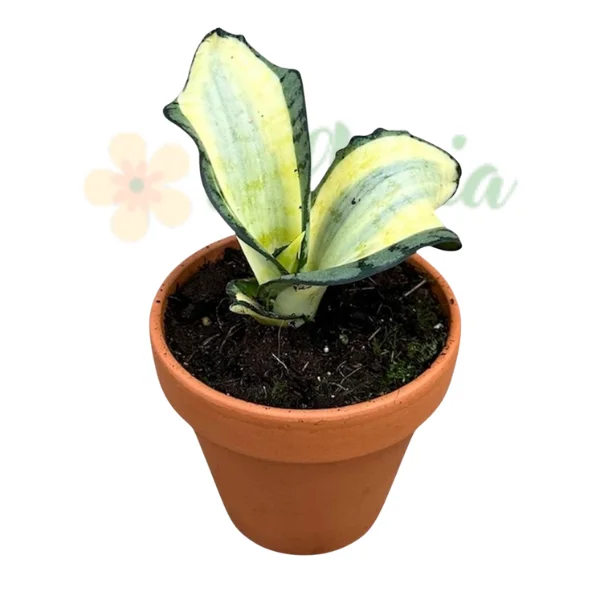
Sansevieria masoniana 'Whale Fin' is one of the most impressive and unusual houseplants: instead of many leaves, it concentrates all its energy into a single giant, broad, paddle-shaped leaf that rises from the earth like a true whale's fin breaking the surface of the water. Hence its popular name, "whale fin" — a description so fitting that, once seen, you can never forget it.
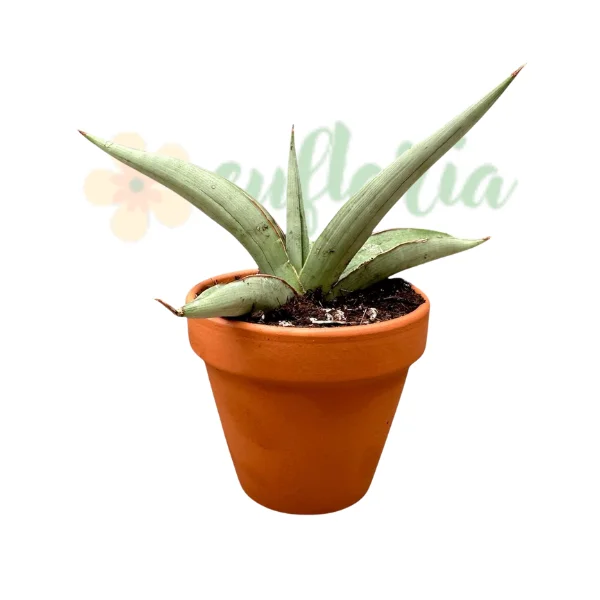
This massive leaf, broad and gently curved, has an overwhelming sculptural presence. Its matte green surface is dusted with a mottled pattern of lighter spots and bands, and the margins are often edged with a fine reddish-purple outline that adds warmth and refinement. It is a statement plant in the truest sense, turning any corner into a dramatic, modern focal point.
Offered in an 8.5 cm pot, it is a young plant with a single spectacular leaf, ready to develop over time. Like all Sansevierias, it grows slowly but gradually produces new leaves from the rhizome, each as impressive as the first. And, as a generous bonus, it comes bundled with one of the most forgiving temperaments in the plant world.
For the plant lover seeking a piece with a strong presence, an out-of-the-ordinary form and a modern aesthetic, 'Whale Fin' is an unforgettable choice — a living sculpture that impresses through its simplicity and its generous scale.
🌍 Origin and Botanical History
Sansevieria masoniana is native to the tropical regions of Central Africa, particularly the Congo River basin, where it grows on poor, stony soils exposed to fierce sun and long dry periods alternating with wet seasons. The species is named in honour of Maurice Mason, a passionate British horticulturist who introduced numerous exotic plants into cultivation in the twentieth century.
Taxonomically, the genus Sansevieria has been reclassified following modern phylogenetic research and is now placed within the genus Dracaena. In horticultural and commercial practice, however, the traditional name Sansevieria remains the most widely used, being deeply rooted in plant-lover culture. Both belong to the Asparagaceae family — the same family that includes edible asparagus.
The arid natural habitat explains all the qualities we love this plant for today. Its massive, succulent leaf is capable of storing water for months on end, and its special CAM metabolism, by which the plant opens its pores at night, when the air is cooler, minimises water loss. This is the same strategy used by cacti, and as a pleasant side effect the plant releases some of its oxygen at night — which is why Sansevierias are often recommended for the bedroom.
The 'Whale Fin' cultivar is prized precisely for its unique, giant leaf, a feature that makes it unmistakable. Knowing its origin as a desert plant, we instinctively understand why it is so tough and easy to care for.
🌱 The Foliage
The foliage — or, more precisely, the leaf — is without doubt the entire reason for this plant's existence. Whale Fin usually produces a single giant, broad, flat, gently curved leaf that rises from the earth and unfolds like a fin or a green sail. On mature specimens, this leaf can reach impressive dimensions, becoming a true living sculpture.
The leaf surface is a matte, deep green, dusted with a mottled pattern of lighter spots and transverse bands that give it depth and visual texture. The leaf margins are often edged with a fine reddish-purple outline, a discreet chromatic detail that warms the green palette and emphasises the broad, generous shape of the leaf. At the base, the leaf narrows into a short, robust petiole that anchors it firmly in the substrate.
The texture of the leaf is firm and thick, slightly succulent, which helps it stay turgid and healthy even when the plant is neglected for a while. The surface has a matte, velvety sheen that catches the light gently, without harsh reflections, and dust settles only reluctantly and wipes away easily with a soft cloth.
As the plant matures, new leaves gradually emerge from the underground rhizome, each as broad and impressive as the first, transforming the plant from a single fin into a small group of vertical green sails — a sculptural spectacle that grows in scale year after year.
🌸 The Flowers
Although grown almost exclusively for its sculptural leaf, Sansevieria masoniana can surprise you, at maturity and in favourable conditions, with a discreet but elegant bloom. From the base of the plant rises a flower spike strung with small, tubular flowers of a delicate greenish-white or cream, often lightly fragrant.
The flowers carry a sweet fragrance, more pronounced in the evening, and sometimes secrete tiny droplets of sweet nectar that glisten like dew. It is a rare and precious sight, because in apartment culture flowering appears only on well-established specimens that have lived for several years in generous light.
Do not expect an explosion of colour — the charm of this bloom lies precisely in its restraint, in the contrast between the massive, sculptural leaf and the delicacy of the fragrant spike. And if your plant never flowers, you lose nothing essential: the leaf remains, year after year, the main reason this Sansevieria deserves a place of honour in your home.
🌱 Growth and Development
Sansevieria masoniana 'Whale Fin' is a slow-growing plant that develops its giant leaves one by one, from the underground rhizome. Patience is key: although it grows slowly, each new leaf is an event, an impressive addition to the plant's silhouette. The habit stays upright and sculptural, ideal for a modern corner, a characterful desk or a space that needs a strong focal point.
Its great advantage is its toughness: it is one of the most tolerant houseplants, able to forgive neglect, changing light and the dry air of heated apartments. That is exactly why it is so often recommended as a first plant for beginners, but also for busy people or workspaces where no one has time for daily care. Its only real sensitivity is excess water.
- Light: prefers bright, indirect light and tolerates even a few hours of gentle direct sun; it copes with lower light too, but the colouring and purple edge show best in generous light.
- Temperature: happiest between 18 and 27 °C; it must be kept away from cold below 10 °C and from chilly winter draughts.
- Watering: water rarely and thoroughly, letting the substrate dry out completely between waterings — usually once every 2–3 weeks in summer and even less in winter; pour water at the edge, sparing the base of the leaf.
- Humidity: undemanding — it does perfectly well in the dry air of homes, with no misting or humidifiers.
- Substrate: choose a very well-draining cactus-and-succulent mix, ideally enriched with perlite or coarse sand to prevent water stagnating at the roots.
- Fertilising: feed moderately, once every 6–8 weeks in the warm season, with a diluted succulent fertiliser; stop feeding entirely in winter.
- Propagation: propagates by separating the basal pups or from leaf cuttings left to dry for a few days before planting; patience is key, as roots appear slowly.
For those who love structural, resilient plants, 'Whale Fin' pairs beautifully with other Sansevierias and succulents of similar care needs — a natural companion for a collection of graphic, low-maintenance plants.
Lungime: 10 cm
Greutate (kg): 0.25 Kg
Denumire: Sansevieria
Cerințe lumină: Umbra
Tip plantă: Decorative
Utilizare: Interior
Tip suport: Ghiveci
Material Suport: Plastic
Why is it called Whale Fin?
Is Sansevieria masoniana toxic to pets?
How often should I water Sansevieria masoniana Whale Fin?
Does Sansevieria masoniana purify the air?
Is it suitable for beginners?
Why is it called 'whale fin'?
How big will it grow?
How to water correctly?
Is Sansevieria 'Whale Fin' toxic?
How is it propagated?
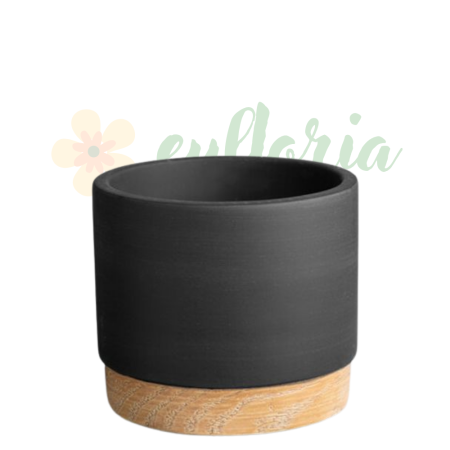
Ai nevoie și de un ghiveci decorativ?








Carmen Monica Deme,
Recomand cu încredere.
ReplyWas this review useful?