EN/
EN/ Romana
Dieffenbachia 'Camilla' Ø12cm
![Dieffenbachia Camilla - ornamental houseplant with green and cream variegated foliage [1]](https://gomagcdn.ro/domains2/eufloria.ro/files/product/original/dieffenbachia-camilla-d12cm-358746.jpg "Dieffenbachia Camilla - ornamental houseplant with green and cream variegated foliage [1]")
Dieffenbachia 'Camilla' is an elegant cultivar from the Araceae family, native to the tropical regions of Central and South America, prized for its generous, oval-lanceolate foliage in a luminous cream-green with distinctive dark green margins. This vigorous indoor plant brings a touch of tropical freshness to any space, ideal for both beginners and experienced collectors. Easy to care for and tolerant of varied light conditions, Dieffenbachia 'Camilla' transforms any corner of your home into a lush green oasis.
Approx height (including pot): 35 cm
Flowering state: No flowers
Pot diameter: 12 cm
- Description
- Characteristics
- Reviews (0)
- FAQ
🌿 A Symphony of Green and Cream — Dieffenbachia 'Camilla'
There are plants that, through their mere presence, manage to transform the atmosphere of a space, bringing a breath of tropical jungle into our daily urban life. Dieffenbachia 'Camilla' is one of those plants that captivates the eye from the very first moment — its large, oval leaves, in a luminous cream-gold, bordered by intense emerald-green, create a visual contrast of rare elegance, reminiscent of the botanical watercolour paintings of nineteenth-century artists.
This cultivar represents one of the most popular selections within the Dieffenbachia genus, valued not only for its ornamental beauty but also for its remarkable resilience in indoor conditions. Unlike many other demanding tropical plants, 'Camilla' adapts with surprising grace to the moderate light of apartments, air-conditioned environments, and the sometimes irregular watering schedules of busy owners. It is the plant that forgives small oversights and rewards you with an ever richer and more expressive foliage.
Dieffenbachia 'Camilla' is not merely a decorative plant — it is a living presence that brings energy and freshness to offices, living rooms, bedrooms, and hallways. Its generous leaves, which can reach 20–25 cm in length, filter natural light and create plays of shadow and colour that change throughout the day, offering a discreet yet continuous natural spectacle.
🌍 Origin and Botanical History
The genus Dieffenbachia was first described by Heinrich Wilhelm Schott in 1829, dedicated to the Austrian botanist Joseph Dieffenbach (1796–1863), head gardener at the Imperial Gardens of Schönbrunn, Vienna. The taxonomic classification places this genus within the family Araceae, alongside celebrated relatives such as Monstera, Philodendron, and Anthurium — a family that dominates the vegetal carpet of tropical forests in the New World.
The base species, Dieffenbachia seguine (syn. D. maculata, D. picta), is native to the humid tropical forests of Central and South America, with a natural distribution extending from Mexico and the Caribbean to Brazil and Argentina. In its natural habitat, Dieffenbachia grows in the shade of tall trees in the lower stratum of the tropical forest, where the light filtered through the dense canopy creates exactly the conditions this plant prefers in cultivation as well.
The cultivar 'Camilla' (sometimes spelled 'Camille') is the result of a lengthy horticultural selection process aimed at accentuating the dramatic contrast between the cream-gold centre of the leaf and the dark green margin. This cultivar was developed in the Netherlands during the second half of the twentieth century and quickly became one of the most commercially successful Dieffenbachia cultivars worldwide, owing to its compactness and the vivid colours of its foliage.
🌱 The Foliage
The leaves of Dieffenbachia 'Camilla' are, without a doubt, the main attraction of this plant. Each leaf is a work of natural art — the oval-lanceolate blade, 15–25 cm in length and 8–12 cm in width, features a central cream-yellowish to whitish-green coloration, surrounded by an irregular border of dark green that varies in width, creating a unique effect on every leaf.
The texture of the leaves is smooth and slightly waxy to the touch, with a glossy surface that reflects light in a pleasing manner. The central vein is prominent and of a lighter green, while the secondary veins branch out towards the margins in an elegant parallel pattern. The petioles are robust, of a uniform light green, 10–15 cm in length, and support the leaves at a slightly ascending angle that gives the plant a graceful, well-balanced habit.
As the plant grows, the lower, older leaves naturally yellow and fall, while the stem apex continuously produces new leaves — a natural cycle that keeps the plant in a state of permanent renewal. Young leaves, freshly unfurled, have a more intense lime-green shade that gradually fades to the characteristic cream as the leaf matures, offering a fascinating chromatic gradient from top to base.
🌸 The Flowers
Although Dieffenbachia 'Camilla' is cultivated almost exclusively for its ornamental foliage, under optimal conditions it can produce inflorescences typical of the Araceae family — a whitish-green spathe surrounding a cylindrical spadix. The inflorescence, 10–15 cm in length, is discreet and does not possess significant ornamental value compared to the spectacular foliage of the plant.
Flowering in indoor cultivation is relatively rare and usually occurs in mature, well-established specimens that benefit from optimal conditions of light, temperature, and nutrition. Most growers prefer to remove the inflorescence as soon as it appears, redirecting the plant's energy towards producing new, more vigorous and colourful leaves. If left to develop, the inflorescence can produce small, orange-reddish fruits, but these are toxic and must not be consumed under any circumstances.
🌱 Growth Habit and Development
Dieffenbachia 'Camilla' has a compact, bushy habit compared to other species in the genus, usually reaching a height of 30–60 cm indoors, although under ideal conditions it can grow to 90 cm. Growth is moderate, with 3–5 new leaves per growing season, and the main stem is thick, fleshy, and erect, with short internodes that keep the leaves in a dense and attractive rosette.
Compared to larger species such as D. seguine 'Tropic Snow' or D. 'Reflector', the 'Camilla' cultivar remains more compact and dense, making it ideal for smaller spaces — offices, bedrooms, shelves, or work desks. With age, the basal stem may become slightly woody and lose its lower leaves, exposing a slender trunk marked by the scars of fallen leaves — an aspect that adds character to the mature plant.
- Light: Medium to bright indirect light. Tolerates low light, but foliage colours will be less contrasted. Avoid direct sunlight, which can burn the delicate leaves. An east or north-east facing window is ideal.
- Temperature: Optimal range 18–26°C. Do not expose below 15°C — Dieffenbachia is sensitive to cold and cold draughts. Avoid placing near exterior doors, frequently opened windows, or direct air conditioning jets.
- Watering: Water when the top 2–3 cm of substrate have dried out. In summer, usually once every 5–7 days; in winter, every 10–14 days. Avoid water stagnation in the saucer — roots are sensitive to rot. Use room-temperature water, dechlorinated if possible.
- Humidity: Prefers medium-high humidity (50–60%). Adapts to dry apartment air, but occasional misting of the leaves or placing on a tray with wet pebbles improves foliage appearance.
- Substrate: Well-drained substrate, peat-based with added perlite or vermiculite (2:1 ratio). A quality universal indoor plant mix enriched with perlite for additional aeration can also be used.
- Fertilisation: Balanced liquid fertiliser (NPK 10-10-10 or 20-20-20), diluted to half the recommended concentration, once every 2–3 weeks during the growing season (April–September). No fertilisation in winter.
- Propagation: Through stem cuttings (5–8 cm sections with at least one node), placed horizontally on moist substrate, or by separating lateral shoots that appear at the base of the mature plant. Optimal period: spring or early summer. Always wear gloves when handling due to the irritating sap. Delivery across the EU.
Lungime: 12 cm
Greutate (kg): 1 Kg
Denumire: Dieffenbachia
Diametru: 12 cm
Cerințe lumină: Strong, indirect light
Tip plantă: Decorative
Utilizare: Interior
Tip suport: Ghiveci
Material Suport: Plastic
How often should I water Dieffenbachia Camilla?
Dieffenbachia Camilla prefers slightly moist soil but never waterlogged. Water the plant when the top 2-3 cm of soil has dried out, typically once every 5-7 days in summer and every 10-14 days in winter. Avoid letting water accumulate in the saucer, as the roots are prone to rot. Use room-temperature, preferably dechlorinated water.
Is Dieffenbachia Camilla toxic to pets?
Yes, Dieffenbachia Camilla is toxic to both cats and dogs. The plant contains calcium oxalate crystals (raphides) which, when chewed or ingested, cause severe irritation of the oral mucosa, excessive drooling, difficulty swallowing, and tongue swelling. Place the plant out of reach of pets and small children. In case of ingestion, contact your veterinarian immediately.
What is the best soil mix for Dieffenbachia Camilla?
Dieffenbachia Camilla thrives in a well-draining, aerated soil mix rich in organic matter. An ideal recipe combines peat or coco coir (40%), perlite (30%), and compost or humus (30%). Good quality universal potting mixes work well, but add extra perlite for drainage. The optimal pH is between 5.5 and 6.5. Avoid overly compact substrates that retain excessive moisture.
Why are my Dieffenbachia Camilla leaves turning yellow?
Yellowing leaves on Dieffenbachia Camilla can have several causes: overwatering (most common), insufficient light, cold drafts, or natural ageing of lower leaves. First check if the soil is too wet and reduce watering frequency. Ensure the plant receives adequate indirect light and is not exposed to temperatures below 15°C. Lower leaves that periodically yellow and drop are a natural part of the growth process.
What light does Dieffenbachia Camilla need?
Dieffenbachia Camilla prefers medium to bright indirect light. Place the plant near an east or north-facing window, or 1-2 metres from a south-facing window with a sheer curtain. Avoid direct sunlight, which can scorch the leaves, causing brown spots. The plant tolerates lower light levels, but growth will be slower and the variegation (cream patches on the leaves) may become less pronounced.
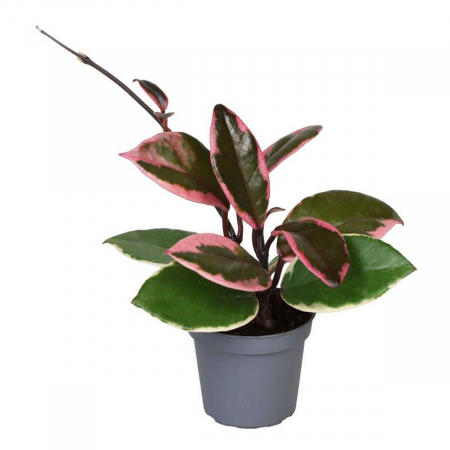
Ai nevoie și de un ghiveci decorativ?