EN/
EN/ Romana
Aglaonema 'Pastella' Ø19cm
![Aglaonema 'Pastella' — pastel sage-green leaves with cream and pink, Ø19cm pot Eufloria [0]](https://gomagcdn.ro/domains2/eufloria.ro/files/product/medium/aglaonema-pastella-748387.png "Aglaonema 'Pastella' — pastel sage-green leaves with cream and pink, Ø19cm pot Eufloria [0]")
![Aglaonema 'Pastella' — pastel sage-green leaves with cream and pink, Ø19cm pot Eufloria [1]](https://gomagcdn.ro/domains2/eufloria.ro/files/product/medium/aglaonema-pastella-786236.png "Aglaonema 'Pastella' — pastel sage-green leaves with cream and pink, Ø19cm pot Eufloria [1]")
![Aglaonema 'Pastella' — pastel sage-green leaves with cream and pink, Ø19cm pot Eufloria [2]](https://gomagcdn.ro/domains2/eufloria.ro/files/product/medium/planta-naturala-de-interior-aglaonema-pastella-d19-654710.png "Aglaonema 'Pastella' — pastel sage-green leaves with cream and pink, Ø19cm pot Eufloria [2]")
![Aglaonema 'Pastella' — pastel sage-green leaves with cream and pink, Ø19cm pot Eufloria [1]](https://gomagcdn.ro/domains2/eufloria.ro/files/product/original/aglaonema-pastella-748387.png "Aglaonema 'Pastella' — pastel sage-green leaves with cream and pink, Ø19cm pot Eufloria [1]")
![Aglaonema 'Pastella' — pastel sage-green leaves with cream and pink, Ø19cm pot Eufloria [2]](https://gomagcdn.ro/domains2/eufloria.ro/files/product/original/aglaonema-pastella-786236.png "Aglaonema 'Pastella' — pastel sage-green leaves with cream and pink, Ø19cm pot Eufloria [2]")
![Aglaonema 'Pastella' — pastel sage-green leaves with cream and pink, Ø19cm pot Eufloria [3]](https://gomagcdn.ro/domains2/eufloria.ro/files/product/original/planta-naturala-de-interior-aglaonema-pastella-d19-654710.png "Aglaonema 'Pastella' — pastel sage-green leaves with cream and pink, Ø19cm pot Eufloria [3]")
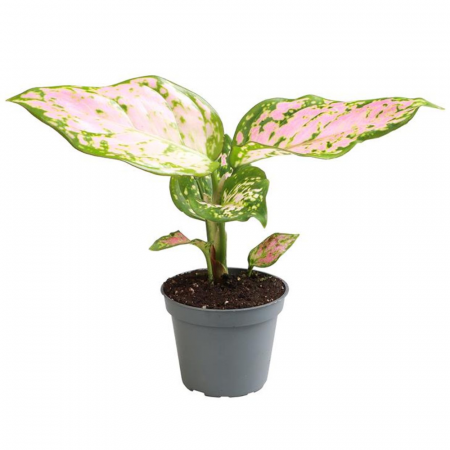
Aglaonema 'Pastella' — Thai cultivar with refined pastel palette of sage-green, cream, powder pink and delicate silver. Soft romantic elegance. Tolerant, purifies air. Humidity 50-70%, 18-27°C. Pastel choice for modern arrangements.
Approx height (including pot): 60 cm
Pot diameter: 19 cm
- Description
- Characteristics
- Reviews (0)
- FAQ
🌿 A Living Watercolour in Pastel Tones — the Quiet Elegance of Cream-Green Foliage
Aglaonema 'Pastella' is one of the most poetic appearances in the houseplant world: a cultivar in which the classic green of tropical foliage has been softened to pastel shades, as if someone had painted each leaf with a brush dipped in diluted watercolour. Sage-green tones melt into areas of cream, ivory and pale green, occasionally dusted with delicate breaths of pink and peach, in a palette so gentle that the plant seems to glow from within even in a darker corner of the room.
Unlike the Aglaonema cultivars with intense red and dramatic contrasts, 'Pastella' plays in the register of subtlety. It is a plant for those who appreciate quiet elegance, who prefer the whisper of colour to its shout. Its generous, broad, slightly glossy foliage creates a rich, orderly volume, perfect for bringing a note of refined freshness to a modern living room, a calm bedroom or a desk that needs a touch of life without demanding attention.
Offered as a mature, well-developed specimen in a generous 19 cm pot, this Aglaonema already has the presence of a statement plant, with numerous overlapping leaves forming a dense, balanced clump. It is the kind of plant you buy once and admire for years, because alongside its pastel beauty it has a remarkably forgiving temperament, tolerating conditions in which many other ornamental plants would protest.
For the plant lover seeking an interior piece with a calm personality, with a colour palette that pairs equally well with light Nordic furniture and warm, textured interiors, 'Pastella' is a choice that never disappoints — accessible beauty that is anything but ordinary.
🌍 Origin and Botanical History
The genus Aglaonema belongs to the large Araceae family, the same that includes philodendrons, monstera and anthurium, and originates in the tropical and subtropical forests of South-East Asia and the western Pacific islands, from India and Thailand to the Philippines and New Guinea. In their natural habitat, these plants grow on the shady forest floor, beneath the dense canopy of tall trees, receiving only filtered light — an adaptation that explains their remarkable tolerance for the low light of our interiors.
The genus name comes from ancient Greek, from the words "aglaos" (bright, shining) and "nema" (thread), a reference to the glossy stamens of the flowers. The genus was scientifically described by the Austrian botanist Heinrich Wilhelm Schott, one of the great nineteenth-century authorities on the Araceae family. For centuries in Asia, Aglaonema has been regarded as a plant of luck and prosperity, kept in homes and shops as a sign of good fortune.
The 'Pastella' cultivar, like most modern coloured Aglaonemas, is the fruit of selection and hybridisation programmes developed especially in Thailand, where breeders transformed a once predominantly silver-green genus into a true palette of colours, from bright red to pink, cream and pastel. 'Pastella' represents the peak of this chromatic refinement: instead of strong contrasts, it offers gentle harmonies, muted tones reminiscent of a summer dawn.
This origin as a tropical understorey plant is the key to its entire character — it explains why it prefers constant warmth, high humidity and indirect light, and why it cannot bear the cold. Knowing where it comes from, we instinctively understand how to make it happy at home.
🌱 The Foliage
The leaves are, of course, the entire reason for this plant's existence. Broad, elongated and slightly pointed at the tip, they usually reach 15–25 cm in length and are carried on short, firm petioles that hold them in an airy, gently arching arrangement. Their surface has a fine, silky sheen that catches and reflects light softly, showcasing the delicate transitions of colour.
What makes 'Pastella' unmistakable is precisely the way the colours interweave across the leaf surface: the central vein and the areas around it tend toward cream and pale ivory, while the margins stay a muted sage-green, and between these extremes unfolds a fine gradient of intermediate tones. Here and there appear small islands and speckles of darker green or warm accents, like patches of light filtered through foliage. Each leaf is thus unique, a small abstract painting in pastel shades.
The texture is firm yet pleasant to the touch, with a slightly fleshy consistency that helps the leaves stay turgid and healthy even when the room air is drier. Young leaves often emerge rolled like delicate scrolls from a central bud, gradually unfurling to reveal their pastel palette one by one — a slow but charming spectacle for those who follow the plant's growth.
The density of the foliage is another asset: on a mature specimen in a 19 cm pot, the leaves overlap generously, creating a full volume and a rounded, balanced silhouette that looks impressive without ever becoming strident. It is a plant that fills a space with its calm presence, without demanding a leading role.
🌸 The Flowers
Like all plants in the Araceae family, Aglaonema can flower by producing the family's typical inflorescence: a central spadix, resembling a small cob, partly wrapped in a bract called a spathe, of a discreet greenish-white. The flowers appear mostly on mature, well-cared-for specimens and have the value of a botanical curiosity rather than a decorative one.
In apartment culture, many plant lovers actually choose to remove the inflorescences as soon as they appear, so the plant concentrates its energy on producing new, vividly coloured leaves — because the foliage, not the flower, is the true spectacle 'Pastella' offers. The pale green spathe adds little to the pastel palette, and removing it keeps the clump compact and vigorous.
If, however, you choose to let the flower develop, you can read it as a sign that your plant truly feels at home — flowering in Aglaonema being proof of a mature and contented specimen. Whatever you decide, the real ornamental value remains in the carpet of pastel leaves that never fades with the passing of a single flower.
🌱 Growth and Development
Aglaonema 'Pastella' is a slow- to moderate-growing plant that gradually builds a dense clump from several short, thick stems that send out leaf after leaf. With age, the plant may develop visible stems at the base and lateral shoots, which can be separated for propagation. The habit stays compact and balanced, making it ideal for placing on a table, a low stand or directly on the floor, beside a sofa or armchair.
It is valued precisely for its toughness and forgiving nature: it tolerates low light, occasional forgetfulness with watering and the drier air of homes, recommending it both to beginners and to those who want a striking plant without fuss. The only things it must truly be protected from are cold and excess water — as long as you provide constant warmth and a well-draining substrate, it will reward your care with healthy, luminous foliage.
- Light: medium to bright, indirect light; the pastel variety keeps its colours best in generous light, but shielded from harsh midday sun that can bleach the leaves.
- Temperature: prefers 18–27 °C and constant warmth; it is sensitive to cold, so keep it away from temperatures below 15 °C and from cold draughts.
- Watering: keep the substrate lightly moist, letting the top layer (2–3 cm) dry between waterings; water less in winter and avoid water pooling at the roots.
- Humidity: enjoys high humidity; occasional misting, grouping with other plants or a humidifier keeps its foliage in peak condition.
- Substrate: an airy, well-draining houseplant mix, with added perlite and fine bark for good air circulation at the roots.
- Fertilising: feed monthly during the warm growing season with a balanced foliage-plant fertiliser diluted to half strength; stop feeding in winter.
- Propagation: by separating lateral shoots when repotting or from stem cuttings with a few leaves, rooted in a warm, moist substrate.
To showcase its delicate palette, 'Pastella' looks superb alongside other coloured Aglaonemas and foliage plants with similar needs — a natural companion for a warm, luminous indoor collection.
Lungime: 30 cm
Greutate (kg): 1 Kg
Denumire: Aglaonema
Cerințe lumină: Partial umbra
Tip plantă: Decorative
Utilizare: Interior
Tip suport: Ghiveci
Material Suport: Plastic
How often should Aglaonema 'Pastella' be watered?
What kind of light does Aglaonema 'Pastella' prefer?
Is Aglaonema 'Pastella' toxic to cats and dogs?
Why are the young leaves paler green than the mature ones?
How is Aglaonema 'Pastella' propagated?
Does Aglaonema 'Pastella' need high humidity?
What colors does 'Pastella' have?
How to maintain the pastel shades?
How to water correctly?
Is 'Pastella' toxic?
How to propagate?
Ai nevoie și de un ghiveci decorativ?