EN/
EN/ Romana
Senecio rowleyanus Ø14cm
![Senecio rowleyanus — pendant stems with green spherical pearls, string of pearls in Eufloria pot [0]](https://gomagcdn.ro/domains2/eufloria.ro/files/product/medium/senecio-rowleyanus-d14cm-524426.png "Senecio rowleyanus — pendant stems with green spherical pearls, string of pearls in Eufloria pot [0]")
![Senecio rowleyanus — pendant stems with green spherical pearls, string of pearls in Eufloria pot [1]](https://gomagcdn.ro/domains2/eufloria.ro/files/product/medium/senecio-rowleyanus-d14cm-280586.png "Senecio rowleyanus — pendant stems with green spherical pearls, string of pearls in Eufloria pot [1]")
![Senecio rowleyanus — pendant stems with green spherical pearls, string of pearls in Eufloria pot [1]](https://gomagcdn.ro/domains2/eufloria.ro/files/product/original/senecio-rowleyanus-d14cm-524426.png "Senecio rowleyanus — pendant stems with green spherical pearls, string of pearls in Eufloria pot [1]")
![Senecio rowleyanus — pendant stems with green spherical pearls, string of pearls in Eufloria pot [2]](https://gomagcdn.ro/domains2/eufloria.ro/files/product/original/senecio-rowleyanus-d14cm-280586.png "Senecio rowleyanus — pendant stems with green spherical pearls, string of pearls in Eufloria pot [2]")
Senecio rowleyanus — string of pearls, iconic South African succulent with pendant stems bearing green spherical pearls. Elegant cascade 60-100 cm for hanging pots. Fragrant cream flowers. Bright light, minimal watering, 18-27°C. Unique plant for succulent lovers.
Approx height (including pot): 10 cm
Country of origin: Denmark
- Description
- Characteristics
- Reviews (0)
- FAQ
🌿 Senecio rowleyanus — string of pearls, elegant succulent of South African deserts
Senecio rowleyanus, popularly known as string of pearls, is one of the most iconic and fascinating succulent plants in the world. Its thin pendant stems bear dozens of green spherical "pearls" — leaves modified into an almost perfectly round shape — flowing in elegant cascades, creating the impression of natural strings of vegetal jewelry.
This extraordinary plant is native to the semi-arid deserts of South Africa, where the spherical leaves represent a brilliant evolutionary adaptation to conserve water and reduce the surface exposed to intense tropical sun. Each "pearl" contains a translucent window on the upper side (thin epidermis) that allows light to penetrate inside for photosynthesis, an ingenious natural design.
In apartment culture, Senecio rowleyanus is one of the most spectacular plants for hanging pots or high shelves where stems can hang freely. Develops cascades of 60-100 cm in a few years, creating a unique and hypnotic plant presence. With a little attention to light and watering, it will reward care with a permanent flow of new pearls.
🌍 Botanical origin and history
Senecio rowleyanus is native to the semi-arid regions of South Africa, particularly the Cape Floristic Region provinces. It was discovered and scientifically described in 1968 by British botanist Gordon D. Rowley, for whom the species was named. In its natural habitat, the plant grows on rocky soils, in rock crevices and on sunny slopes, forming dense carpets of pearled stems.
The Senecio genus (now included in the Curio genus after recent taxonomic reclassification) comprises over 1,000 species distributed globally — from herbaceous plants to shrubs and succulents. The Asteraceae family (formerly Compositae) is one of the largest flowering plant families, with over 23,000 species.
The name "rowleyanus" honors the memory of Gordon Rowley, and "string of pearls" reflects the distinctive shape. The plant has become extremely popular in recent years due to its distinctive appearance and resistance in apartment culture.
🌱 The pearled foliage
The foliage of Senecio rowleyanus is the unique visual signature of the plant. The leaves are spherical, almost perfectly round, with a diameter of 5-9 millimeters, fresh green with slightly silvery shades. Each "pearl" has on the upper side a thin translucent stripe — the "epidermal window" that allows light to penetrate inside the leaf for photosynthesis.
The stems are thin, flexible and vining, brownish-green, 60-90 cm long at maturity. Each stem bears pearls arranged 2-3 cm apart. Mature plants develop multiple stems that flow in dense cascades from hanging pots.
The pearl texture is firm, almost waxy, and the surface catches light delicately. The pearls contain enough water stored to survive short drought periods, typical succulent characteristic.
🌸 The fragrant flowers
Senecio rowleyanus produces delicate flowers in spring and summer. The flowers are small, almost round, composed of capitula of small tubular flowers, creamy white, surrounded by prominent reddish-purple stamens. The flower as a whole looks like a small cream ball with sparkling stamens.
The fragrance is one of the plant's most pleasant surprises — sweet, subtle, reminiscent of cinnamon and vanilla, more intense in the afternoon and evening. A mature plant in bloom can delicately perfume an entire room.
Flowers persist 3-5 days, and a healthy plant can produce several capitula simultaneously. Do not cut flower stems after blooming — they can form dry fruits with viable seeds, although propagation is easier by cuttings.
🌱 Growth habit and care
Senecio rowleyanus is a moderately demanding succulent with specific requirements that must be respected. Wrong watering is the main cause of plant loss.
- Light: BRIGHT — essential. South or west windowsill with direct sun 3-5 hours per day. Insufficient light makes stems thin and distances between pearls larger.
- Temperature: 18-27°C optimal; in winter can tolerate 10-15°C (rest period).
- Watering: MINIMAL — water ONLY when pearls start to slightly wrinkle or substrate is completely dry. Every 10-14 days in summer, every 3-4 weeks in winter. Overwatering is the MAIN cause of death.
- Humidity: low, 30-50% — dry air is beneficial.
- Substrate: VERY well-drained — cactus substrate + perlite (40%) + coarse sand. Roots rot quickly in prolonged wet substrate.
- Fertilization: minimal — every 1-2 months during growing season with cactus fertilizer diluted to a quarter.
- Propagation: by stem cuttings — cut a 10-15 cm portion, let scab 1-2 days, plant in moist substrate.
🌿 Why choose Senecio rowleyanus
Perfect choice for succulent lovers with unique character. The distinctive string of pearls shape makes the plant unmistakable, and the elegant cascade is ideal for hanging pots, high shelves or windowsills. Minimalist, modern, boho-chic — integrates beautifully into any decor. With a little attention to light and minimal watering, will reward with its unique beauty for years.
Toxicity: Senecio rowleyanus is toxic to humans and pets (dogs, cats), according to ASPCA. Ingestion can cause mucosal irritation, vomiting, diarrhoea and, in severe cases, liver issues. Keep the plant elevated, away from children and pets.
Ideal pairings: String of Pearls pairs spectacularly with other trailing Senecio species (S. herreanus — string of tears, S. radicans — string of bananas), as well as with String of Hearts (Ceropegia), Hoya and Rhipsalis. A mixed hanging basket creates a spectacular cascading effect.
Seasonal cycle: Active growth in spring and autumn, semi-rest in summer and winter at extreme temperatures. Flowering occurs in late winter — early spring on mature plants with a slight cool night period in winter.
Botanical curiosities: The round "pearls" are not only decorative — they are a brilliant adaptation to drought: internal water stores are maximised, and a small transparent "window" on each sphere lets light penetrate deep into the leaf tissue for photosynthesis, while simultaneously reducing the surface exposed to evaporation. The plant was formally described only in 1968 by botanist Gordon Rowley.
Why Eufloria: Our plants are grown in premium Dutch greenhouses, acclimatised for European transport and manually checked before shipping.
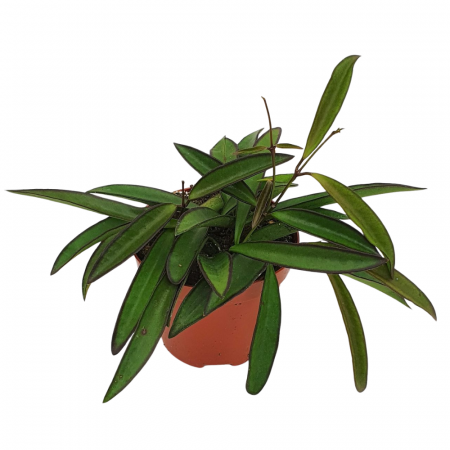
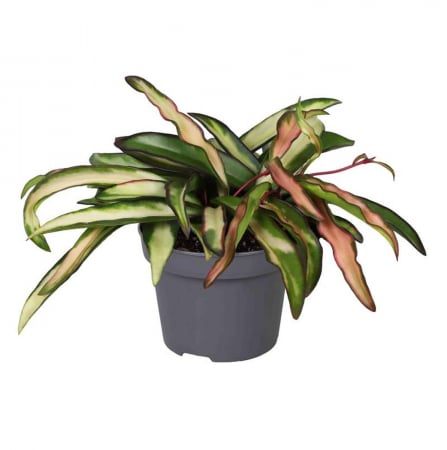
On Eufloria you can find more trailing houseplants that pair well with Senecio rowleyanus: Hoya wayetii, Hoya guppyi, Hoya 'Mathilde', Codonanthe crassifolia and Aeschynanthus 'Bolero Bicolore' — all thrive next to the string of pearls in a hanging basket.
Lungime: 15 cm
Greutate (kg): 1.5 Kg
Denumire: Senecio
Cerințe lumină: Soare indirect
Tip plantă: Decorative
Utilizare: Interior
Tip suport: Ghiveci
Material Suport: Plastic
Why is it called 'string of pearls'?
How to water 'string of pearls' correctly?
Why are the pearls wrinkling?
Is Senecio rowleyanus toxic?
How to make cuttings?
Recommendations
Ai nevoie și de un ghiveci decorativ?