EN/
EN/ Romana
Hoya wayetii Ø6cm
![Hoya wayetii — narrow elongated lime-green leaves with violet-black margins [0]](https://gomagcdn.ro/domains2/eufloria.ro/files/product/medium/hoya-wayetii-d9-057033.png "Hoya wayetii — narrow elongated lime-green leaves with violet-black margins [0]")
![Hoya wayetii — narrow elongated lime-green leaves with violet-black margins [1]](https://gomagcdn.ro/domains2/eufloria.ro/files/product/medium/hoya-wayetii-d9-252762.png "Hoya wayetii — narrow elongated lime-green leaves with violet-black margins [1]")
![Hoya wayetii — narrow elongated lime-green leaves with violet-black margins [1]](https://gomagcdn.ro/domains2/eufloria.ro/files/product/original/hoya-wayetii-d9-057033.png "Hoya wayetii — narrow elongated lime-green leaves with violet-black margins [1]")
![Hoya wayetii — narrow elongated lime-green leaves with violet-black margins [2]](https://gomagcdn.ro/domains2/eufloria.ro/files/product/original/hoya-wayetii-d9-252762.png "Hoya wayetii — narrow elongated lime-green leaves with violet-black margins [2]")
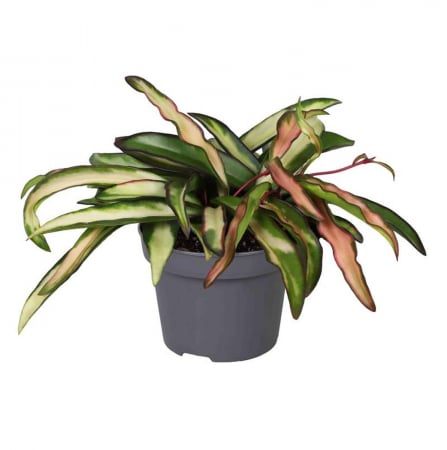
Hoya wayetii is an epiphytic species endemic to the Philippines, with narrow lance-shaped lime-green leaves and spectacular violet-black margins under bright light. Star-shaped red flowers with sweet-caramel fragrance. Compact and resilient, ideal for hanging baskets.
Approx height (including pot): 10 cm
Flowering state: No flowers
Country of origin: Netherlands
- Description
- Characteristics
- Reviews (0)
- FAQ
🌿 Plant Characteristics
Hoya wayetii is an epiphytic indoor plant from the Apocynaceae family, native to the humid forests of the Philippines and Southeast Asia. Collectors love it for its small, lance-shaped, thick, semi-succulent leaves arranged in symmetrical pairs along long, graceful stems. Deep green leaves develop a distinctive red-purple margin when given strong indirect light — a detail that makes it instantly recognizable in any Hoya collection.
The D6cm pot variant is perfect for beginner collectors or those expanding their collection without a big investment. The plant matures with stems 60–80 cm long, easy to train on a hanging basket or small trellis. Hoya wayetii can live for decades in suitable conditions and shares its epiphytic habitat with Hoya 'Mathilde' and Codonanthe crassifolia.
☀️ Light Requirements
Hoya wayetii prefers strong indirect light. An east- or west-facing window is ideal, especially for morning sun. A few hours of direct sun (morning until 11 AM or late afternoon) can stimulate flowering and deepen the red coloration on young leaves. Avoid harsh midday direct sun, which burns the fragile foliage. Indoors, placed 1–2 meters from a large south-facing window, the plant receives enough light for healthy growth.
If natural light is insufficient, a full-spectrum grow lamp (LED 4000–6500K, minimum 30W) on for 10–12 hours daily supports proper metabolism. A plant grown in low light becomes leggy, thin and weak with large spaces between leaves (etiolation) — a clear sign to move it closer to the light source. If leaves yellow or develop brown patches after direct sun exposure, gradually move the plant away over several days.
💧 Care and Watering
Semi-succulent leaves store water, so Hoya wayetii tolerates short dry periods. Let the substrate dry 60–70% between waterings — test with your finger or a wooden stick 3–4 cm deep. Water thoroughly until water exits through drainage holes, then drain excess. In warm season (April–September) water every 7–10 days; in winter reduce to once every 2–3 weeks.
Optimal humidity is 50–70%. In cold season with dry heat from radiators, use a humidifier or a pebble tray with water under the pot. Fine misting helps but avoid spraying directly on flowers, which may stain. Water with room-temperature water left to decant 24 hours to remove chlorine.
Fertilize every 3–4 weeks in the growing season (April–September) with a balanced liquid fertilizer (NPK 10-10-10 or 20-20-20) diluted to 1/2 of the recommended dose. During flowering, benefit from a higher-phosphorus fertilizer (NPK 10-30-20). In winter stop fertilizing completely. Avoid over-fertilization, which burns roots and causes brown leaf tips.
🌡️ Temperature and Climate
Hoya wayetii prefers 18–28°C (64–82°F) during the day and 15–20°C (59–68°F) at night. A 5–10°C day-night difference in the flowering season (July–September) stimulates inflorescence formation. It tolerates poorly temperatures below 12°C — leaves may drop and roots can rot when cold combines with wet substrate.
Protect the plant from drafts, winter-open windows and direct heat sources (radiator, stove). Large shifts in temperature or humidity can delay flowering by months. In summer the plant can be moved to a semi-shaded balcony (see balcony plants) when nighttime temperatures exceed 15°C.
🪴 Pot and Substrate
The pot must have excellent drainage holes. Prefer terracotta or unglazed ceramic pots, which allow excess moisture to evaporate through the walls. Pot size should be only 1–2 cm larger than the root system — Hoya prefers slightly pot-bound roots for flowering.
The ideal substrate is an aerated, well-draining mix: 50% fine pine bark, 20% perlite, 20% acidic peat (Sphagnum), 10% activated charcoal or zeolite. This mix holds moisture in a controlled way and allows root oxygenation. Avoid regular garden soil, which compacts and leads to rot. You can buy a ready-made Hoya / epiphyte mix on Eufloria.
Repot every 2–3 years in late spring. Signs it needs repotting: roots emerging through drainage holes, substrate holding too much water, slow growth in active season, substrate smelling moldy. After repotting, avoid watering for 5–7 days to allow root healing.
🌼 Flowering and Special Notes
Hoya wayetii produces stunning clusters of waxy star-shaped flowers, cream-white with red-burgundy centers, with strong sweet fragrance especially at night — reminiscent of vanilla and caramel. Inflorescences appear on mature stems, on floral peduncles that remain after flowers fall. Do not prune the peduncles — they are reblooming sites in following years! A healthy 3–5 year plant can produce 20–30 clusters per year.
Hoya wayetii is excellent for office, semi-shaded balcony and apartments with reasonable windows — it does not require intense direct light and tolerates diverse microclimates. It is non-toxic to cats and dogs according to ASPCA, making it ideal for homes with pets.
If you love Hoya wayetii, explore on Eufloria the mature Hoya wayetii D12cm, the variegated Hoya wayetii 'Tricolor', as well as Hoya guppyi, Hoya 'Mathilde', Senecio rowleyanus or Codonanthe crassifolia — all epiphytic and trailing plants pair well with Hoya wayetii. Delivery across the EU.
📚 Additional Cultivation Notes
Hoya wayetii propagates easily from stem cuttings with 2–3 leaf nodes. Cut just below a node with a sterile blade, let it callous for 1–2 days, then place in moist sphagnum moss or a light perlite mix. Roots typically appear in 3–6 weeks at 22–25°C. Cover with a plastic bag to maintain humidity. Once roots reach 2–3 cm, transplant into standard Hoya mix.
Common issues and solutions: yellow leaves usually indicate overwatering or cold stress — reduce watering frequency and check for drafts. Shriveled leaves point to underwatering or root damage — inspect roots and rehydrate slowly. Black spots on leaves may be sunburn or fungal infection — move away from direct sun and improve airflow. No flowers for years typically means the plant needs more light, a larger day/night temperature difference, or is still too young (flowering usually starts after 2–3 years).
Pests to watch: mealybugs, scale insects and spider mites. Inspect leaf undersides monthly. Treatment: wipe with cotton pad soaked in 70% isopropyl alcohol, or use insecticidal soap. For heavy infestations, neem oil diluted at 1–2% with a drop of dish soap works well.
Lungime: 9 cm
Greutate (kg): 0.25 Kg
Denumire: Hoya
Diametru: 9 cm
Cerințe lumină: Strong, indirect light
Tip plantă: Decorative
Utilizare: Interior
Tip suport: Ghiveci
Material Suport: Plastic
How often should I water Hoya wayetii?
Water when the top 3–4 cm of substrate have dried completely. In summer, this means once every 7–14 days, and in winter once every 2–3 weeks. Hoya tolerates drying better than overwatering.
Is Hoya wayetii toxic to pets?
No, Hoya wayetii is considered non-toxic to cats and dogs according to the ASPCA. The milky sap may cause minor gastric irritation in large quantities, but it is not dangerous.
Why don’t the leaves have reddish margins?
The reddish margins appear with bright light exposure. If the plant receives too little light, leaves remain uniformly green. Move the plant near a bright window and the margins will colour up within 2–4 weeks.
When does Hoya wayetii bloom?
Flowering occurs 2–3 years after rooting. The flowers are star-shaped, waxy, reddish-burgundy and fragrant. Do not cut the peduncles (spurs) after flowers drop — they will produce new blooms in subsequent seasons.
How do you propagate Hoya wayetii?
Propagation is done through stem cuttings with at least 2 nodes. Place the cutting in moist sphagnum or water at 22–28°C. Roots appear within 2–4 weeks. The success rate is high, 80–90%.
How Do I Recognize Hoya wayetii?
Narrow elongated leaves (10–12 cm long, 1–1.5 cm wide), dark green with reddish-purple edges. Supple stems that sway with any breeze.
How Often to Water?
Every 7–10 days in summer, 14–21 days in winter, only when top substrate is dry.
What Light Does It Prefer?
Bright indirect (PPFD 200–400). 1–2 m from east/west window, no direct midday sun.
Is It Toxic to Cats?
Non-toxic per ASPCA for cats, dogs, horses. Milky latex may irritate sensitive skin.
How to Propagate?
Stem cuttings with 2–3 nodes, rooting in moist perlite 3–6 weeks at 22–26°C.
How Do I Recognize Hoya wayetii?
Narrow elongated leaves (10–12 cm), dark green with reddish-purple edges under bright light. Supple cascading stems.
How Often to Water?
Every 7–10 days in summer, 14–21 days in winter, only when top substrate is dry.
Why Do the Leaves Have Red Edges?
Under intense light, edges develop anthocyanins (red pigment). Good sign: enough light.
Is It Toxic to Cats?
Non-toxic per ASPCA for cats, dogs, horses. Milky latex may irritate sensitive skin.
How to Propagate?
Stem cuttings with 2–3 nodes, rooting in moist perlite 3–6 weeks at 22–26°C.
Recommendations
Ai nevoie și de un ghiveci decorativ?