EN/
EN/ Romana
Hoya undulata Green
![Hoya undulata Green indoor plant with wavy leaves [1]](https://gomagcdn.ro/themes/fashion/gfx/no-image.png "Hoya undulata Green indoor plant with wavy leaves [1]")
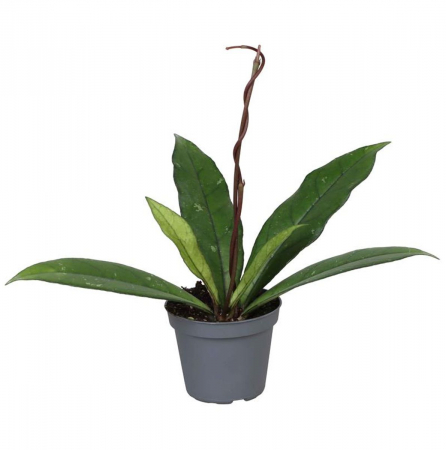
Hoya undulata Green is the classic green form of the fascinating Hoya undulata species, renowned for its large, strongly wavy leaves with a unique waxy texture and prominent venation creating spectacular three-dimensional relief. A rare collector species native to Borneo, with an elegant trailing habit and fragrant flowers.
- Description
- Reviews (0)
- FAQ
🌿 Green tropical waves — leaves that defy the plane and create living sculpture
Some plants impress through colour, others through rarity, and others through texture. Hoya undulata Green belongs to the last category — and dominates it with authority. Its leaves are, literally, an exercise in botanical sculpture: large, broad, strongly undulating, with the surface rising and falling in regular waves, creating a three-dimensional relief that transforms each leaf into a small landscape of miniature green hills. The name "undulata" (from the Latin undula — small wave) is a perfect description of this defining trait.
The Green form is the classic, original variant of the species — uniformly green leaves without variegation or splash, but with a textural complexity that more than compensates for the absence of any chromatic ornament. The waxy, thick surface, with a thin but visible sheen, captures light differently on each "wave" of the undulation, creating a play of shadows and reflections that changes throughout the day.
On the Hoya collector market, undulata has rapidly earned a special place due to its morphological uniqueness. Few species in the Hoya genus (over 500 recognised) exhibit a similar degree of foliar undulation. At Eufloria, Hoya undulata Army and Hoya undulata Dikaya Priroda are other variants of the same species, each with its own chromatic personality, but the Green form remains the classic, the one that defines the species.
We offer healthy specimens with mature leaves exhibiting the characteristic complete undulation. Young plants may have slightly flatter leaves — the undulation intensifies as the leaf matures and thickens, gradually revealing the three-dimensional sculpture that makes this species so memorable.
🌍 Origin and botanical history — from the cloud forests of Borneo
Hoya undulata was described by the Dutch botanist Casper Georg Carl Reinwardt in the first half of the 19th century, based on specimens collected in Borneo (Kalimantan). The species is endemic to Borneo — one of the world's most biodiverse islands — where it grows in tropical montane forests at altitudes of 500—1,500 metres, as an epiphyte on tree trunks and on rocks covered in moss and lichens.
Borneo is a global hotspot for Hoya diversity, with over 100 native species described. Hoya undulata is one of the island's emblematic species, distinct among congeners through its large, wavy leaves — considered an adaptation to fluctuating light conditions in the forest understorey. Taxonomically, it belongs to the family Apocynaceae, subfamily Asclepiadoideae, classified among large-leaved species alongside Hoya latifolia and Hoya imperialis.
🌱 The foliage — waves of green wax in an ocean of textures
The leaves are remarkable through multiple simultaneous traits. Dimensions are generous for the Hoya genus: 8—15 cm length and 4—8 cm width at maturity, with a thickness of 2—3 mm giving them a firm succulent quality. The basic shape is ovate-lanceolate, but what makes them truly distinctive is the strong surface undulation — the margins and surface rise and fall in regular waves with an amplitude of 5—10 mm, creating a three-dimensional effect unmistakable from any other species.
The surface is covered in a thick waxy layer giving them a satin-like visible sheen. The venation is pronounced, visible on both surfaces, forming a complex reticulate pattern that follows the leaf's undulating topography. Colour is medium to dark green, uniform across the entire surface. New leaves appear lighter green, sometimes with slightly reddish margins, darkening as they mature.
Compared to other large-leaved species (Hoya latifolia, Hoya diversifolia Maharani), undulata is categorically distinguished by its pronounced undulation — others have large but flat or only slightly curved leaves.
🌸 The flowers — fragrant pale-pink stars on wavy branches
The flowers match the spectacular foliage. Umbels are medium to large, formed of 15—25 individual flowers each 12—18 mm in diameter — significantly larger than in miniature species. Petals are pale pink, sometimes with orange or salmon tones, with a glossy waxy texture and a darker central corona (deep pink or red). The fragrance is pronounced — more intense than in miniature species — with notes of honey, cinnamon, and vanilla that intensify dramatically in the evening. A single umbel can perfume an entire room.
Flowering conditions: strong indirect light, maturity of at least 3—4 years, winter rest at 15—18°C with reduced watering, and a pot small enough to stimulate the "productive stress" that triggers floral bud formation. Do not cut old peduncles.
🌱 Growth habit and development — slow sculpture, created with patience
Hoya undulata Green has a natural trailing habit with semi-woody stems producing new leaf pairs every 3—6 weeks during the active season. Growth is slow — slower than most Hoya species, typical for large-leaved species that invest significant resources in each individual leaf. Stems can reach 1—2 metres over several years.
The plant excels on a moss pole or trellis where aerial roots anchor and stimulate larger leaf production. A large open terrarium with controlled humidity is also excellent.
Care requirements:
- Light: Strong indirect. Essential for healthy growth and full development of foliar undulation. East or west window. Direct summer sun burns the leaves.
- Temperature: 18—28°C optimal. Tolerates 12°C briefly. The species is from tropical montane zones, preferring moderately warm temperatures.
- Watering: Substrate half-dry between waterings (not completely dry as with miniature species — large leaves lose more water through transpiration). Summer: 5—7 days. Winter: 10—14 days.
- Humidity: 60—80% ideal. Undulata comes from cloud forests and appreciates high humidity more than other Hoyas. A humidifier is almost mandatory for optimal results.
- Substrate: Well-draining but with moderate retention: 40% pine bark, 25% perlite, 20% coco chips, 15% sphagnum or Hoya substrate. More retention than for miniature species, but not standard potting soil.
- Fertilising: Balanced liquid at 1/2 concentration, once monthly in warm season.
- Propagation: Stem cuttings with 1—2 nodes and at least one leaf, on moist sphagnum or in water. Rooting: 4—8 weeks. Spring optimal. Cuttings need high humidity during rooting.
Why are Hoya undulata leaves wavy?
Does Hoya undulata Green need higher humidity than other Hoyas?
How does undulata Green differ from undulata Army and Dikaya Priroda?
Is Hoya undulata Green toxic to pets?
Can Hoya undulata Green bloom indoors?

Ai nevoie și de un ghiveci decorativ?