EN/
EN/ Romana
Hoya curtisii Silver
![Hoya curtisii Silver indoor plant with silver leaves [1]](https://gomagcdn.ro/domains2/eufloria.ro/files/product/original/hoya-curtisii-silver-eufloria-084775.png "Hoya curtisii Silver indoor plant with silver leaves [1]")
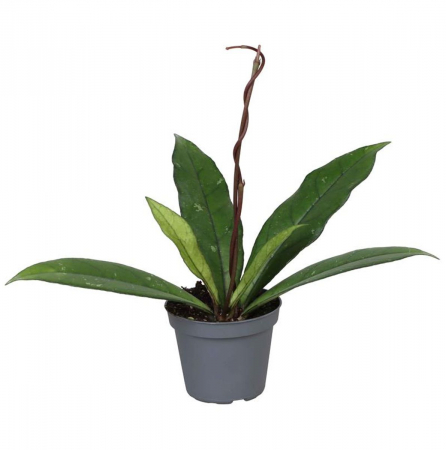
Hoya curtisii Silver is a distinctive variant of Hoya curtisii, selected for its exceptionally strong silver reflections that cover nearly the entire leaf surface. The small, heart-shaped leaves have an almost metallic appearance, like living silver coins. A collector piece with a compact, trailing habit, ideal for miniature Hoya enthusiasts.
- Description
- Reviews (0)
- FAQ
🌿 Living silver on tropical green — when nature creates botanical jewellery
Few plants in the botanical world truly deserve the epithet "metallic," but Hoya curtisii Silver is one of them. This selected variant of Hoya curtisii is distinguished by a silver pattern so intense and uniform that the leaves appear coated in a thin film of liquid silver. While the standard curtisii already impresses with delicate silver spots distributed across the green background, the Silver variant takes this trait to the extreme: silver covers 70—90% of the leaf surface, leaving only narrow green margins visible and transforming each leaf into a living, shimmering coin.
The visual effect is truly remarkable. In good light, the leaves capture and reflect rays like miniature mirrors, shifting their hue from cool silver (in direct morning light) to warm silver with golden reflections (in sunset light). This play of light makes Hoya curtisii Silver one of the most photogenic houseplants — every photograph captures a different nuance, a different angle of metallic reflection.
This is not artificial — it is the result of a fascinating natural phenomenon. The silver pattern of curtisii is caused by microscopic air pockets located between the epidermis and the mesophyll cell layer. These pockets reflect light rather than absorbing it, creating the metallic appearance. In the Silver variant, these pockets are larger and more uniformly distributed than in the standard form, resulting in nearly complete silver coverage. The mechanism is similar to that in Hoya krohniana Splash or Scindapsus pictus leaves, but in curtisii Silver the intensity is far more pronounced.
At Eufloria, each Hoya curtisii Silver specimen is verified for the intensity and uniformity of its silver pattern. We offer only plants with strong, stable reflections that maintain their metallic appearance throughout their lifetime — unlike unstable variegations, the silver pattern is a permanent genetic trait that does not revert.
🌍 Origin and botanical history — from the Malaysian jungle, selected for brilliance
Hoya curtisii was described by Henry Nicholas Ridley in 1908, based on specimens collected by Charles Curtis in the montane forests of peninsular Malaysia. The species grows natively as an epiphyte and lithophyte in Malaysia, Thailand, the Philippines, and western Indonesian islands, at altitudes of 0—800 metres. Taxonomically, it belongs to the family Apocynaceae, subfamily Asclepiadoideae, classified among miniature species alongside Hoya serpens and Hoya engleriana.
The Silver variant is not a mutation in the classical sense (like albo or inner variegation) but a horticultural selection — cultivators identified and propagated specimens with the most intense silver pattern from available populations. This artificial selection, carried out over multiple generations of vegetative propagation, has resulted in plants with significantly stronger silver reflections than any wild specimen. The major advantage over variegated variants: the Silver pattern is permanently stable and does not revert, because it depends on the physical structure of the epidermis, not on chlorophyll distribution.
🌱 The foliage — living silver coins on velvet branches
The leaves maintain the species' characteristic form: small (2—3 cm length, 1.5—2.5 cm width), broad heart or spade-shaped, thick and succulent. What differentiates the Silver variant is the intensity of silver coverage. In standard curtisii, silver spots cover 30—50% of the surface. In Silver, it covers 70—90%, sometimes nearly 100%, resulting in an almost uniformly metallic appearance. Only a fine green outline remains visible along the margins and central vein.
Viewed up close, the leaves reveal fascinating textural complexity: the silver layer is not a uniform surface but a mosaic of tiny reflective cells, each with its own reflection angle, creating an effect similar to microscopic fish scales or a metallic silk weave. Compared to curtisii Albo Variegated (with golden sectors on green) or curtisii Inner Variegated (with luminous centre), Silver is distinguished by the uniformity and permanence of its metallic appearance.
The leaf underside remains green without silver reflections — an interesting difference demonstrating that the mechanism is related to the upper epidermis structure, not the entire leaf's cellular composition.
🌸 The flowers — pink on silver, a dream contrast
The flowers are identical in form and fragrance to the standard species — compact umbels of 10—15 individual flowers, each 6—8 mm, pale pink with a darker central corona, porcelain waxy texture, and a subtle sweet caramel-vanilla fragrance. But the visual context is entirely different: pink flowers appear against a backdrop of shimmering silver leaves, creating a chromatic contrast of rare elegance.
Flowering conditions are classic Hoya: maturity (2—3 years), strong indirect light, winter rest (15—18°C, reduced watering), and preservation of old peduncles. An advantage of Silver over variegated variants: the plant has complete chlorophyll (hidden beneath the silver layer), producing energy at normal capacity with flowering potential similar to the standard form.
🌱 Growth habit and development — slow but constant brilliance
The habit is trailing and creeping, with filiform stems producing leaf pairs every 2—3 weeks during the active season. Growth rate is similar to the standard form (not slowed like variegated variants), since functional chlorophyll is fully present beneath the reflective layer. Stems can reach 40—80 cm over several years, branching naturally at nodes.
The plant develops magnificently in a hanging basket or on a high shelf. The metallic appearance is best showcased by oblique light — near a window where morning or evening sun touches the leaves laterally, the brilliance effect is at its maximum.
Care requirements:
- Light: Strong indirect. While the silver pattern does not depend on light for maintenance (it does not revert), good light stimulates growth and highlights metallic reflections. East or west ideal.
- Temperature: 18—28°C optimal. Not below 12°C. Tropical lowland plant.
- Watering: Substrate nearly completely dry between waterings. Summer: 7—10 days. Winter: 14—21 days. Fine roots vulnerable to excess moisture.
- Humidity: 60—80% ideal. Humidifier or pebble tray recommended.
- Substrate: Extremely well-draining: fine pine bark, perlite, coco chips, activated charcoal. Special Hoya substrate recommended. Small pot with generous drainage.
- Fertilising: Balanced liquid diluted, every 2 weeks in warm season.
- Propagation: Stem cuttings with 2—3 nodes on moist sphagnum. Rooting: 4—8 weeks. The silver pattern is faithfully transmitted through vegetative propagation — all cuttings will have silver reflections.
Is the silver pattern permanent or can it disappear?
Does Hoya curtisii Silver grow faster than variegated variants?
What light is ideal to showcase the silver reflections?
Is it toxic to cats and dogs?
What substrate should I use for curtisii Silver?
Ai nevoie și de un ghiveci decorativ?