EN/
EN/ Romana
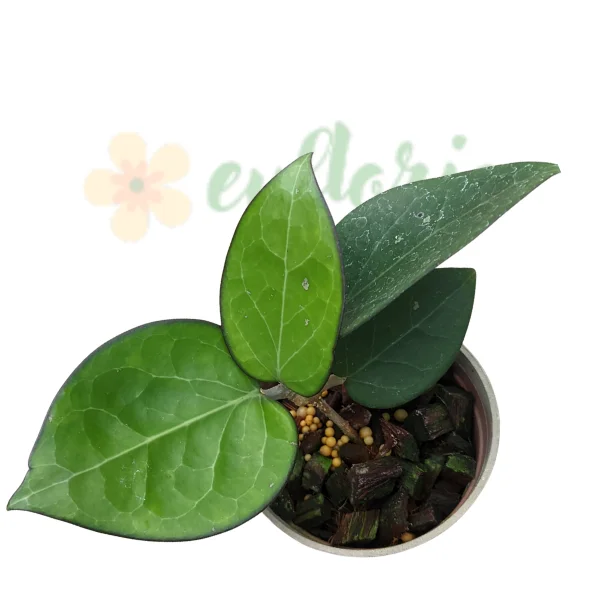
Hoya aff. vitellina Ø10.5cm
![Hoya aff. vitellina IML 1348 — green leaves with purple margins, orange-gold flowers, Ø10.5cm pot | Eufloria [1]](https://gomagcdn.ro/domains2/eufloria.ro/files/product/original/hoya-aff-vitellina-d10-5-217028.png "Hoya aff. vitellina IML 1348 — green leaves with purple margins, orange-gold flowers, Ø10.5cm pot | Eufloria [1]")
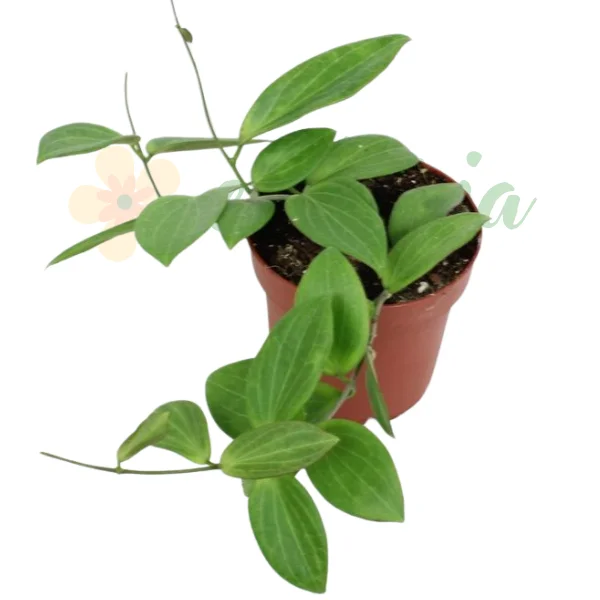
Hoya aff. vitellina (IML 1348 clone) — horticultural entity from Java, related to H. vitellina. Oblong-elliptical green leaves with red-purple margins under light, star-shaped orange-gold flowers with white corona. Sweet scent. Ø10.5cm pot.
Approx height (including pot): 15 cm
Flowering state: No flowers
Pot diameter: 10.5 cm
- Description
- Characteristics
- Reviews (0)
- FAQ
🌿 Hoya aff. vitellina (IML 1348) — gold on purple-tinged green from Java
Hoya aff. vitellina is a horticultural entity with stable identity but without formal taxonomic description, originally distributed by Liddle's Nursery (Australia) under the collection code IML 1348 and originating from Java, Indonesia. The prefix "aff." (from Latin affinis = "related to") indicates a plant with clear affinities to Hoya vitellina Blume, but sufficiently different in morphology to not be treated as a validated species. It is part of our Hoya collection and belongs to the finlaysonii-type group.
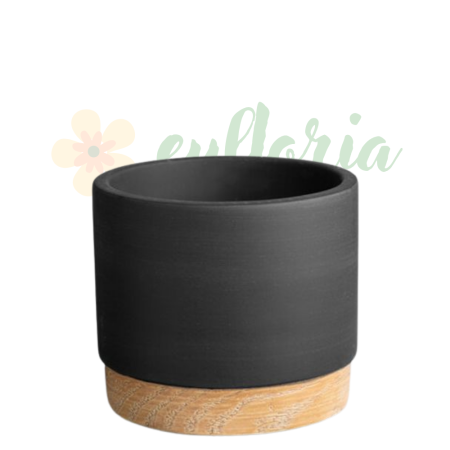
Our specimen comes in a Ø10.5cm nursery pot, perfect to be moved into a decorative ceramic pot of the same size.
🌍 What "aff." means and where it comes from
In botanical taxonomy, "aff." (affinis) is a convention used for entities about which the collector/botanist is sure that they differ from an already described species, but which they have not yet formally described. Unlike "cf." (identification uncertainty), "aff." signals that the plant is certainly a distinct entity — frequently a candidate for a new species. In this case, IML 1348 was imported under the label "Hoya sp. vitellina from Java", but the morphology (leaves with purple margins and distinct orange-gold flowers) does not exactly match Carl Blume's 1849 description.
The mother species Hoya vitellina Blume is native to the western island of Java and Borneo (Sarawak). Unlike Hoya carnosa 'Krimson Queen' with structural variegation on the margins, aff. vitellina shows a pattern of subtle silver speckles on green, with margins that become red-purple under strong light.
🌱 Foliage — green with purple reflex under light
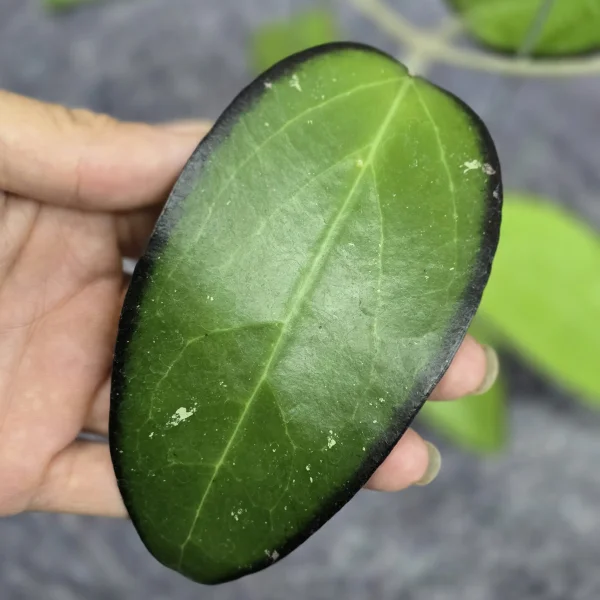
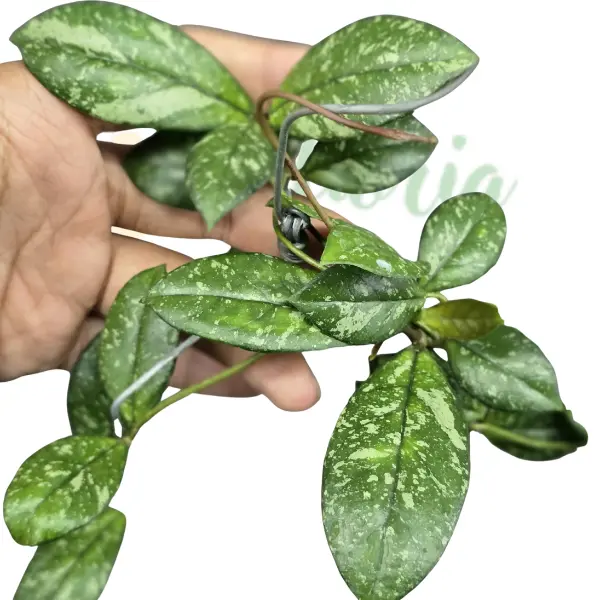
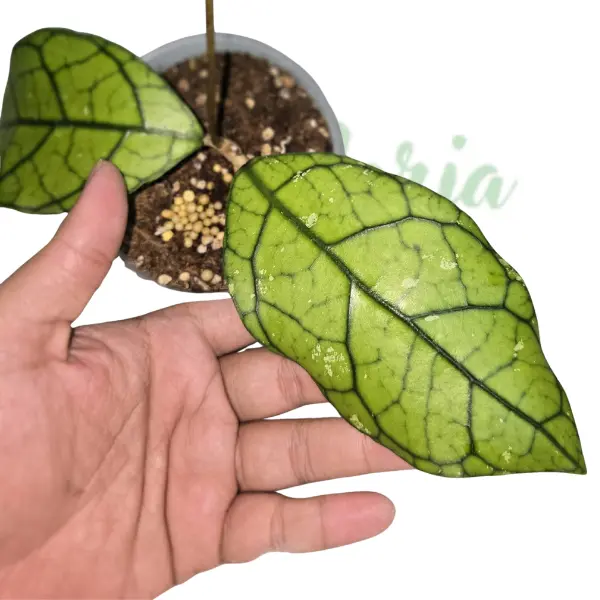
The leaves of Hoya aff. vitellina are oval-elongated to oblong, firm, tough, with a "long and tough" texture described by experienced growers. The base colour is green, but the main diagnostic feature is the red-purple margins that progressively appear when the plant receives strong indirect light — an ornamental trait appreciated by collectors. Some specimens may also show subtle silver speckles on the lamina ("silver splash"), and the veins are visible, lighter in colour.
The stems are voluble, the shoots grow vigorously — the plant has fast growth compared to other Hoyas, which is why it needs more frequent repotting. The habit is mixed climbing-trailing; new shoots grip naturally on any support.
🌸 Inflorescences — orange-gold flowers with white corona
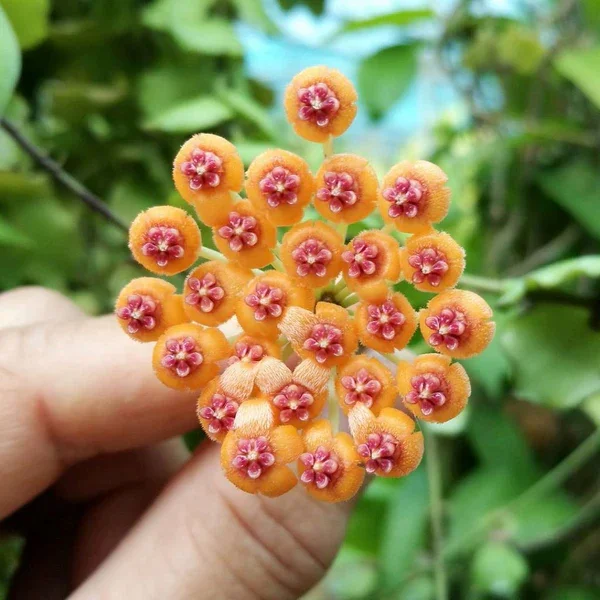
The flowers are one of the most appreciated traits of this entity: ~12 mm in diameter, star-shaped, orange-gold or yellow-gold with a central white corona, arranged in umbels of up to ~20 flowers. The golden colour is distinctive in the Hoya genus, where most species have white, pink, or red flowers. The scent is described as sweet, pleasant, sometimes slightly fruity.
The flowering cycle repeats on the same perennial peduncles — you must not break off dried inflorescences. See more flowering indoor plants.
🌞 Care Requirements — Complete Guide
- Light: bright indirect; tolerates a few hours of mild morning sun — necessary for the development of the leaves' red-purple margins. Avoid direct afternoon sun in summer.
- Temperature: optimal 18-27°C. Do not expose below 12°C.
- Watering: moderate — let the top half of the substrate dry between waterings. Summer every 7-10 days, winter every 14-18 days.
- Humidity: 50-80% — tolerates a wide range, making it accessible in home environments.
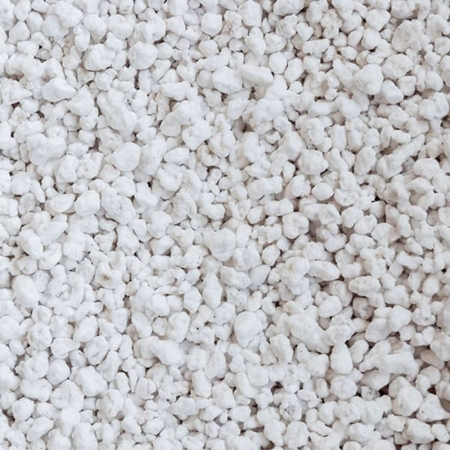
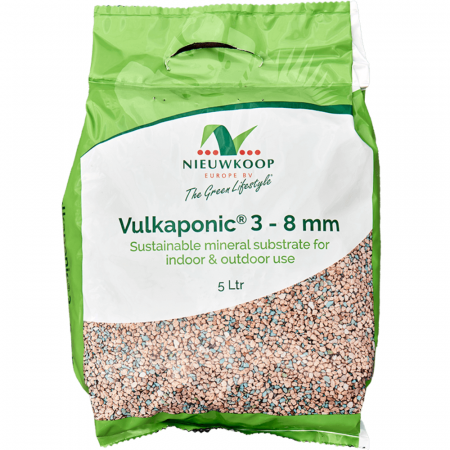
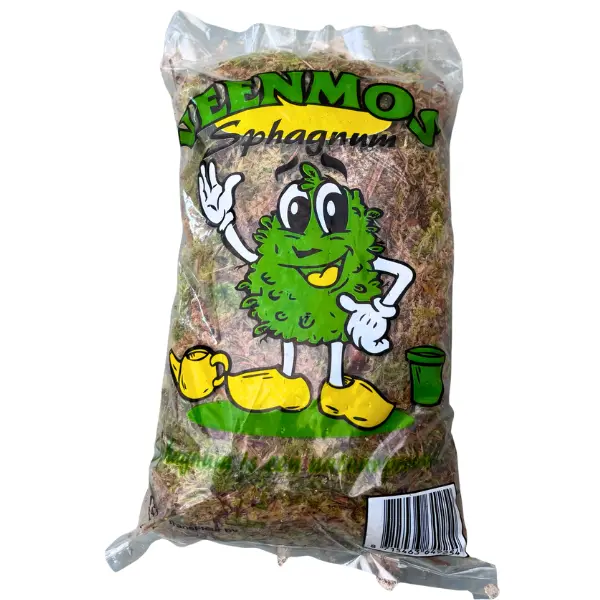
- Substrate: airy and well-drained — a mix of medium pine bark (50%), natural sphagnum (20%), perlite (20%), and a drainage layer of Vulkaponic at the pot base (10%).
- Repotting: more frequent than other Hoyas (every 1-2 years) — due to vigorous growth.
- Fertilising: monthly spring-summer with a mild formula for flowering plants (NPK 6-10-8).
- Propagation: stem cuttings with 1-2 nodes in moist sphagnum; roots in 3-5 weeks. High success rate.
🐾 Toxicity and Home Safety
The Hoya genus is considered non-toxic according to the ASPCA database, being safe for dogs, cats, and children. The milky sap, common in the Apocynaceae family, may cause minor skin irritation in very sensitive individuals — a pair of gloves is enough at repotting. Hoya aff. vitellina is thus featured among our child- and pet-friendly plants.
🎓 Why Choose Hoya aff. vitellina
It is an acquisition for collectors who appreciate the rare combination between foliage with purple reflex (under strong light) and inflorescence with orange-gold flowers — a distinctive colour palette in the Hoya genus. The "aff." status adds value as an interesting botanical object — an entity that has not yet received its formal scientific name, but which is commercially traceable (the IML 1348 clone). It integrates beautifully into the rare Hoya collection and is a solid option for enthusiasts who want to add a species with clear ornamental identity. See other options for office plants with indirect light.
📚 Read also
Lungime: 15 cm
Greutate (kg): 0.5 Kg
Denumire: Hoya
Diametru: 10.5 cm
Cerințe lumină: Partial umbra
Tip plantă: Decorative
Utilizare: Interior
Tip suport: Ghiveci
Material Suport: Plastic
What does "aff." in the name mean?
What is IML 1348?
Why are the purple margins not visible on the leaves?
What colour are the flowers?
Is it safe for cats and dogs?
Recommendations



Ai nevoie și de un ghiveci decorativ?