EN/
EN/ Romana
Hoya vangviengiensis D7
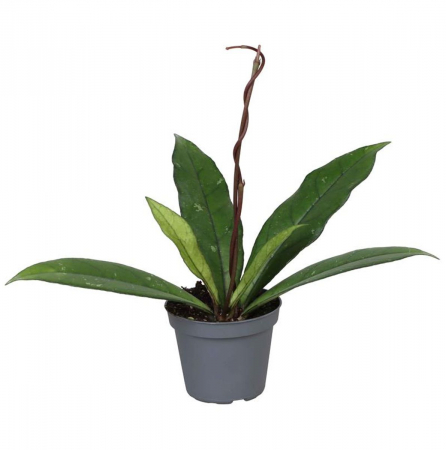
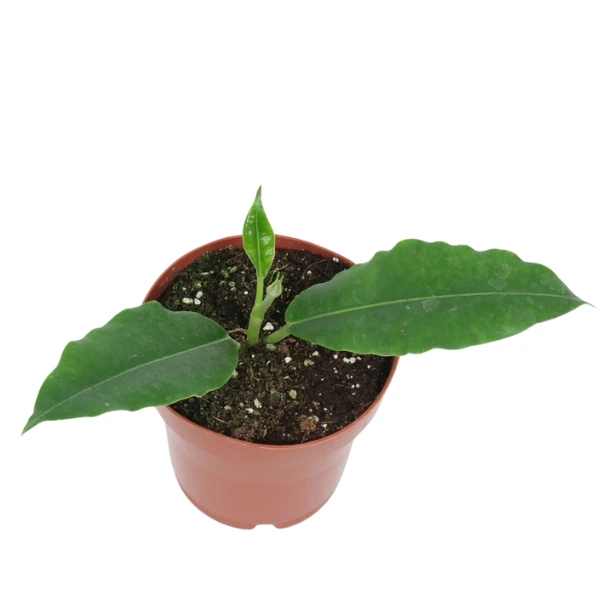
![Hoya vangviengiensis with fleshy green leaves in plastic nursery pot [1]](https://gomagcdn.ro/domains2/eufloria.ro/files/product/original/hoya-vangviengiensis-d12-009933.png "Hoya vangviengiensis with fleshy green leaves in plastic nursery pot [1]")
Hoya vangviengiensis is a rare Hoya species from the Apocynaceae family, native to the limestone forests of the Vang Vieng region in Laos. It stands out for its thick, fleshy leaves with a robust waxy texture and an exotic appearance that immediately draws attention. Its flowers, grouped in fragrant umbels ranging from creamy yellow to pink, release a sweet, intense fragrance that intensifies in the evening. A moderately growing epiphyte, ideal for hanging baskets and rare species collections.
Approx height (including pot): 15 cm
Flowering state: No flowers
Pot diameter: 7 cm
- Description
- Characteristics
- Reviews (0)
- FAQ
🌿 A Botanical Gem from the Heart of Laos
Hoya vangviengiensis is one of those botanical discoveries that transforms an ordinary plant collection into a veritable cabinet of vegetal curiosities. Scientifically described only in 2011 by Michele Rodda and Nadhanielle Simonsson, this species carries in its name the imprint of its place of origin — Vang Vieng, a small town surrounded by spectacular limestone formations in central Laos. Here, in the low-altitude tropical forests that embrace the karst cliffs, Hoya vangviengiensis found its ecological niche — clinging to the trunks of ancient trees, bathed in the persistent humidity of the valleys and nourished by the monsoon rains of Southeast Asia.
What makes this species truly special is the combination of leaf robustness and flower delicacy. The leaves are thick, fleshy, with a texture reminiscent of the fine skin of an exotic fruit — smooth to the touch, yet with a firmness that betrays the plant's capacity to store water. And when it blooms, its fragrant umbels transform any corner of a room into a miniature tropical garden, with sweet-spicy aromas that intensify after sunset.
The genus Hoya comprises over 500 recognised species according to Kew Royal Botanic Gardens (WCSP), distributed from tropical Asia to Australia and Oceania. Hoya vangviengiensis belongs to the succulent-leaved section, adapted to variable humidity conditions and nutrient-poor epiphytic substrates. In indoor cultivation, it behaves as a grateful plant — tolerating minor neglect while rewarding patience with steady growth and, at maturity, spectacular inflorescences.
For European collectors, Hoya vangviengiensis represents a valuable acquisition: a relatively new species in the horticultural circuit, with limited availability and considerable aesthetic potential. Each specimen carries with it the story of the limestone forests of Laos and the promise of fragrant blooms worth the wait.
🌍 Origin and Botanical History
Hoya vangviengiensis (Rodda & Simonsson, 2011) is a species from the Apocynaceae family, subfamily Asclepiadoideae, tribe Marsdenieae. Its classification was published in Webbia: Journal of Plant Taxonomy and Geography, based on specimens collected from Vientiane province, Laos, in the Vang Vieng area. The holotype is deposited at the Singapore Herbarium (SING).
The etymology is direct and geographical: “vangviengiensis” derives from the Latinisation of the toponym “Vang Vieng,” reflecting the traditional taxonomic practice of naming species after their place of discovery. Vang Vieng is a locality situated on the Nam Song River, approximately 160 km north of Vientiane, the capital of Laos, in a region dominated by karst formations that create unique microclimates.
Natural habitat: tropical evergreen karst forests at elevations of 200–500 m. The plant grows as an epiphyte on trunks and branches of mature trees, anchoring its aerial roots in moss and natural matter accumulated in bark crevices. The regional climate is tropical monsoonal, with mean annual temperatures of 25–28°C, rainfall of 1,500–2,500 mm/year, and relative humidity consistently above 70%.
In the international horticultural circuit, the species began appearing in specialised collections from Thailand and Singapore around 2015, then spread to Europe through Dutch and German nurseries. Today, it remains a species with limited commercial distribution, sought by collectors who value the rarity and authenticity of botanical provenance.
🌱 The Foliage — Green Sculptures of Natural Wax
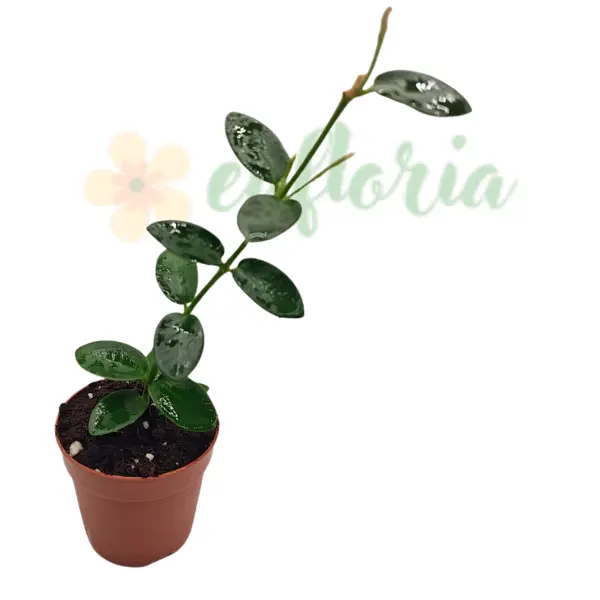
The leaves of Hoya vangviengiensis are, without exaggeration, the plant's main attraction in the absence of flowers. They are opposite, arranged in pairs along the stem, with an ovate to elliptical shape measuring 5–10 cm in length and 3–5 cm in width at maturity. Their thickness is remarkable — 3–5 mm — reflecting the succulent adaptation to epiphytic conditions where water is not always available.
The texture of the leaves is one of the elements that distinguishes this species from its more common relatives. The adaxial (upper) surface is smooth, with a semi-waxy appearance that reflects light in a subtle way, without the excessive shine of species like H. carnosa. To the touch, the leaves convey a sensation of pleasant firmness, like a fragment of green rubber. The margins are entire, slightly undulate, and the apex is acute to slightly acuminate.
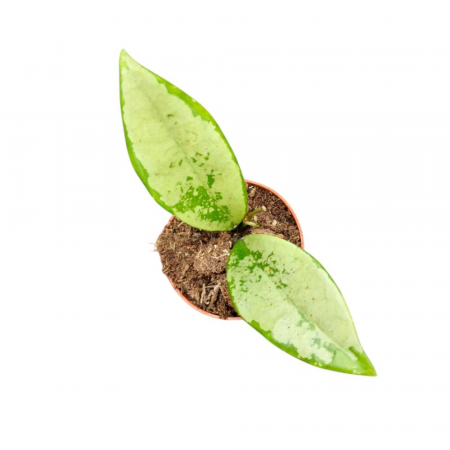
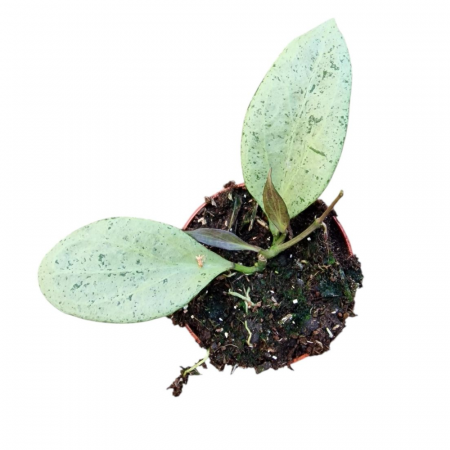
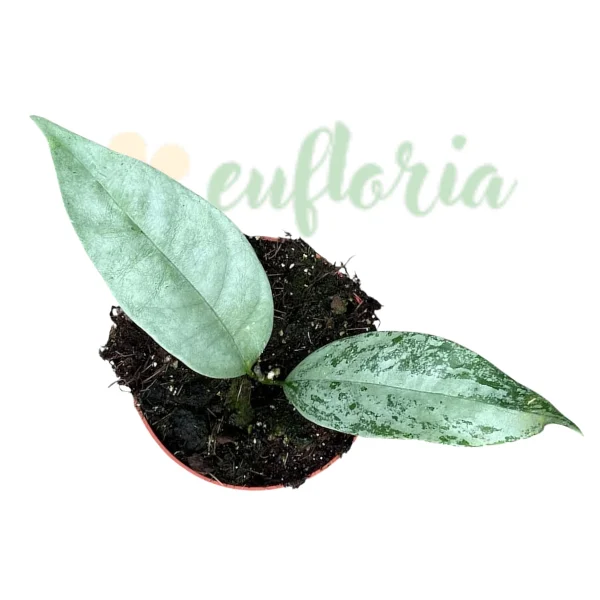
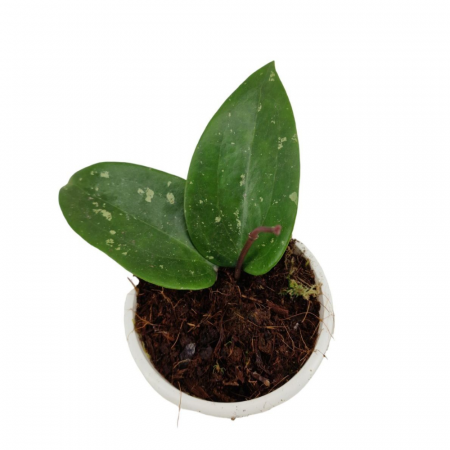
The predominant colour is a uniform dark green, though specimens exposed to more intense light may develop slightly lighter shades or even silver reflexes in the form of “splash” — a characteristic sought by collectors. The midrib is visible on both leaf surfaces, slightly prominent on the underside. The lateral veins are fine, visible only by transparency when the leaf is held against the light.
The petiole is short and robust, 0.5–1.5 cm, green to yellow-green, sometimes with a purplish tinge at the base. Young leaves frequently have a lighter shade, almost lime green, that darkens as they mature. This colour transition creates a pleasant contrast between the growing tips and the mature foliage, adding visual dynamism to the plant.
🌸 The Flowers — Fragrant Wax Stars
The inflorescences of Hoya vangviengiensis are the reason many collectors wait years, tending the plant with patience and hope. The umbels comprise 15–30 individual flowers, each with the form of a perfect star with five waxy, glossy petals arranged symmetrically. The colour ranges from creamy yellow to pale pink, with nuances that depend on the light conditions and temperature during bud development.
The fragrance is perhaps the most memorable trait of the flowers. It is a complex blend of sweet, floral, and slightly spicy notes, reminiscent of jasmine and vanilla, with a honey undertone. The intensity increases dramatically after sunset, when the plant releases its volatile compounds to attract nocturnal pollinators — particularly moths from the Sphingidae family. In an enclosed room, the fragrance can be overwhelmingly intense.
Flowers develop on permanent peduncles (spurs) that must NOT be cut after flowering. The same peduncle will produce new flowers in subsequent seasons, and cutting it means losing the flowering potential on that branch. Each flower secretes visible nectar droplets that glisten like tiny jewels on the waxy petal surface.
Flowering occurs predominantly in spring and summer, though mature and well-cared-for specimens may produce flowers in autumn as well. A mature plant of 3–5 years, grown under optimal conditions, can simultaneously produce 3–8 umbels, transforming the hanging basket into an unparalleled floral and olfactory spectacle. The essential condition: a winter rest period with temperatures of 15–18°C and reduced watering, which stimulates flower bud formation, according to the Royal Horticultural Society recommendations.
🌱 Growth Habit and Care Guide
Hoya vangviengiensis grows as an epiphytic vine, producing long, flexible trailing stems that cling to any available support or cascade gracefully from hanging baskets. The growth rate is moderate — under optimal indoor conditions, expect 20–50 cm of new stem growth per year and 3–6 new leaf pairs per stem. Young stems are green and flexible, becoming semi-woody at maturity.
Propagation is most efficiently achieved through stem cuttings with 2–3 nodes. Cut below a node with a sterilised blade, allow the cut end to dry for 24–48 hours, then place in moist perlite or filtered water. According to the RHS, rooting takes 4–8 weeks at 22–26°C, with an 85–90% success rate. Air layering is an excellent alternative for thicker stems.
Care requirements are as follows:
- Light: Bright indirect (10,000–20,000 lux). East/west windows ideal. Avoid direct summer sun between 11–15. Minimum 8,000 lux for flowering.
- Temperature: 18–30°C, optimum 22–27°C. Minimum tolerable: 12°C briefly. A cooling period (15–18°C in winter) stimulates flowering.
- Watering: “Soak and dry” method — saturate the substrate, wait for the top 4–5 cm to dry completely. Summer: every 7–12 days, winter: 14–25 days. Excess causes root rot.
- Humidity: 50–70% ideal, minimum 40% acceptable. A humidifier is preferred over direct leaf misting.
- Substrate: 40% pine bark (1–2 cm), 25% perlite, 20% coir, 10% horticultural charcoal, 5% dolomite (reflecting the limestone habitat). pH: 6.0–7.0.
- Fertilising: Balanced liquid fertiliser (NPK 20-20-20) diluted to half strength, every 2–4 weeks during the growing season (March–September). Stop fertilising in winter.
- Propagation: Stem cuttings with 2–3 nodes, in moist perlite or water. Air layering for mature stems. Optimal period: spring.
Lungime: 20 cm
Greutate (kg): 0.5 Kg
Denumire: Hoya
Diametru: 12 cm
Cerințe lumină: Partial umbra
Tip plantă: Decorative
Utilizare: Interior
Tip suport: Ghiveci
Material Suport: Plastic
How often should I water Hoya vangviengiensis?
Is Hoya vangviengiensis toxic to cats and dogs?
When does Hoya vangviengiensis bloom indoors?
What is the best substrate for Hoya vangviengiensis?
How do you propagate Hoya vangviengiensis?
Ai nevoie și de un ghiveci decorativ?