EN/
EN/ Romana
Hoya mathilde Inner Variegated
![Hoya mathilde Inner Variegated indoor plant [1]](https://gomagcdn.ro/domains2/eufloria.ro/files/product/original/hoya-mathilde-inner-variegated-244624.png "Hoya mathilde Inner Variegated indoor plant [1]")
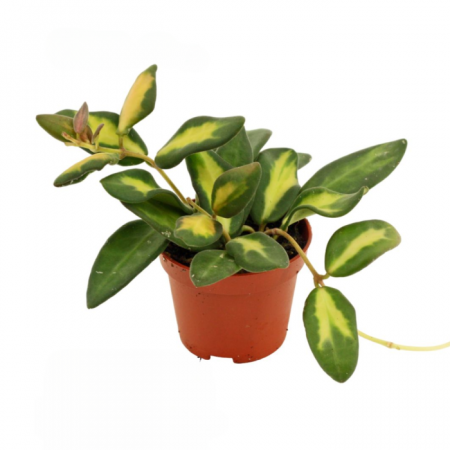
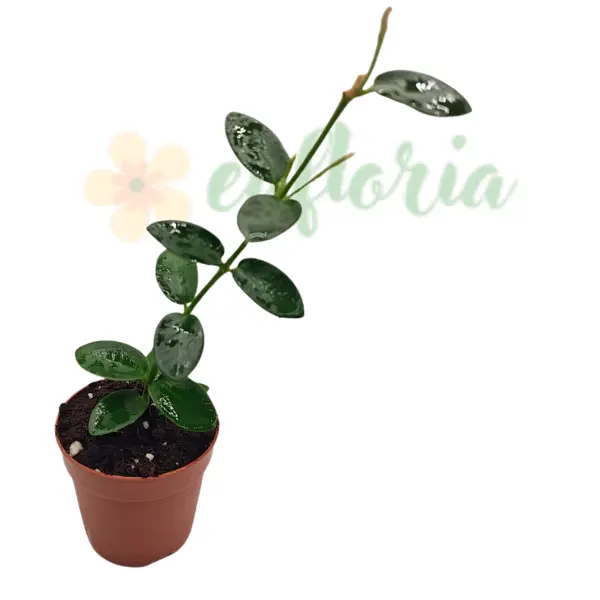
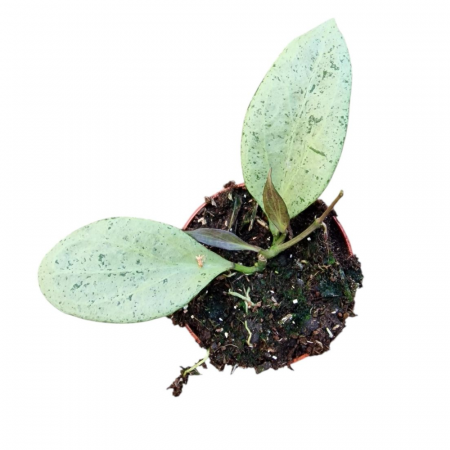
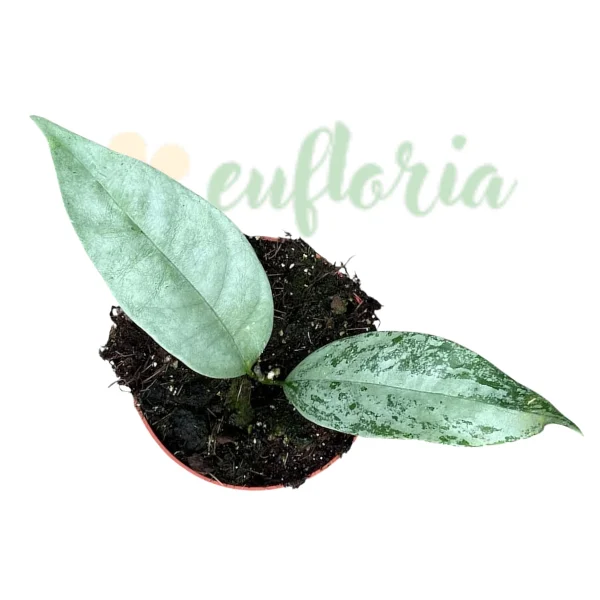
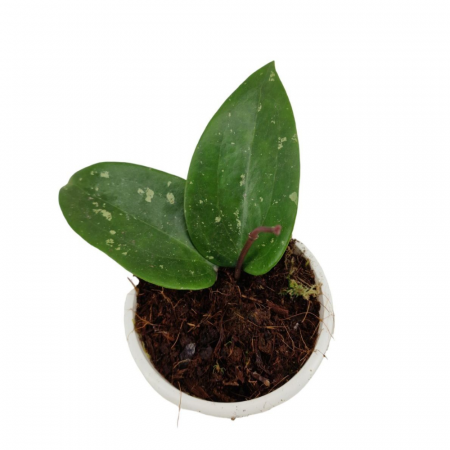
Hoya mathilde Inner Variegated is a rare hybrid between Hoya carnosa and Hoya serpens, prized for its small, round leaves with inner variegation that creates a luminous effect at the centre of each leaf. A collector’s plant with an elegant trailing habit, perfect for the enthusiast seeking rare Hoya varieties.
- Description
- Reviews (0)
- FAQ
🌿 The hidden beauty at the heart of every leaf — the story of a hybrid that conquered the collector world
Some plants win you over through sheer size, spectacular blooms, or absolute rarity. And then there is Hoya mathilde Inner Variegated — a plant that conquers through detail. Every leaf of this exceptional hybrid is a small universe unto itself: a luminous centre, almost glowing, in shades of cream or pale green, surrounded by a dark green margin that dramatically accentuates the contrast. This effect, known as inner variegation, transforms an already beautiful plant into a living work of botanical art.
Hoya mathilde is the result of crossing two legendary species from the Hoya world: Hoya carnosa, the undisputed queen of the genus, renowned for its longevity, robustness, and flowers of almost unreal beauty, and Hoya serpens, a Himalayan montane species with a uniquely miniaturised charm — tiny, round leaves covered in fine fuzz that gives them the appearance of botanical jewels. From this union emerged plants with small, perfectly round, thick, succulent leaves that combine the resilience of carnosa with the elegant delicacy of serpens.
The Inner Variegated variant brings this already remarkable hybrid an additional dimension of rarity and beauty. Unlike marginal variegation (where white or cream appears along the edges), inner variegation places the luminous zone right at the centre of the leaf, creating a hypnotic effect of "eyes" or "windows" through which you seem to glimpse another shade of green. This mutation occurs spontaneously in cultivation and is extremely difficult to stabilise — not all cuttings maintain the pattern, making every specimen with stable variegation a true treasure for collectors.
At Eufloria, we offer hand-selected specimens with strong, stable variegation, grown under controlled conditions to ensure a healthy start in their new home. Each plant is unique — the variegation pattern varies from leaf to leaf, guaranteeing that the piece you receive has no identical duplicate anywhere in the world.
🌍 Origin and botanical history — two parents, two continents, one perfect hybrid
To truly understand Hoya mathilde Inner Variegated, we must know the story of its two parents. Hoya carnosa was scientifically described by the Scottish botanist Robert Brown in 1810 in his monumental work "Prodromus Florae Novae Hollandiae." The species is native to East Asia — from southern China and Taiwan to northern Australia — growing in tropical and subtropical forests as an epiphyte, anchoring itself to tree trunks and drawing nutrients from the natural matter accumulated in bark crevices. It is one of the most widely cultivated Hoya species in the world, with over 200 years of history in European horticulture.
The second parent, Hoya serpens, was described by Sir Joseph Dalton Hooker in 1883 in "Flora of British India." This species hails from the montane forests of the Himalayas in India and Nepal, where it grows at remarkable altitudes of 1,500–2,000 metres. Unlike carnosa, serpens is a much rarer species in cultivation, with tiny leaves (under 2 cm) covered in fine trichomes that give it an irresistibly velvety appearance. Its flowers, though small, are considered among the most beautiful in the Hoya genus: globular, snow-white, with a delicate fragrance reminiscent of lily of the valley.
The Hoya mathilde hybrid was created through artificial crossing, likely in the 1990s–2000s, though the exact origin is not precisely documented. The name "mathilde" is a horticultural tribute — a common practice in the Hoya world, where hybrids receive elegant feminine names. The Inner Variegated variant emerged as a spontaneous somatic mutation, most likely in a meristematic node of a standard mathilde plant. Stabilising this mutation requires careful vegetative propagation: each cutting must contain at least one node with active variegation, and light conditions must be optimised to prevent reversion to the green form.
From a taxonomic perspective, Hoya mathilde belongs to the family Apocynaceae (formerly Asclepiadaceae), subfamily Asclepiadoideae. The genus Hoya numbers over 500 recognised species and hundreds of hybrids, but few have captured collectors' imaginations quite like this small hybrid with round leaves and inner variegation. On the international collector market, specimens with stable variegation command significant prices, confirming this plant's status as an authentic rarity.
🌱 The foliage — small round jewels with hearts of light
The leaves of Hoya mathilde Inner Variegated are, without exaggeration, among the most photogenic in the entire Hoya genus. Small, nearly perfectly round or slightly ovoid, measuring 1.5–2.5 cm in diameter, they possess a remarkable thickness that gives them a succulent texture, pleasant to the touch — firm yet not rigid, with a slight elasticity suggesting the water reserves stored within. The upper surface is covered in a thin waxy layer, characteristic of the Hoya genus, which lends them a subtle, elegant sheen, capturing and reflecting natural light in a way that shifts nuances throughout the day.
The defining trait of the Inner Variegated variant is, of course, the luminous centre of each leaf. Here, the partial absence of chlorophyll reveals tones of cream, pale yellow, lime green, or even greenish-white, depending on light intensity and leaf age. The margins remain dark green, sometimes with a slight greyish tone, creating a contrast that becomes more pronounced as the leaf matures. The visual effect is one of natural "eyes" or "windows" — looking at a branch full of leaves, the impression is of a string of green lanterns, each with a cream flame within.
Compared to related species such as Hoya curtisii (whose leaves have a more spatulate shape with prominent silver venation) or Hoya krohniana (with similar-sized leaves but a splash pattern on the surface), Hoya mathilde Inner Variegated distinguishes itself through its perfectly round shape and central variegation that has no equivalent in other species. Compared to Hoya serpens, one of its parents, the leaves are slightly larger and thicker, lacking the fine trichomes that give serpens its velvety look.
The leaf venation is fine and nearly invisible to the naked eye, concealed beneath the protective waxy layer. On young leaves, the central vein may be slightly more visible, but as the leaf matures and fully develops its waxy coating, the surface becomes almost uniformly smooth. The petioles are short (3–5 mm), connecting the leaves tightly to the main stem and creating a dense "garland" effect when the plant is grown on a support or in a hanging basket.
🌸 The flowers — fragrant porcelain-and-honey umbels
Like all species and hybrids in the Hoya genus, mathilde Inner Variegated has the capacity to produce flowers — and Hoya flowers are, without doubt, among the most fascinating in the plant kingdom. The blooms are grouped in umbels (globular inflorescences) composed of 10–20 individual miniature flowers, each approximately 8–12 mm in diameter. Colours range from pure white to pale pink, with a more intensely coloured centre (deep pink or reddish), and the petal texture is waxy, almost porcelain-like — hence the popular name "wax flower" attributed to many Hoya species.
The flower fragrance is one of the genus's greatest attractions. Hoya mathilde emits a sweet scent with notes of honey and vanilla that intensifies significantly in the evening and at night — an evolutionary strategy for attracting nocturnal pollinators. In a well-ventilated room, a single blooming umbel can perfume the space sufficiently to be perceptible from several metres away. Each umbel remains open for approximately 5–7 days, and under ideal conditions, the plant can produce multiple consecutive umbels throughout the warm season.
To encourage flowering, the plant requires several specific conditions: maturity (at least 2–3 years from planting), strong indirect light during the day, a winter rest period with slightly reduced temperatures (15–18°C) and less frequent watering, and — crucially — do NOT cut the old peduncles ("spurs"). Hoyas bloom on the same peduncles year after year. Cutting them eliminates the chance of flowering for months or even years to come. Additionally, avoid moving the plant while buds are forming — changing orientation relative to the light source can cause buds to drop before opening.
It is worth noting that inner variegation may slightly slow the flowering process compared to the standard form, as the plant produces less energy through photosynthesis. With patience and optimal conditions, the reward is all the more satisfying — an umbel of flowers on a branch with variegated leaves is a rare and memorable botanical spectacle.
🌱 Growth habit and development — patience and light, the recipe for success
Hoya mathilde Inner Variegated has a natural trailing habit, with thin but surprisingly resilient stems that grow continuously from the tip, producing a new leaf every 2–4 weeks during the active growing season. Stems can reach 50–100 cm in length over several years, branching spontaneously at nodes to create a dense, decorative mass of vegetation. Growth is moderate — slower than the standard green form because the variegated areas of the leaves produce less energy through photosynthesis. This is not a flaw but a feature: the slower pace allows appreciation of each new leaf, watching it unfurl and gradually reveal its unique variegated pattern.
The plant develops most beautifully in a hanging basket or on a high shelf, allowing the branches to cascade naturally in green waterfalls with luminous accents. Alternatively, it can be trained on a moss pole or small trellis, in which case it will develop slightly larger leaves due to the aerial roots' contact with the moist support surface. Whichever option you choose, the result will be an elegant botanical presence full of personality.
Care requirements are straightforward once you understand the principles:
- Light: Strong indirect light — this is the single most important requirement for maintaining variegation. A spot near an east- or west-facing window is ideal. Direct summer sunlight (between 11 am and 4 pm) can burn the leaves, especially the variegated zones which are more sensitive. Insufficient light leads to reversion: new leaves emerge completely green, without variegation. If you notice this sign, immediately move the plant to a brighter location.
- Temperature: 18–28°C optimal range. Tolerates brief periods at 12°C, but damage occurs below 10°C. Absolutely avoid cold draughts and sudden temperature fluctuations (do not place near open windows in winter or near air conditioning units).
- Watering: The golden rule for all Hoya species: allow the substrate to dry almost completely between waterings. Test with your finger — if the top 2–3 cm of substrate are dry, it is time to water. Summer: once every 7–10 days. Winter: once every 14–21 days. Overwatering is the primary cause of Hoya plant loss. Always use room-temperature water.
- Humidity: 50–70% ideal. Tolerates lower humidity (40%), but variegation is stronger at higher humidity. A humidifier near your plant collection works wonders. Avoid direct misting on leaves — standing water on waxy leaves can cause spots.
- Substrate: A very well-draining mix is essential. Recommendation: 40% pine bark (medium grade), 30% perlite, 20% coco chips, 10% activated charcoal. Similar to the special Hoya substrate available at Eufloria. Standard potting soil retains too much water and will cause root rot.
- Fertilising: Balanced liquid fertiliser (NPK 20-20-20) diluted to half the recommended concentration, once a month during the active growing period (March–September). Do not fertilise during the cold season or recently transplanted plants.
- Propagation: Through stem cuttings with at least one node and one variegated leaf. Place in clean water (changed every 2–3 days) or moist sphagnum. Rooting takes 3–6 weeks. Important: choose ONLY stems with strong variegation — cuttings from reverted branches will produce green plants. Spring and early summer are the best periods for propagation.
How do I maintain the variegation on Hoya mathilde Inner Variegated?
How often should this plant be watered?
Is Hoya mathilde Inner Variegated toxic to pets?
What is the best substrate for this Hoya?
Can Hoya mathilde Inner Variegated bloom indoors?
Ai nevoie și de un ghiveci decorativ?