EN/
EN/ Romana
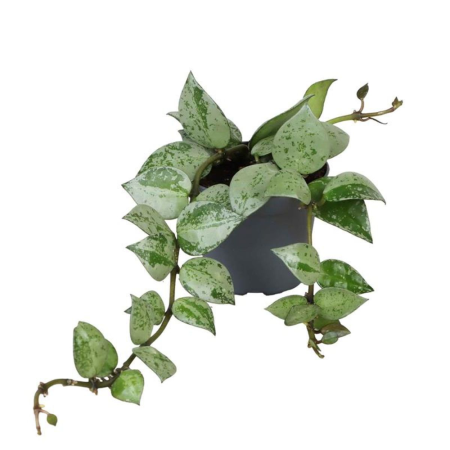
Hoya Carnosa 'Stardust' Ø10.5cm
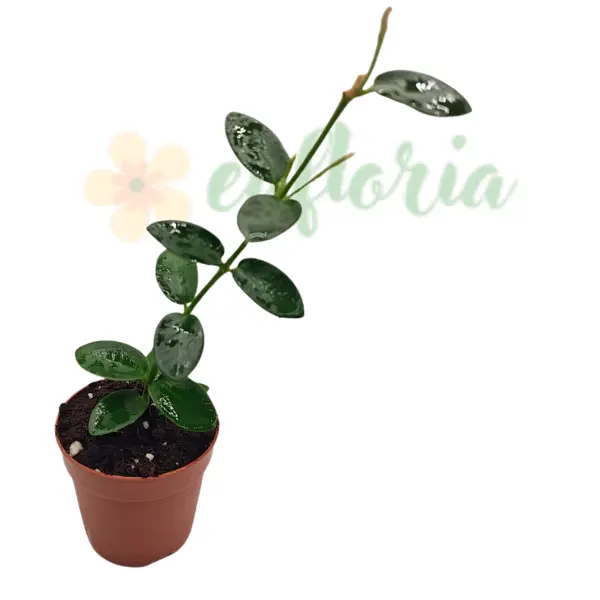
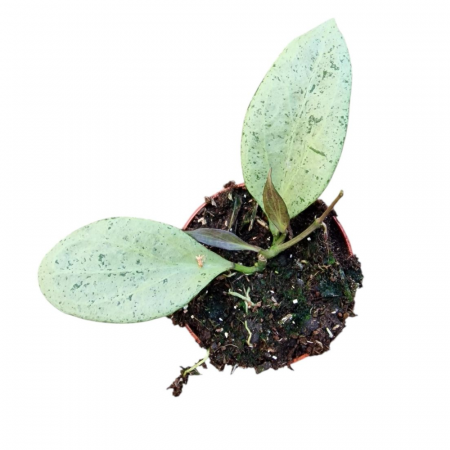
![Hoya carnosa Stardust - epiphytic plant with silver-speckled leaves [1]](https://gomagcdn.ro/domains2/eufloria.ro/files/product/original/hoya-carnosa-stardust-d10-5-153695.png "Hoya carnosa Stardust - epiphytic plant with silver-speckled leaves [1]")
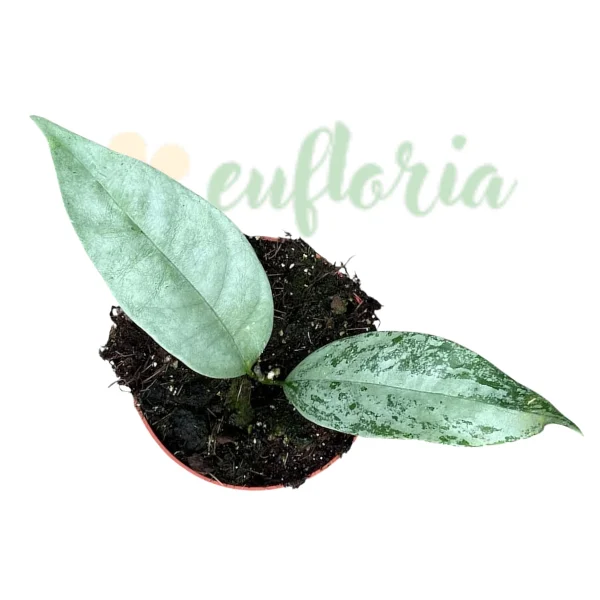
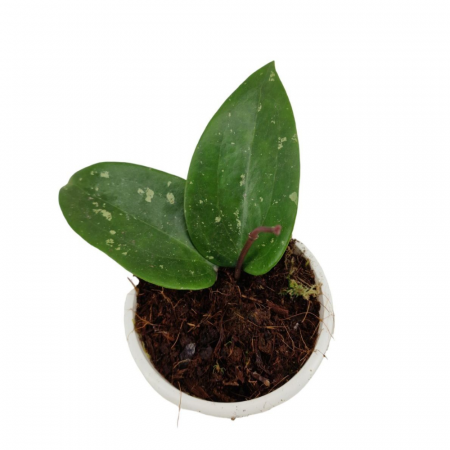
Hoya carnosa ‘Stardust’ is a rare cultivar of Hoya carnosa, native to East Asia and Australia, distinguished by its thick, waxy oval leaves speckled with distinctive silver star-like spots that glisten beautifully in the light. As an epiphytic vine, it produces dense clusters of small, star-shaped white-pink flowers with a warm caramel-vanilla fragrance after 1–2 years of cultivation. Non-toxic and adaptable, this collector’s Hoya thrives in bright indirect light and is ideal for hanging baskets or decorative supports, making it a perfect choice for plant lovers across the EU who seek an exotic yet easy-to-maintain houseplant.
Approx height (including pot): 15 cm
Flowering state: No flowers
Pot diameter: 10.5 cm
- Description
- Characteristics
- Reviews (0)
🌿 Hoya Carnosa ‘Stardust’ — When Nature Paints with Silver and Fragrance
There are plants that fill your home with greenery, and there are plants that fill your life with stories. Hoya carnosa ‘Stardust’ belongs to the latter category — a climbing indoor vine that carries in every leaf something of the magic of the night sky, with silvery speckles that glisten in the light as though a patient artist had scattered stardust across the dark green canvas of its foliage. This remarkable cultivar of Hoya carnosa stands out through a striking visual contrast: against a deep, dense, succulent green background, thousands of silver points create a hypnotic pattern, almost mineral in intensity, yet perfectly natural in its expression. This is not conventional variegation, but the presence of specialized epidermal cells with large air-filled vacuoles that reflect light differently from the rest of the leaf surface — a fascinating botanical mechanism, subtle in its science, spectacular in its visual result.
Hoya enthusiasts know it as one of those varieties that “gets you” — once you have seen it in bloom, once you have caught the warm caramel-vanilla scent of its flowers drifting through a room at dusk, it becomes difficult to pass by a specimen without pausing. There is an almost narrative quality to the way Hoya carnosa ‘Stardust’ grows indoors: slow, methodical, building year by year a presence that grows more impressive with time, until its long, flexible vining stems transform a shelf, a windowsill or a hanging basket into a corner of a private botanical greenhouse. It is a plant for those who have patience and are generously rewarded: after one to two years of consistent care, it produces dense clusters of star-shaped flowers, each bearing a central corona with deeper-colored margins against pale petals — a botanical jewel in miniature.
🌍 Botanical Origins and History
Hoya carnosa (R.Br.) is one of the most widely known species in the genus Hoya, family Apocynaceae, subfamily Asclepiadoideae. It was first described by Scottish botanist Robert Brown in his work Prodromus Florae Novae Hollandiae et Insulae Van Diemen in 1810, based on specimens collected from northeastern Australia. Subsequently, the natural distribution of the species was found to be far more extensive: Hoya carnosa grows natively across a broad range covering southern China (Fujian, Guangdong, Guangxi, Guizhou and Yunnan provinces), Taiwan, southern Japan (Ryukyu Islands), South Korea, Vietnam, the Philippines and northern Australia.
The genus Hoya was named in honor of the British botanist Thomas Hoy (1750–1821), head gardener at Syon House in London and an avid collector of exotic plants. The specific epithet carnosa (from Latin: “carnous”, meaning “fleshy, succulent”) refers to the thick, waxy texture of the leaves. In its natural habitat, Hoya carnosa is an epiphytic or hemi-epiphytic plant, growing on tree trunks and branches in tropical and subtropical forests from sea level to approximately 1,800 metres altitude. The ‘Stardust’ cultivar emerged in cultivation during the second half of the twentieth century through selection of plants with more pronounced silver speckling. The genetic mechanism behind the silver spots involves epidermal cells with large air-filled vacuoles that create the optical effect of “glittering” through diffuse light reflection — the more intense the light, the more pronounced the silver effect.
🌱 Foliage
The leaves of Hoya carnosa ‘Stardust’ are the true spectacle of this plant. Oval to elliptic in shape, 5–9 cm long and 3–5 cm wide, they have a distinctive texture: thick, slightly succulent to the touch, with a gently waxy surface bearing that subtle sheen characteristic of plants that do not need to shout for attention. The base colour is a deep, intense green that creates maximum contrast with the silver speckling. The silver spots are distributed unevenly, denser toward the midrib area and sparser toward the margins, creating an asymmetric, natural visual texture. Each leaf carries a unique pattern, like a botanical fingerprint. In strong light, from certain angles, the leaves appear to emit their own glow — a fascinating optical effect that intensifies with the age of the plant. Young leaves, on emergence, are slightly paler and less speckled, gaining chromatic intensity as they mature. Mature leaves can remain on the plant for years without losing their vitality — a characteristic trait of Hoya, which builds its foliar structure slowly but durably.
🌸 Flowers
The flowering of Hoya carnosa ‘Stardust’ is an event that first-time witnesses invariably describe as a surprise. The floral umbel forms on persistent peduncles known as “spurs” — structures that must never be removed, as the plant re-blooms on the same peduncle year after year. Each umbel contains 20–40 individual flowers arranged radially, forming a perfect spherical structure 5–8 cm in diameter that hangs elegantly from the vine. Individual flowers are small (1.0–1.5 cm), but structurally complex: five waxy petals, white or pale pink, surrounding a central corona of deeper pink with darker-edged margins. The fragrance is what transforms flowering into a multi-sensory experience: discreet during the day, it intensifies at dusk and in the early evening hours, releasing warm caramel and creamy vanilla notes, sometimes with a subtle floral background reminiscent of jasmine. In warm summer conditions, a single umbel can delicately perfume an entire room. Flowering duration: 2–4 weeks per umbel, with the possibility of re-blooming on the same spurs in subsequent seasons.
🌱 Growth Habit and Care
Hoya carnosa ‘Stardust’ grows as an epiphytic vine, producing long, flexible stems with internodes of 5–15 cm. Growth rate is moderate — in one year with good light and regular fertilisation, a plant may add 30–60 cm of new stem. It is excellent as a hanging plant (in a basket or hanging pot, letting the stems trail freely) or trained on a decorative circular support or hoop. Young shoots emerge reddish-bronze before developing their characteristic green colour as they mature.
- Light: Bright indirect light, within 1 metre of an east- or south-facing window. A few hours of gentle morning sun are beneficial, but avoid harsh midday rays. More intense light enhances the silver speckling and promotes flowering.
- Temperature: Optimal 18–27°C. Tolerates a minimum of 10°C for short periods, but growth stops below 12°C. A cooler winter period (13–16°C) can help stimulate flowering.
- Watering: Allow the top 2–4 cm of substrate to dry between waterings. In summer, water every 7–14 days. In winter, reduce to once every 3–4 weeks. Use room-temperature water. A pot with drainage holes is essential — waterlogging at the roots is the most common risk.
- Humidity: Adapts to typical household humidity (40–50%), but thrives at 50–70%. In winter with central heating, a humidifier or a pebble tray with water beneath the pot helps considerably. Avoid misting directly onto leaves as this can leave limescale marks.
- Substrate: Well-draining mix: 50% perlite + 25% orchid bark + 25% sphagnum moss. Alternatively, standard potting mix + 40% perlite works well. Optimal pH: 5.5–6.5. Repot in spring, only when roots emerge from the drainage holes.
- Fertilisation: Balanced liquid fertiliser (NPK 20-20-20) or a formula higher in phosphorus for flowering plants, diluted to half the recommended dose, once every 3–4 weeks in spring and summer. Do not fertilise in autumn and winter.
- Propagation: Stem cuttings with 2–3 nodes, placed to root in moist perlite or water. Rooting takes 4–8 weeks at 22–25°C with bright indirect light. Cut below a node, not through it. Do not use flowering spurs for cuttings.
Lungime: 15 cm
Greutate (kg): 0.5 Kg
Denumire: Hoya
Diametru: 10.5 cm
Cerințe lumină: Partial umbra
Tip plantă: Decorative
Utilizare: Interior
Tip suport: Ghiveci
Material Suport: Plastic
Ai nevoie și de un ghiveci decorativ?