EN/
EN/ Romana
Mimosa pudica Ø8cm
![Mimosa pudica - sensitive plant with finely compound leaves that fold at touch and pink-violet pom-pom flowers [0]](https://gomagcdn.ro/domains2/eufloria.ro/files/product/medium/mimosa-pudica-d8-853800.webp "Mimosa pudica - sensitive plant with finely compound leaves that fold at touch and pink-violet pom-pom flowers [0]")
![Mimosa pudica - sensitive plant with finely compound leaves that fold at touch and pink-violet pom-pom flowers [1]](https://gomagcdn.ro/domains2/eufloria.ro/files/product/medium/mimosa-pudica-d8-474415.webp "Mimosa pudica - sensitive plant with finely compound leaves that fold at touch and pink-violet pom-pom flowers [1]")
![Mimosa pudica - sensitive plant with finely compound leaves that fold at touch and pink-violet pom-pom flowers [1]](https://gomagcdn.ro/domains2/eufloria.ro/files/product/original/mimosa-pudica-d8-853800.webp "Mimosa pudica - sensitive plant with finely compound leaves that fold at touch and pink-violet pom-pom flowers [1]")
![Mimosa pudica - sensitive plant with finely compound leaves that fold at touch and pink-violet pom-pom flowers [2]](https://gomagcdn.ro/domains2/eufloria.ro/files/product/original/mimosa-pudica-d8-474415.webp "Mimosa pudica - sensitive plant with finely compound leaves that fold at touch and pink-violet pom-pom flowers [2]")
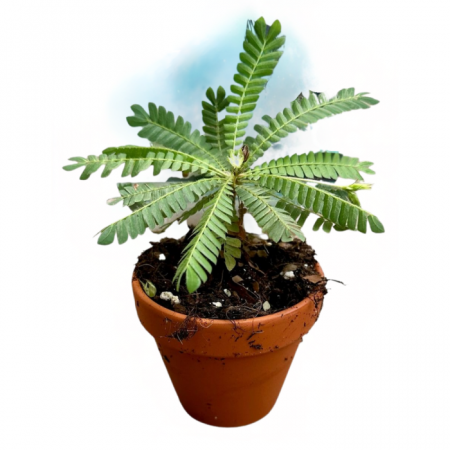
Mimosa pudica, also known as the sensitive plant or shameful plant, is a fascinating species from the Fabaceae family that instantly folds its small compound leaves when touched or moved. It produces pink-violet pom-pom flowers in summer. An interactive plant, perfect for children and as a living botanical experiment.
Pot diameter: 8 cm
- Description
- Reviews (0)
- FAQ
🌿 The Plant That Blushes at a Touch — an Interactive Botanical Miracle
Mimosa pudica is, without doubt, one of the most fascinating plants on Earth. Not just for the beauty of its delicate, finely compound foliage, or its pink-violet flowers resembling small magical pom-poms, but especially for its almost animal-like behavior: at the slightest touch, the leaves fold rapidly and visibly, as if the plant were shy or withdrawing its hands.
This spectacular phenomenon, called seismonasty or thigmonasty, occurs thanks to specialized cells (pulvini) at the base of each leaf. Upon tactile or thermal stimulus, these cells rapidly release water, causing the leaf to collapse. After a few minutes, the cells refill and the leaves reopen. It is a plant that turns every corner of a home into a small living experiment, fascinating both children and adults.
In English, Mimosa pudica is popularly known as the "sensitive plant," "shy plant," or "shameful plant." Native to Central and South America, this species is now cultivated worldwide as a houseplant — not only for its decorative appearance, but for the unique experience of interacting with the plant world. A perfect plant for children, biology teachers, and any plant lover seeking something truly special.
🌍 Origin and Botanical History
Mimosa pudica L. was officially described by Carl Linnaeus in 1753, in the famous work Species Plantarum that founded modern botanical systematics. The specific epithet "pudica" comes from Latin and means "shy," "shameful," or "modest" — a direct reference to the plant's seismonastic behavior. The species belongs to the Fabaceae family (legumes), the same family as peas, beans, and many other food plants.
The natural distribution range includes tropical and subtropical regions of Central America (Mexico, Guatemala, Honduras, Nicaragua, Panama) and South America (Brazil, Peru, Venezuela, Colombia, Bolivia). In these areas, the plant grows as an annual or short-lived perennial in open places, roadsides, sparse tropical forests, and disturbed land, at altitudes of 0-1500 m.
Today, Mimosa pudica has spread to tropical Africa, Southeast Asia, and Oceania as a naturalized species. In many tropical regions it is considered an invasive plant or even an agricultural weed, due to its rapid growth and resilience. In apartment cultivation, the plant retains this vigor: it grows quickly from seed and can flower in just 3-4 months.
🌱 The Foliage
The leaves are the star element of this plant — not only because they are delicate and beautiful, but because they are protagonists in the seismonastic phenomenon that made the plant famous. Each leaf is bipinnately compound, consisting of 4-8 pairs of secondary leaflets, each in turn containing 15-25 small tertiary leaflets in light green, symmetrical, with an appearance similar to fern leaves or delicate feathers.
The reaction to touch is astonishing: when a leaf is mechanically stimulated (touch, vibration, strong wind) or thermally (sudden heat, flame), the leaflets fold rapidly in pairs and then the entire compound leaf closes. Within 1-2 seconds, an entire leaf can appear almost invisible. After 5-15 minutes, the plant "wakes up" and the leaves reopen.
The foliage color is light green under moderate light conditions, taking on reddish-bronze tints under direct sun or environmental stress. At night, the leaves fold naturally (a phenomenon called nyctinasty) — a different behavior from tactile seismonasty, which also shows the plant's sensitivity to day-night cycles. The stems are herbaceous, with fine small thorns, and can reach 40-80 cm in height under ideal conditions.
🌸 The Flowers
Mimosa pudica produces small but spectacular flowers grouped in spherical inflorescences called capitula, pom-pom shaped. Each capitulum is approximately 1-1.5 cm in diameter and contains dozens of tiny flowers with long pink-violet stamens that give them the characteristic fluffy appearance.
Flower color varies from pale pink to intense pink-violet, sometimes with magenta hues. The blooming period is long, usually summer-autumn (June-October), with continuous flowering in cycles: new capitula appear constantly under optimal conditions. Flowers open in the morning and emit a fine, subtle, sweet fragrance perceptible at close range.
After flowering, the plant produces small pods with a few seeds — excellent material for propagation, as Mimosa pudica germinates easily from seed, within 1-2 weeks after scarification. In apartment cultivation, the plant lives as a short-lived perennial (1-3 years), but can be easily regrown from its own seeds.
🌱 Growth and Development
Mimosa pudica is an annual or short-lived perennial (1-3 years in apartment cultivation) with rapid growth and moderate vigor. In the first months it can reach 15-25 cm in height, and at maturity (3-5 months) it reaches 40-60 cm. The habit is herbaceous to semi-woody, with fine stems that branch naturally. Under ideal light and warmth conditions, it flowers within 3-4 months of germination.
It is a relatively easy-to-care-for plant if several key conditions are respected: bright light, warmth (20-28°C), moderate watering, and atmospheric humidity above 50%. It does not tolerate complete substrate drying and does not endure temperatures below 15°C. In autumn-winter, growth slows dramatically, and after 2-3 years the plant naturally ages and dry patches may appear.
- Light: Bright indirect light or direct morning/evening sun (2-4 hours). East or west-facing windows ideal. South window with thin curtain. Insufficient light — the plant stretches toward light and does not flower.
- Temperature: Optimal 20-28°C. Minimum tolerated 15°C. Does not withstand frost, cold drafts, or cold air from air conditioning. Stable temperature above 22°C promotes flowering.
- Watering: Substrate must be consistently moist but not saturated. Summer — every 2-3 days. Winter — every 5-7 days. Do not let it dry completely, as the leaves wither rapidly.
- Humidity: 50-70% ideal. Tolerates average humidity (40%), but leaves decline faster in dry air. Occasional misting helps.
- Substrate: Universal houseplant substrate with good drainage — mix 70% peat/coco fiber + 30% perlite.
- Fertilization: Balanced liquid fertilizer at half dose, once every 3-4 weeks during the growing season (April-September). Excess nitrogen is harmful.
- Propagation: Very easy from seed — scarify the seed, soak 24h in warm water, then sow in moist substrate. Germination in 7-14 days. Young plants flower in 3-4 months.
Why do Mimosa pudica leaves close when I touch them?
Mimosa pudica reacts to touch through a phenomenon called seismonasty. Upon mechanical stimulus, the cells at the base of the leaflets (pulvinus) rapidly lose potassium, water shifts osmotically, turgor pressure drops, and the leaflets fold within seconds. This response protects the plant from herbivores and water loss in strong wind. After 5-15 minutes, if the stimulus has ceased, the leaflets return to their original position. Repeated touching in a short time can temporarily exhaust the plant — give it breaks between demonstrations.
Is Mimosa pudica toxic for children or pets?
Mimosa pudica is considered mildly toxic. It contains mimosine, a non-protein amino acid present in all parts of the plant, more concentrated in the seeds. In small amounts it poses no significant risk, but consuming large amounts of leaves or seeds can cause digestive upset, excessive salivation, or, in animals, hair loss (alopecia). We recommend placing it in a spot accessible for observation but out of reach of very young children or pets that might bite the leaves.
How often should Mimosa pudica be watered?
Mimosa pudica prefers consistently slightly moist substrate, never soaked. In spring and summer, water regularly when the top 1-2 cm of substrate begins to dry — usually every 2-3 days depending on temperature and light. In winter, reduce frequency to once a week or less, letting the substrate dry more between waterings. Use room-temperature water, ideally decanted or rainwater. Prolonged drying causes leaflet drop; overwatering promotes root rot.
What light does Mimosa pudica need and can it be placed in direct sun?
Mimosa pudica loves bright light and moderate direct sun — its tropical origin sees it growing in sunny clearings of Central and South America. Best spot: east or south-east window with a few hours of morning sun. Under strong midday summer sun, leaves can wilt or scorch — protect with a sheer curtain. Insufficient light makes the plant leggy and weak (etiolated) and reduces touch sensitivity. For flowering (pink-violet pom-poms in summer), it needs at least 6 hours of bright light per day.
How long does Mimosa pudica live and can it be propagated at home?
In indoor cultivation, Mimosa pudica is generally treated as an annual or biennial — it retains its vigor for 1-2 years, after which it becomes woody and less reactive. Propagation at home is very simple through seeds: scarify them lightly with sandpaper or soak them in warm water for 12-24 hours, then sow them 1 cm deep in coco coir or peat substrate at 22-26°C. Germination occurs in 7-14 days. To prolong its life, cut the inflorescences after wilting — this redirects energy to foliage rather than seed formation. See also our collection of easy-care plants.
Ai nevoie și de un ghiveci decorativ?