EN/
EN/ Romana
Hoya 'Crassipetiolata Splash' Ø10.5cm
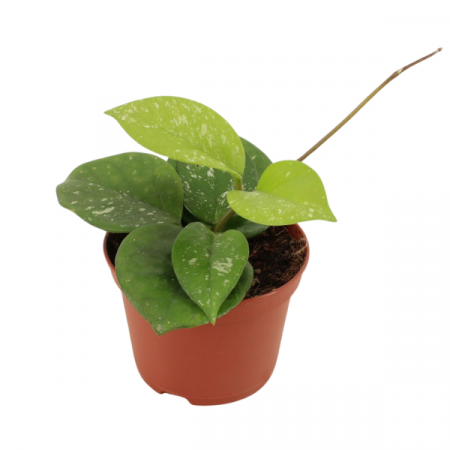
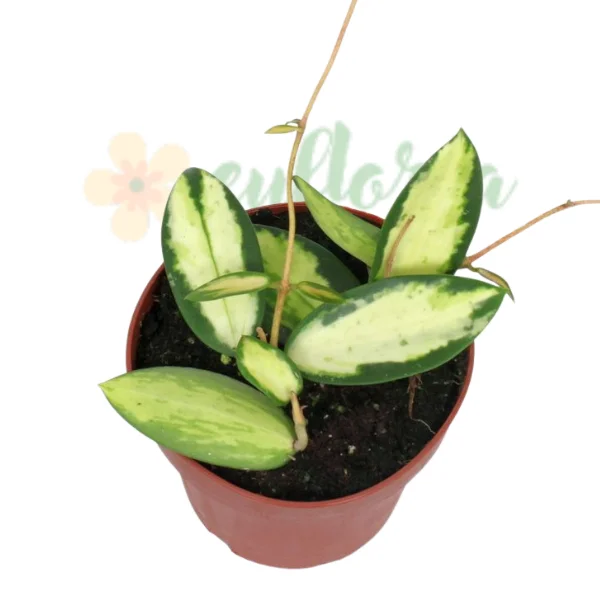
![Hoya crassipetiolata 'Splash' — rhombic-elliptical leaves with silver tessellation and thick petiole, Ø10.5cm pot | Eufloria [0]](https://gomagcdn.ro/domains2/eufloria.ro/files/product/medium/hoya-crassipetiolata-splash-d10-5-231826.png "Hoya crassipetiolata 'Splash' — rhombic-elliptical leaves with silver tessellation and thick petiole, Ø10.5cm pot | Eufloria [0]")
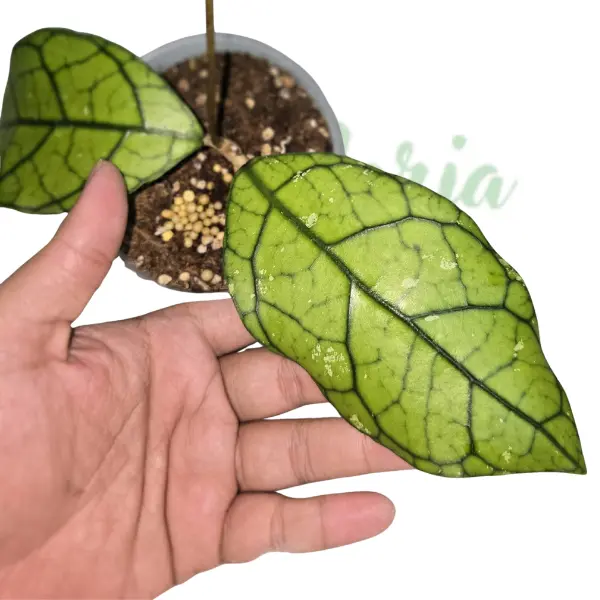
![Hoya crassipetiolata 'Splash' — rhombic-elliptical leaves with silver tessellation and thick petiole, Ø10.5cm pot | Eufloria [1]](https://gomagcdn.ro/domains2/eufloria.ro/files/product/medium/hoya-crassipetiolata-splash-d10-5-579808.png "Hoya crassipetiolata 'Splash' — rhombic-elliptical leaves with silver tessellation and thick petiole, Ø10.5cm pot | Eufloria [1]")
![Hoya crassipetiolata 'Splash' — rhombic-elliptical leaves with silver tessellation and thick petiole, Ø10.5cm pot | Eufloria [1]](https://gomagcdn.ro/domains2/eufloria.ro/files/product/original/hoya-crassipetiolata-splash-d10-5-231826.png "Hoya crassipetiolata 'Splash' — rhombic-elliptical leaves with silver tessellation and thick petiole, Ø10.5cm pot | Eufloria [1]")
![Hoya crassipetiolata 'Splash' — rhombic-elliptical leaves with silver tessellation and thick petiole, Ø10.5cm pot | Eufloria [2]](https://gomagcdn.ro/domains2/eufloria.ro/files/product/original/hoya-crassipetiolata-splash-d10-5-579808.png "Hoya crassipetiolata 'Splash' — rhombic-elliptical leaves with silver tessellation and thick petiole, Ø10.5cm pot | Eufloria [2]")
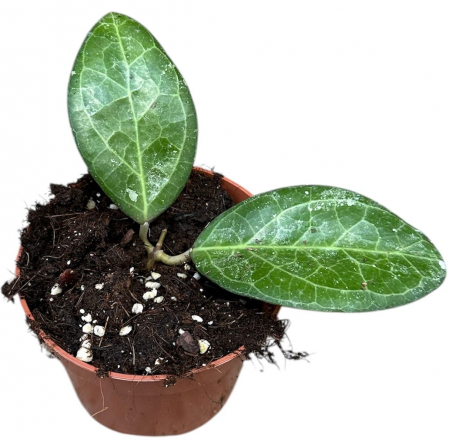
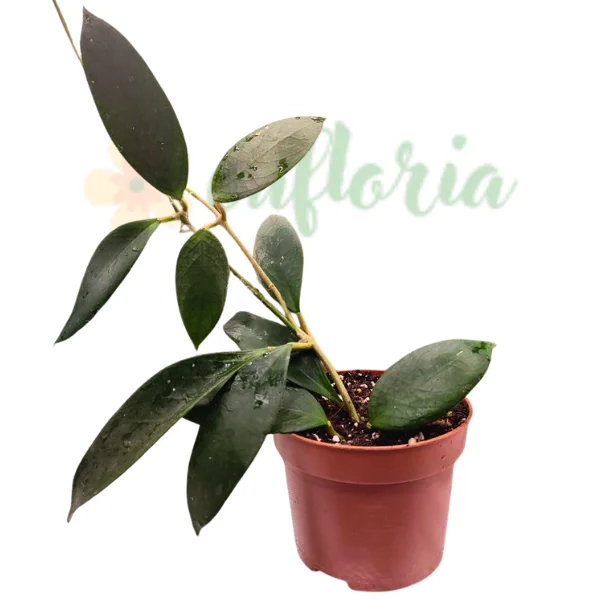
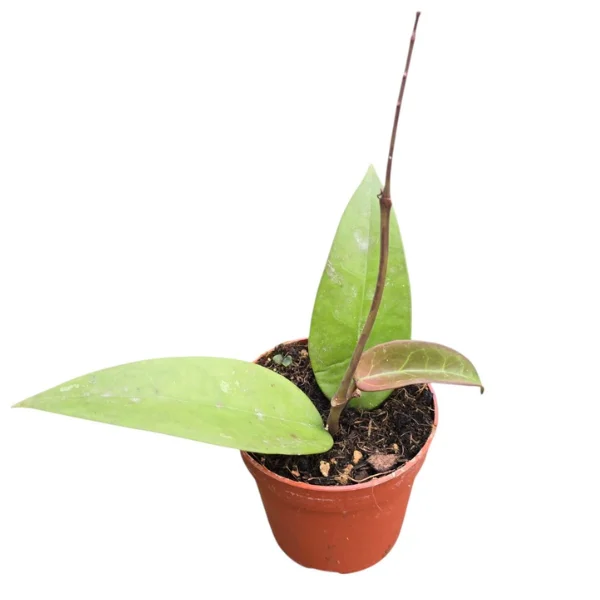
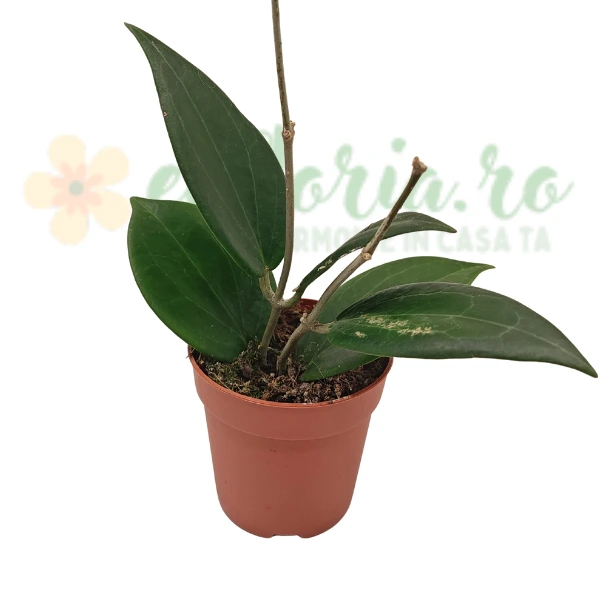
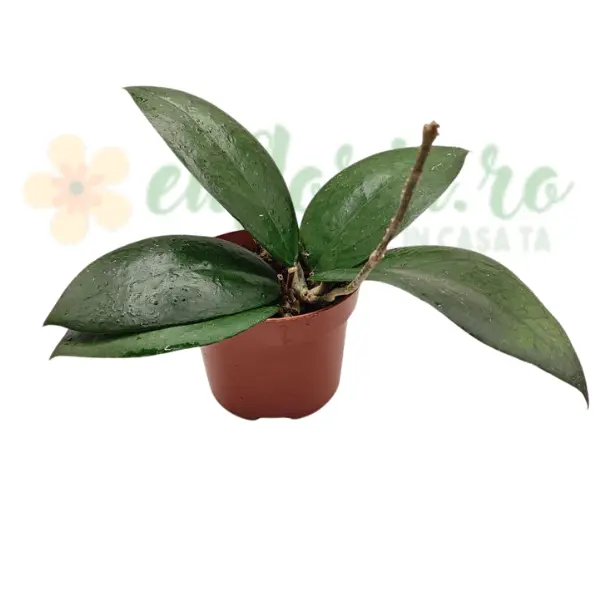
Hoya crassipetiolata 'Splash' — species endemic to Vietnam, described 2017. Rhombic-elliptical leaves with silver tessellation between veins and remarkably thick petiole (diagnostic feature). Small odorless white flowers. Ø10.5cm pot.
Approx height (including pot): 15 cm
Flowering state: No flowers
Country of origin: Netherlands
- Description
- Characteristics
- Reviews (0)
- FAQ
🌿 Hoya crassipetiolata 'Splash' — silver tessellation from Vietnam's karst forests
Hoya crassipetiolata Aver., V.T.Pham & T.A.Le is an epiphytic vine endemic to Vietnam, officially described relatively recently (2017) in the journal Turczaninowia. Apocynaceae family. The species name comes from Latin — crassus ("thick") + petiolus ("petiole") — and describes the main diagnostic feature: the petioles are remarkably thick, often twice the stem diameter. The 'Splash' form is a commercial name for clones with pronounced silver tessellation on the upper surface. It is part of our Hoya collection.
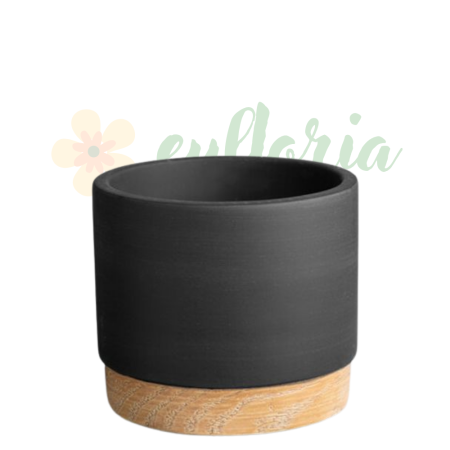
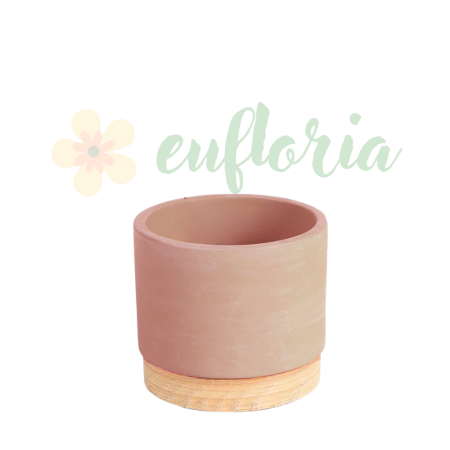
Our specimen comes in a Ø10.5cm nursery pot, perfect to be moved into a decorative ceramic pot of the same size.
🌍 Origin and taxonomic description
Hoya crassipetiolata is endemic to primary broad-leaved evergreen forests in northern, central, and southern Vietnam (Bac Kan, Dien Bien, Khanh Hoa, Quang Binh, Quang Tri provinces). The typical habitat is karst limestone substrate — on steep slopes, rocks, and mossy tree trunks, at altitudes between 10 and 1400 m. The species was collected by Averyanov, Pham, and Le in 2016 and officially described in 2017; the IUCN conservation status is DD (Data Deficient).
Unlike Hoya carnosa 'Krimson Queen' with structural variegation on the margins, crassipetiolata 'Splash' shows a silver pattern between the veins (white-greenish tessellation) — a trait that appears naturally in the species, but is intensified in clones selected as 'Splash' or 'Super Splash'. The 'Splash' name is not an officially registered ICRA cultivar, but a commercial designation for material with pronounced pattern.
🌱 Foliage — thick petiole and silver tessellation
The leaves of Hoya crassipetiolata 'Splash' are rhombic-elliptical, shortly acuminate at base and apex, with typical dimensions 5.5-9.5 cm long × 2.5-4 cm wide. The texture is fleshy-coriaceous, firm. The base colour is green with white-greenish/silver tessellation distributed between the veins — a pattern that appears in irregular spots, the intensity varying from leaf to leaf and depending on the amount of light received. On the underside, the lamina is pale green to white.
The universally recognized diagnostic feature remains the very thick petiole (2.8-5 mm in diameter, often double the stem diameter), curved or twisted, 0.8-2 cm long. The stems are thin, wiry, flexuous, grey-green, long (1.5-6 m at maturity), climbing through adventitious roots. The internodes are long (8-18 cm) — the habit is typical of an epiphytic climbing vine, suitable for hanging pots, baskets, or moss poles.
🌸 Inflorescences — small white flowers without scent
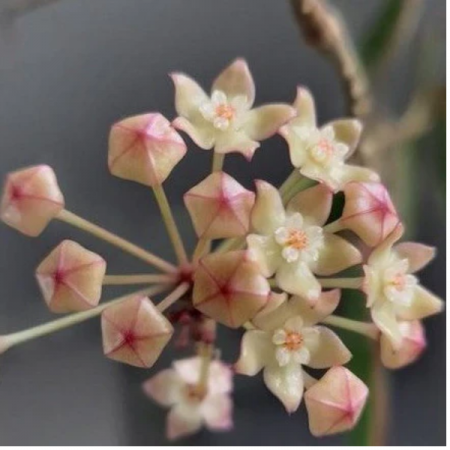
The flowers are grouped in extra-axillary, multi-flowered umbels, arranged on peduncles of 2-8 cm. The individual flowers are small (1.5-1.8 cm in diameter), with white corolla with greenish or pale pink lobes, strongly reflexed petals, and the central corona is pure white or with a pale pink tint. Unlike most Hoya species, the flowers are odorless according to the original description in the taxonomic protologue — a rarely encountered trait in the genus.
The flowering cycle repeats on the same perennial peduncles, reblooming for 2-3+ consecutive years from the same rhachis — do not break off dried inflorescences. Natural flowering occurs May-August. See more flowering indoor plants.
🌞 Care Requirements — Complete Guide
- Light: bright indirect; moderate direct sun can intensify the silver pattern and may give red-purple tints to the leaves — progressive acclimation needed. Avoid intense midday sun in summer.
- Temperature: optimal 16-29°C. Tolerates a wide range due to distribution across varied altitudes (10-1400 m) in Vietnam.
- Watering: let the upper substrate dry between waterings. As an epiphytic species, sensitive to standing water; summer every 7-10 days, winter every 14-20 days.
- Humidity: moderate to high (50-80%) — comes from humid tropical forests.
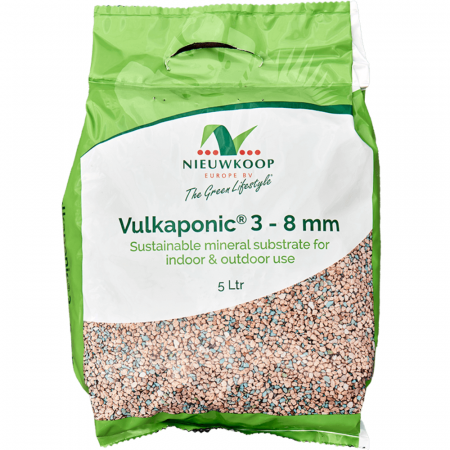
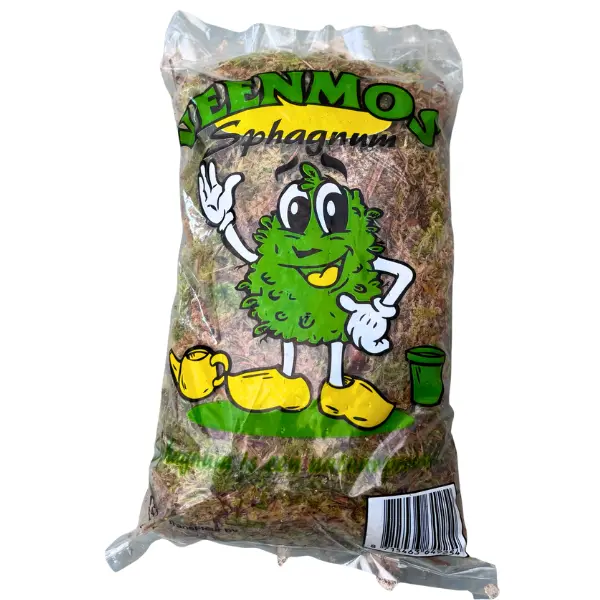
- Substrate: well-drained, epiphytic — a mix of medium pine bark (50%), natural sphagnum (20%), perlite (20%), and a drainage layer of Vulkaponic at the pot base (10%).
- Fertilising: monthly spring-summer with a mild formula for flowering plants (NPK 6-10-8).
- Propagation: stem cuttings with 1-2 nodes in moist sphagnum; roots in 4-6 weeks.
🐾 Toxicity and Home Safety
The Hoya genus is considered non-toxic according to the ASPCA database, being safe for dogs, cats, and children. The milky sap, common in the Apocynaceae family, may cause minor skin irritation in very sensitive individuals — a pair of gloves is enough at repotting. Hoya crassipetiolata is thus featured among our child- and pet-friendly plants.
🎓 Why Choose Hoya crassipetiolata 'Splash'
It is a top species for collectors who appreciate plants with recent and clear taxonomic identity — officially described in 2017, without synonyms, with accessible protologue. The unmistakable feature of the thick petiole + the silver pattern between the veins makes it a botanical statement for botanical rarity enthusiasts. Unlike generic species, crassipetiolata offers added value through the recent discovery history (Vietnam, karst forests) and through the flexible habit. It integrates beautifully into the rare Hoya collection and is a solid option for office plants or easy-care plants with ornamental pattern.
📚 Read also
Lungime: 20 cm
Greutate (kg): 0.5 Kg
Denumire: Hoya
Diametru: 10.5 cm
Cerințe lumină: Partial umbra
Tip plantă: Decorative
Utilizare: Interior
Tip suport: Ghiveci
Material Suport: Plastic
Why is the species called "crassipetiolata"?
Is the "Splash" form an official cultivar?
Are the flowers fragrant?
How often should I water it?
Is Hoya crassipetiolata safe for cats and dogs?
Recommendations


Ai nevoie și de un ghiveci decorativ?