EN/
EN/ Romana
Begonia 'Two Face' Ø8cm
![Begonia Two Face - decorative indoor begonia with bicolour green and burgundy foliage [0]](https://gomagcdn.ro/domains2/eufloria.ro/files/product/medium/begonia-two-face-d8cm-863480.jpg "Begonia Two Face - decorative indoor begonia with bicolour green and burgundy foliage [0]")
![Begonia Two Face - decorative indoor begonia with bicolour green and burgundy foliage [1]](https://gomagcdn.ro/domains2/eufloria.ro/files/product/medium/begonia-two-face-d8cm-941589.jpg "Begonia Two Face - decorative indoor begonia with bicolour green and burgundy foliage [1]")
![Begonia Two Face - decorative indoor begonia with bicolour green and burgundy foliage [1]](https://gomagcdn.ro/domains2/eufloria.ro/files/product/original/begonia-two-face-d8cm-863480.jpg "Begonia Two Face - decorative indoor begonia with bicolour green and burgundy foliage [1]")
![Begonia Two Face - decorative indoor begonia with bicolour green and burgundy foliage [2]](https://gomagcdn.ro/domains2/eufloria.ro/files/product/original/begonia-two-face-d8cm-941589.jpg "Begonia Two Face - decorative indoor begonia with bicolour green and burgundy foliage [2]")
Approx height (including pot): 20 cm
Pot diameter: 8 cm
- Description
- Characteristics
- Reviews (0)
- FAQ
🌿 Begonia 'Two Face' – a plant of two faces, one single charm
Begonia 'Two Face' is one of the most spectacular foliage begonias, instantly recognizable thanks to the dramatic contrast between the two sides of its leaves. On one side, an emerald-green surface with subtle textures and metallic reflections, and on the other, a deep burgundy-maroon reverse that captivates the eye. This bicolour contrast earned it the evocative name 'Two Face' – a name that celebrates the fascinating duality of nature.
Native to the tropical regions of South and Central America, the genus Begonia comprises over 2,000 described species, making it one of the largest genera of flowering plants in the world. 'Two Face' is a hybrid cultivar specifically selected for its exceptional ornamental qualities, bringing together in a single plant the very best of decorative foliage begonias.
This begonia is an ideal choice for collectors who appreciate plants with character, as well as beginners who want a striking decorative effect with minimal care effort. Each new leaf that unfurls is a small revelation, gradually revealing the play of colours that makes this plant a centrepiece in any collection.
🌍 Origin and Botanical History
The genus Begonia was first described by Charles Plumier in 1700 and named in honour of Michel Bégon, governor of the French colony of Saint-Domingue and a passionate plant collector. The systematic classification was later completed by Carl Linnaeus in 1753, placing the genus within the family Begoniaceae.
Begonias are naturally distributed across tropical and subtropical regions of South and Central America, Africa, Southeast Asia, and the Pacific islands. Their natural habitat includes humid tropical forests, where they grow as terrestrial or epiphytic plants on tree trunks and moss-covered rocks, at elevations between 500 and 2,500 metres.
'Two Face' is a modern hybrid cultivar, the result of selective breeding aimed at combining dramatic foliage colour contrast with good growth vigour and enhanced tolerance to indoor growing conditions. Although not found in the wild, its genetic heritage carries the imprint of the tropical jungles from which its parents originate.
🌱 The Foliage
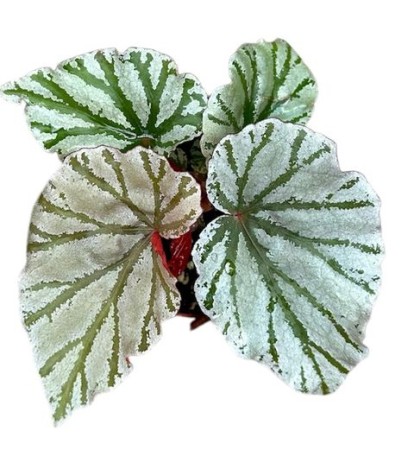
The leaves are, without doubt, the central attraction of this begonia. Asymmetrical in shape and slightly oblique – a characteristic trait of the genus Begonia – the leaves measure 10-15 cm in length and 6-10 cm in width, with gently undulating margins and a pointed tip. The adaxial surface (upper side) displays a deep emerald green with subtle silvery metallic reflections that shimmer in indirect light, creating an almost holographic effect.
The leaf reverse (abaxial surface) is an explosion of intense, uniform burgundy-maroon colour that contrasts spectacularly with the green above. This chromatic feature is due to a high concentration of anthocyanins – natural pigments that protect the leaf tissues from excessive ultraviolet radiation. The veins are prominent on the reverse, creating a fine relief that adds texture and visual complexity.
The leaf texture is slightly fleshy, with a semi-glossy surface that reflects light pleasantly. The petioles are slender but firm, green with reddish tones at the base, supporting the leaves at an angle that allows them to capture optimal light. As the plant matures, the leaves become larger and more colourful, with the contrast between the two faces intensifying.
🌸 The Flowers
Begonia 'Two Face' can produce small, delicate flowers grouped in lax inflorescences on slender peduncles that rise above the foliage. The flowers are pale white-pink, with fine, translucent petals, of modest dimensions – approximately 1-2 cm in diameter. While not the main attraction of this cultivar, the flowers add a delicate, romantic accent to the decorative ensemble.
The flowering period is variable and depends on growing conditions, usually occurring in spring and summer when days are longer and light more intense. Some growers prefer to remove the inflorescences to direct the plant's energy towards producing new, larger, and more colourful foliage. However, under optimal conditions, the plant can flower without sacrificing foliage vigour.
🌱 Growth and Development
Begonia 'Two Face' has a compact, bushy growth habit, forming a dense mound of overlapping leaves. Growth is moderate, with the plant reaching a height of 20-35 cm and a similar spread at maturity. The stems are fleshy, semi-succulent, with relatively short internodes, contributing to the compact, full appearance of the plant.
The plant is ideal for 8-14 cm pots, where it forms an attractive, well-proportioned specimen. It branches naturally but can be pinched to encourage denser branching and a more compact habit.
Care requirements are moderate, making it accessible to both beginners and experienced growers:
- Light: Bright, indirect light. Avoid direct sunlight which can scorch the delicate leaves. An east or north-facing window is ideal. Tolerates medium light, but colours will be less intense.
- Temperature: 18-25°C optimal, minimum 15°C. Does not tolerate cold draughts or sudden temperature fluctuations.
- Watering: Water when the top 2-3 cm of substrate has dried out. Avoid overwatering which can cause root rot. Use room-temperature, preferably dechlorinated water.
- Humidity: 50-70% relative humidity. Benefits from a humidifier or placement on a pebble tray. Do not mist leaves directly – water droplets can cause spots and fungal diseases.
- Substrate: Well-draining, slightly acidic mix (pH 5.5-6.5). Recommended blend: 40% peat, 30% perlite, 20% fine bark, 10% vermiculite.
- Fertilising: Balanced liquid fertiliser (NPK 10-10-10) diluted to half strength, every 2-3 weeks during the growing season (March-October). Reduce or stop fertilising in winter.
- Propagation: By stem or leaf cuttings, in moist substrate or water. Spring and summer offer the best results. Cuttings root in 2-4 weeks.
Lungime: 8 cm
Greutate (kg): 0.25 Kg
Denumire: Begonia
Diametru: 8 cm
Cerințe lumină: Strong, indirect light
Tip plantă: Decorative
Utilizare: Interior
Tip suport: Ghiveci
Material Suport: Plastic
How do I care for Begonia Two Face?
Begonia 'Two Face' prefers indirect light and moderate humidity. Water when the top layer of soil has dried out. Avoid direct sunlight and cold drafts. Ideal temperature is between 18-24°C. Fertilise monthly during the growing season with liquid houseplant fertiliser.
How do I care for Begonia?
Begonia prefers bright indirect light, well-drained soil and temperatures between 18-24°C (65-75°F). Avoid direct sunlight which burns leaves and water moderately, allowing the soil to dry slightly between waterings. Medium to high humidity is ideal.
How often should I water Begonia?
Water Begonia when the top layer of soil (2-3 cm) has dried. In summer, this usually means 2-3 times per week. Avoid watering on leaves as this can cause fungal diseases. Reduce watering in winter.
Is Begonia toxic to pets?
Yes, Begonia is toxic to dogs and cats. The most toxic part is the tuber (root). Ingestion can cause oral irritation, excessive drooling, difficulty swallowing and vomiting. Keep the plant away from animals.
How do I propagate Begonia?
Begonia can be propagated through leaf or stem cuttings. Cut a healthy leaf with petiole, place it in water or moist substrate. Roots appear in 2-4 weeks. This method works best in spring and summer.
What temperature does Begonia prefer?
Begonia prefers temperatures between 18-24°C (65-75°F). It does not tolerate temperatures below 13°C (55°F) and is sensitive to cold drafts. Avoid placing near cold windows in winter or direct heat sources like radiators.
Recommendations
Ai nevoie și de un ghiveci decorativ?