EN/
EN/ Romana
Begonia darthvaderiana 'Green Spots' Ø8cm
![Begonia darthvaderiana Green Spots with black leaves and green spots [0]](https://gomagcdn.ro/domains2/eufloria.ro/files/product/medium/begonia-darthvaderiana-green-spots-o8-cm-266072.jpg "Begonia darthvaderiana Green Spots with black leaves and green spots [0]")
![Begonia darthvaderiana Green Spots with black leaves and green spots [1]](https://gomagcdn.ro/domains2/eufloria.ro/files/product/medium/begonia-darthvaderiana-green-spots-o8-cm-007558.jpg "Begonia darthvaderiana Green Spots with black leaves and green spots [1]")
![Begonia darthvaderiana Green Spots with black leaves and green spots [2]](https://gomagcdn.ro/domains2/eufloria.ro/files/product/medium/begonia-darthvaderiana-green-spots-o8-cm-121943.jpg "Begonia darthvaderiana Green Spots with black leaves and green spots [2]")
![Begonia darthvaderiana Green Spots with black leaves and green spots [3]](https://gomagcdn.ro/domains2/eufloria.ro/files/product/medium/begonia-darthvaderiana-green-spots-o8-cm-858599.jpg "Begonia darthvaderiana Green Spots with black leaves and green spots [3]")
![Begonia darthvaderiana Green Spots with black leaves and green spots [4]](https://gomagcdn.ro/domains2/eufloria.ro/files/product/medium/begonia-darthvaderiana-green-spots-o8-cm-972113.jpg "Begonia darthvaderiana Green Spots with black leaves and green spots [4]")
![Begonia darthvaderiana Green Spots with black leaves and green spots [1]](https://gomagcdn.ro/domains2/eufloria.ro/files/product/original/begonia-darthvaderiana-green-spots-o8-cm-266072.jpg "Begonia darthvaderiana Green Spots with black leaves and green spots [1]")
![Begonia darthvaderiana Green Spots with black leaves and green spots [2]](https://gomagcdn.ro/domains2/eufloria.ro/files/product/original/begonia-darthvaderiana-green-spots-o8-cm-007558.jpg "Begonia darthvaderiana Green Spots with black leaves and green spots [2]")
![Begonia darthvaderiana Green Spots with black leaves and green spots [3]](https://gomagcdn.ro/domains2/eufloria.ro/files/product/original/begonia-darthvaderiana-green-spots-o8-cm-121943.jpg "Begonia darthvaderiana Green Spots with black leaves and green spots [3]")
![Begonia darthvaderiana Green Spots with black leaves and green spots [4]](https://gomagcdn.ro/domains2/eufloria.ro/files/product/original/begonia-darthvaderiana-green-spots-o8-cm-858599.jpg "Begonia darthvaderiana Green Spots with black leaves and green spots [4]")
![Begonia darthvaderiana Green Spots with black leaves and green spots [5]](https://gomagcdn.ro/domains2/eufloria.ro/files/product/original/begonia-darthvaderiana-green-spots-o8-cm-972113.jpg "Begonia darthvaderiana Green Spots with black leaves and green spots [5]")
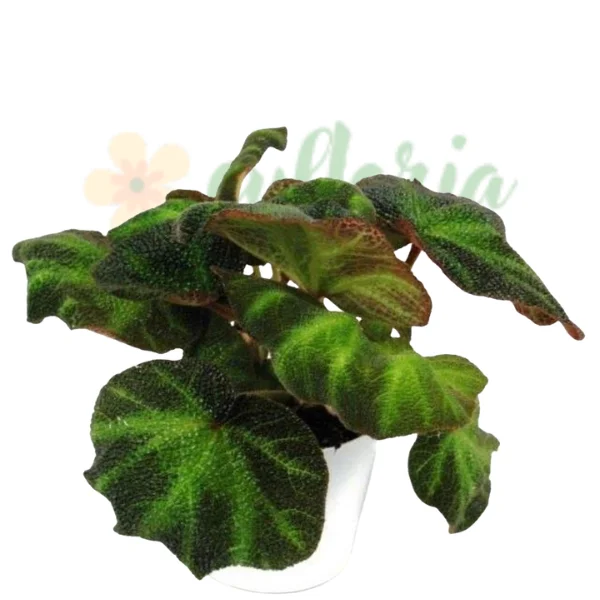
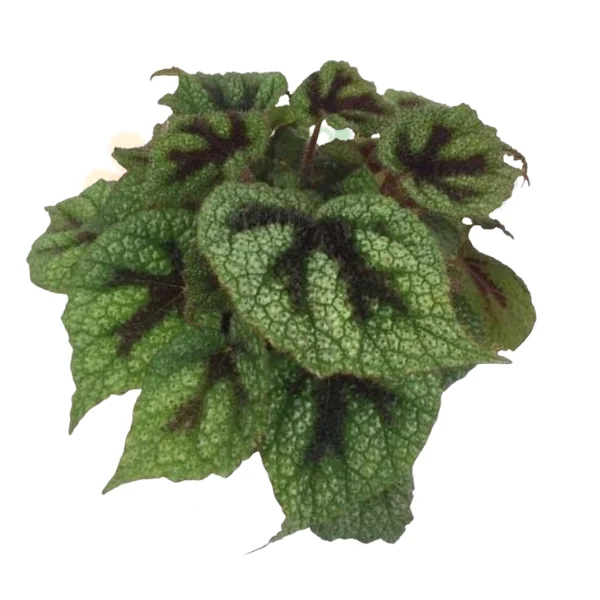
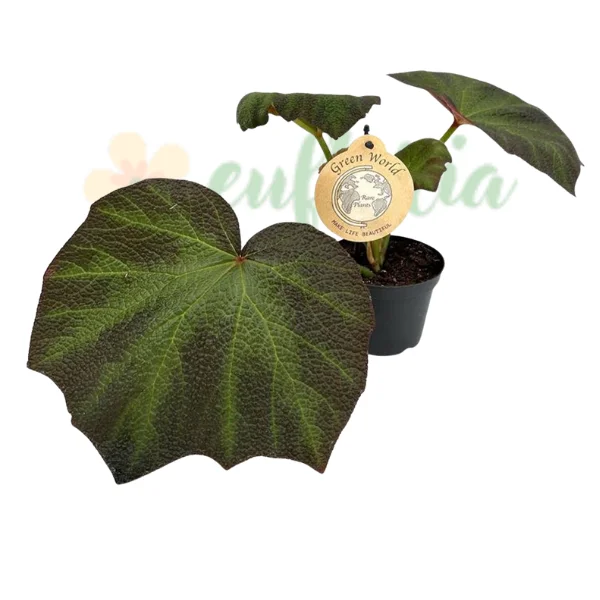
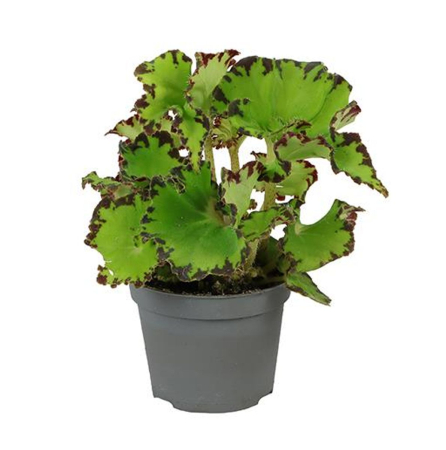
Rare Bornean begonia with near-black leaves and irregular green spots. Collector cultivar requiring high humidity (70-80%) and filtered light. Asymmetric velvety leaves with wine-red undersides.
Note: Product images are for guidance only. Due to different batches of imported products, there may be differences between the images on the website and the actual appearance of the products.
Approx height (including pot): 10-15 cm
Diametru Ghiveci: 8 cm
- Description
- Characteristics
- Reviews (0)
- FAQ
Characteristics of Begonia darthvaderiana 'Green Spots'
Begonia darthvaderiana 'Green Spots' is an exceptionally rare cultivar prized for its dramatic foliage featuring a near-black background punctuated by irregular green spots that create a striking graphic contrast. The mother species was formally described only in 2014, named after the Darth Vader character due to its leaves being so dark they appear to absorb light. The 'Green Spots' variant adds a patterned element that elevates the plant into a sought-after collector specimen among rare begonia enthusiasts.
The plant stays compact, reaching 20-30 cm in height, with a slow but steady rhizomatous growth under optimal conditions. The asymmetric heart-shaped leaves have a velvety texture and a thickness that makes them appear cut from leather. The pattern of green spots varies from individual to individual, some plants showing small scattered dots while others develop larger green zones across the black surface. This is a plant for growers who appreciate unusual aesthetics and are willing to provide the high humidity it demands.
Origin of Begonia darthvaderiana 'Green Spots'
The species Begonia darthvaderiana originates from the montane rainforests of Sarawak, on the island of Borneo, Malaysia. It was discovered in extremely humid forest habitats at altitudes between 300 and 900 metres, where it grows on soils rich in natural matter beneath the dense canopy of primary jungle. Botanists Che-Wei Lin and Ching-I Peng described the species in 2014, placing it in the Petermannia section of the Begonia genus.
The 'Green Spots' cultivar emerged in cultivation through selection of phenotypes with natural green spotting observed in wild populations, or through vegetative propagation of clones bearing this pattern. Due to its restricted habitat and collection pressure for the horticultural trade, the mother species is considered vulnerable in the wild. Plants offered by Eufloria come exclusively from legal commercial cultivation, respecting international conventions for species protection.
Foliage of Begonia darthvaderiana 'Green Spots'
The leaves are the dominant feature of this begonia — they exhibit a shade of green so deep that they appear black in most lighting conditions, revealing their underlying tones only under strong direct illumination. The surface is velvety, with a fine texture produced by microscopic hairs that reflect light in a subtle iridescent manner. The leaf shape is asymmetric, typical of rhizomatous begonias, with one large lobe and one small lobe at the base of the central vein.
The green spots characteristic of the cultivar form on the upper surface, with variable dimensions between 2 and 8 millimetres, distributed irregularly across the leaf blade. The underside of the leaf is deep wine-red, a trait common to many Bornean begonias living in the dim forest understory that use this pigment to reflect light back through the leaf, maximising photosynthesis. New leaves emerge with a metallic sheen before they fully mature.
Flowers of Begonia darthvaderiana 'Green Spots'
Begonia darthvaderiana produces small, delicate flowers of white with pale pink tones, grouped in axillary panicles that rise above the foliage. Each flower measures 1-1.5 cm in diameter, with four tepals (two larger and two smaller) arranged in the geometry characteristic of the Begonia genus. The plant produces male and female flowers separately on the same stem, being monoecious like most begonias.
Flowering occurs sporadically throughout the year under cultivation, with a peak in late spring and early summer. The flowers are subtly fragrant, with a sweet-greenish note that attracts small pollinators in the natural habitat. Although flowers can be appreciated aesthetically, most collectors grow this species exclusively for the foliage, frequently removing flowers to redirect the plant energy toward rhizome and leaf development.
Growth pattern of Begonia darthvaderiana 'Green Spots'
Begonia darthvaderiana 'Green Spots' requires high atmospheric humidity, a minimum of 70-80%, to thrive. In ordinary indoor spaces, cultivation in a terrarium, display case or under a glass cloche is nearly mandatory. Preferred temperatures range between 18 and 24°C during the day and should not drop below 16°C at night. The recommended exposure is filtered, indirect, intense light — a north-east or east-facing window sheltered from direct rays.
The ideal substrate is very airy with good drainage capacity: a mix of coconut fibre, perlit, fine pine bark and sphagnum moss in roughly equal parts. Watering is carried out when the upper layer of the substrate begins to dry, using room-temperature water, preferably filtered or rain water. Fertilisation is applied diluted, once every 3-4 weeks during the active growing season. Propagation is achieved through leaf cuttings with petiole or by division of the rhizome in a medium with 90-100 per cent humidity.
Propagation of Begonia darthvaderiana 'Green Spots'
Begonia darthvaderiana is most easily propagated through leaf cuttings — a classic technique for rhizomatous Begonia. Cut a mature leaf with petiole, slice the lamina into triangles with veins, place them on moist sphagnum moss in an airtight container. New plantlets appear at the base of the cut veins in 4–6 weeks. Humidity of 90–100% and temperature of 23–26°C are essential.
Alternatives: propagation by dividing the rhizome in spring or by stem cuttings with a node. This species does NOT multiply efficiently through seeds in amateur conditions.
Decor and Home Styling
Begonia darthvaderiana 'Green Spots' is a statement piece — its almost black leaves with green spots catch the eye against light backgrounds. Styling ideas:
- Open glass terrarium: ideal for maintaining humidity and highlighting the chromatic contrast;
- Shelf with white lights and white background: black leaves become living artworks;
- Next to plants with golden/light green foliage: spectacular contrast;
- Desk in creative space: almost gothic plant that fits perfectly with dark-academia aesthetics.
Frequently Asked Questions about Begonia darthvaderiana 'Green Spots'
Where does the 'Darth Vader' name come from?
The species was described in 2014 by Peter Boyce and Ruth Kiew from Sarawak, Borneo. The name directly references the almost black color and metallic sheen of the leaves — similar to the Darth Vader mask from Star Wars.
What distinguishes 'Green Spots'?
This cultivar has distinct green spots in the center of the leaves — a dramatic contrast against the black background. The typical species form is completely black.
How do I keep it alive in an apartment?
70%+ humidity, medium-bright indirect light, constantly slightly moist substrate (NOT waterlogged), temperature above 18°C. Terrarium or pot with partial lid is the recommended setup.
Greutate (kg): 0.25
Cerințe lumină: Lumina indirectă
Tip plantă: Planta cu frunze
How do I care for Begonia darthvaderiana ‘Green Spots’?
What light does ‘Green Spots’ need?
How often should it be watered?
Is it toxic to pets?
How do I propagate it?
Why is it called darthvaderiana?
How to care for it?
Is it toxic?
Can it live outside a terrarium?
How to propagate?
Ai nevoie și de un ghiveci decorativ?