EN/
EN/ Romana
Begonia 'Mantuk' Ø8cm
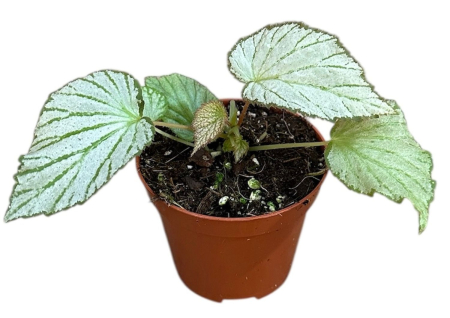
![Begonia Mantuk with asymmetric green leaves with silver spots [0]](https://gomagcdn.ro/domains2/eufloria.ro/files/product/medium/begonia-mantuk-o8-cm-453428.jpg "Begonia Mantuk with asymmetric green leaves with silver spots [0]")
![Begonia Mantuk with asymmetric green leaves with silver spots [1]](https://gomagcdn.ro/domains2/eufloria.ro/files/product/medium/begonia-mantuk-o8-cm-137293.jpg "Begonia Mantuk with asymmetric green leaves with silver spots [1]")
![Begonia Mantuk with asymmetric green leaves with silver spots [1]](https://gomagcdn.ro/domains2/eufloria.ro/files/product/original/begonia-mantuk-o8-cm-453428.jpg "Begonia Mantuk with asymmetric green leaves with silver spots [1]")
![Begonia Mantuk with asymmetric green leaves with silver spots [2]](https://gomagcdn.ro/domains2/eufloria.ro/files/product/original/begonia-mantuk-o8-cm-137293.jpg "Begonia Mantuk with asymmetric green leaves with silver spots [2]")
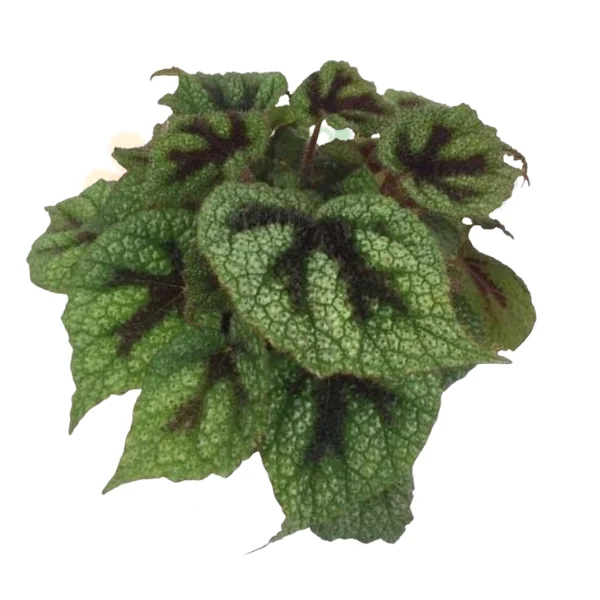
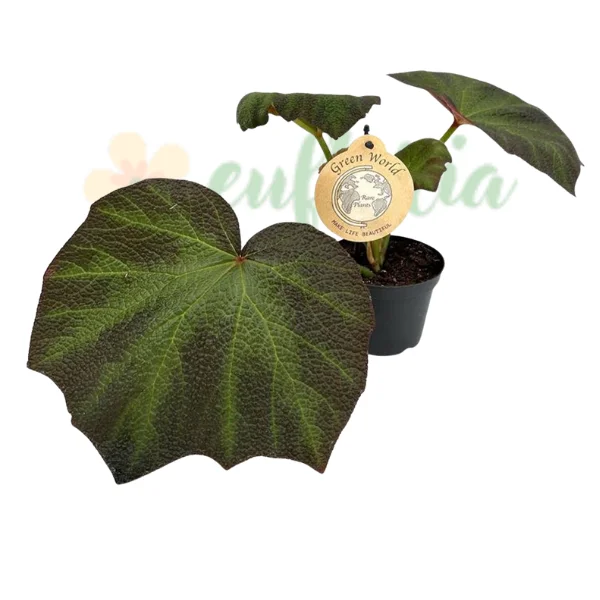
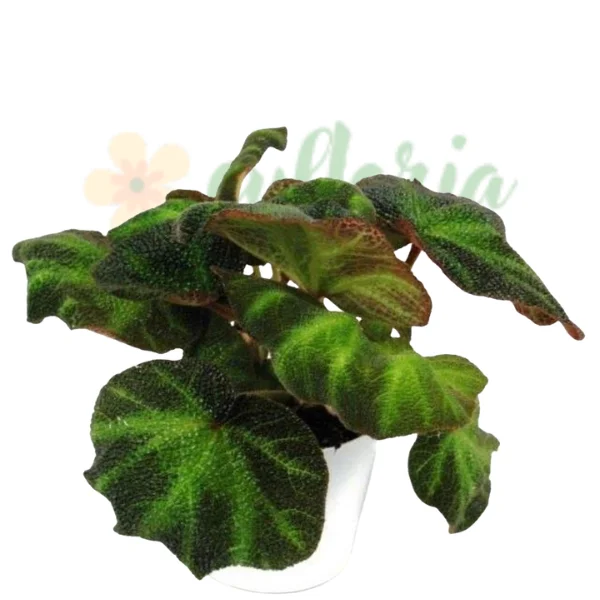
Rare rhizomatous begonia collected from the Mantuk area, Borneo. Velvety dark green leaves with metallic silvery zones and burgundy underside. Collector cultivar requiring 70-85% humidity.
Note: Product images are for guidance only. Due to different batches of imported products, there may be differences between the images on the website and the actual appearance of the products.
Approx height (including pot): 10-15 cm
Pot diameter: 8 cm
- Description
- Characteristics
- Reviews (0)
- FAQ
Characteristics of Begonia 'Mantuk'
Begonia 'Mantuk' is a rare rhizomatous begonia collected from the Mantuk area of the Indonesian island of Borneo, prized for leaves with a metallic surface and a distinctive pattern. The cultivar stands out through dense foliage painted with contrasts between near-black dark green and silvery or light green zones that catch the light in an unusual manner. It is a compact plant with a bushy habit that rarely exceeds 25-30 cm in height, making it ideal for rare begonia collections, tropical terrariums or humid display cases.
Growth is typical of rhizomatous begonias — slow, with a creeping rhizome that gradually branches and produces new leaves at intervals of several weeks. Mature leaves can reach 8-12 cm in length, with a typically asymmetric shape and a velvety texture due to microscopic hairs on the surface. The 'Mantuk' cultivar is still rarely encountered in the European horticultural trade, being cultivated mainly by specialised collectors and propagated vegetatively from original clones collected in the 2010s.
Origin of Begonia 'Mantuk'
Begonia 'Mantuk' originates from West Kalimantan Province, on the island of Borneo (Indonesia), from the area of the village of Mantuk that gave it its name. The natural habitat consists of humid tropical forests on limestone slopes, at altitudes between 200 and 600 metres, where the plant grows on humus-rich soils, in the shade of tall trees and shrubs that maintain permanently high humidity. Average habitat temperatures oscillate between 22 and 28°C throughout the year.
This begonia reached European cultivation through specialised collectors who brought specimens during authorised botanical expeditions conducted between 2015 and 2020. It is often confused with other Bornean rhizomatous begonias, such as Begonia chlorosticta or Begonia amidalae, but distinguishes itself through its own foliage pattern and the fact that it is a Mantuk collection, not a formally described species. Plants sold by Eufloria come exclusively from legal vegetative propagation in specialty nurseries.
Foliage of Begonia 'Mantuk'
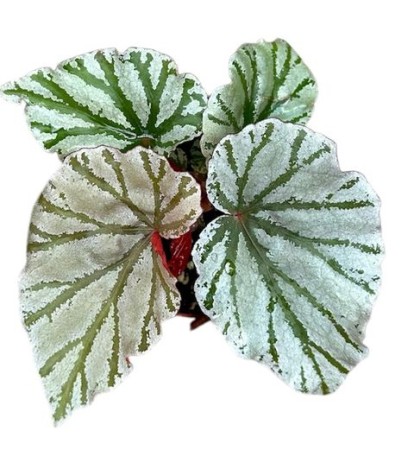
The leaves of Begonia 'Mantuk' are the cultivar defining feature — they have an asymmetric flattened heart shape, with a slightly undulating edge and a size of 8-12 cm at maturity. The base colour is a very dark green, almost black, over which silvery, light green or metallic zones are superimposed, forming a pattern that varies from leaf to leaf. The velvety texture is due to microscopic hairs that reflect light in subtle iridescent tones.
The leaf underside has an intense burgundy-red colour, a trait common to many begonias of the tropical forest understory, which use this pigment to reflect light back through the leaf lamina and maximise photosynthesis in low-light conditions. The central vein is lighter than the lamina, while secondary veins form a pattern of silvery nodes that amplify the decorative appearance. New leaves emerge with a pronounced metallic sheen that gradually fades as they mature.
Flowers of Begonia 'Mantuk'
Begonia 'Mantuk' produces small, discreet flowers of white with pale pink bases, grouped in cymose inflorescences that rise slightly above the foliage. Each flower measures approximately 1-1.5 cm in diameter and displays four tepals arranged in the typical begonia fashion — two larger and two smaller. Like all begonias, it is a monoecious plant, producing separate male and female flowers on the same inflorescence, with female flowers distinguished by a triangular winged ovary.
Flowering occurs sporadically throughout the year under good cultivation conditions, with a peak observed in late spring. The flowers are discreetly fragrant and visited in the natural habitat by small pollen-collecting insects. In cultivation, flowers are often removed by collectors to redirect plant energy toward rhizome development and new leaf production, which constitutes the main interest of growers of this species.
Growth pattern of Begonia 'Mantuk'
Begonia 'Mantuk' prefers high atmospheric humidity, between 70 and 85 per cent, making it ideal for cultivation in tropical terrariums, enclosed display cases or under a glass cloche. In ordinary rooms, the plant quickly suffers from leaf edge drying if humidity drops below 60 per cent. Ideal temperatures range between 20 and 26°C during the day, without dropping below 17°C at night. The recommended exposure is bright indirect filtered light — without direct western or southern sun rays.
The ideal substrate is loose and well-drained, based on coconut fibre, perlite, fine pine bark and sphagnum moss in roughly equal proportions, with a slightly acidic pH (5.5-6.5). Watering is carried out with filtered or rain water when the upper layer of the substrate begins to dry, avoiding wetting the leaves to prevent fungal diseases. Fertilisation is applied diluted (a quarter of the recommended dose), once every 3-4 weeks during the active growing season. Propagation is achieved through leaf cuttings with petiole or by rhizome division under high humidity conditions.
Propagation of Begonia 'Mantuk'
Begonia 'Mantuk' multiplies efficiently through rhizome cuttings or leaf cuttings using the vein-slicing technique. For rhizome cuttings: in spring, cut a 3–5cm section with at least one node, let it callus for 24h, then plant in moist sphagnum moss in an airtight container. Rooting in 3–5 weeks.
For leaf cuttings: cut the leaf at the base of the petiole, slice the lamina into triangular pieces that include a portion of the central vein, place them on sphagnum moss. In 5–7 weeks, small plantlets appear at the base of the veins. Humidity 90–100%, stable temperature 23–26°C.
How 'Mantuk' Fits into Your Collection
Begonia 'Mantuk' is an excellent choice for:
- Begonia collectors: complements large forms (B. maculata, B. masoniana) with its compact foliage and fine details;
- Terrarium design: small dimensions make it ideal for 20–30L terrariums, without dominating the ecosystem;
- Advanced beginner plant lovers: more forgiving than demanding rare Begonia (B. darthvaderiana, B. rajah), but preserves the charm of rare varieties;
- Modern plant styling: fits minimalist interiors where you want a plant that adds texture without overwhelming the space.
Frequently Asked Questions about Begonia 'Mantuk'
Where does the 'Mantuk' name come from?
'Mantuk' is a cultivar discovered in Borneo (Sarawak) and multiplied in Europe through horticultural selections. The name refers to the locality in the plant's native habitat.
Is it harder or easier than other rare Begonias?
Mantuk is one of the most forgiving rare Begonias — it tolerates humidity levels of 60–65%, conditions commonly found in normal apartments. Alongside higher humidity (70–80%), it looks impressive.
How big does it grow?
In typical cultivation, it remains compact — 15–25cm tall and 20–30cm wide after 2 years. With strong light, growth is dense and compact; with low light, the petiole elongates and the appearance becomes irregular.
Lungime: 10 cm
Greutate (kg): 0.25
Denumire: Begonia
Cerințe lumină: Lumină indirectă puternică
Tip plantă: Planta cu frunze
Utilizare: Interior
Tip suport: Ghiveci
Material Suport: Plastic
How do I water Begonia Mantuk correctly?
Begonia Mantuk prefers a constantly slightly moist substrate, but never waterlogged. Water at the base of the plant, avoiding wetting the velvety leaves, when the top 1-2 cm of substrate is dry (typically every 4-6 days in summer, 8-10 days in winter). Use filtered or settled water at room temperature (20-22°C). Excess stagnant water in the saucer rapidly causes rhizome rot.
Is Begonia Mantuk toxic to cats and dogs?
According to ASPCA (American Society for the Prevention of Cruelty to Animals), the entire Begoniaceae family is classified as toxic to dogs, cats and horses due to insoluble calcium oxalates and a toxin more concentrated in the tuber/rhizome. Ingestion can cause excessive salivation, oral irritation and vomiting. Place the plant out of reach of pets.
What is the ideal substrate for Begonia Mantuk?
Rhizomatous begonias like Mantuk require an airy, well-draining substrate. Recommended mix: 40% peat or coco peat, 30% perlite, 20% fine pine bark, 10% horticultural charcoal. Optimal pH is 5.8-6.5. Avoid compacted substrate or one with high water retention — they are sensitive to rhizome rot. Repot annually in spring, into a slightly larger pot (1-2 cm wider).
What humidity and temperature does Begonia Mantuk prefer?
Begonia Mantuk prefers high humidity (60-80%) and temperatures of 18-25°C during the day, with a minimum of 15°C at night. Below 50% humidity, leaf edges become dry and brittle. Use a humidifier or a tray with moist pebbles underneath. Avoid spraying leaves directly (it causes brown spots). Do not expose the plant to cold drafts or direct radiator heat.
How is Begonia Mantuk propagated?
Begonia Mantuk is most effectively propagated by leaf or rhizome cuttings. For leaf cuttings: cut a healthy leaf with a 3-5 cm petiole, plant in a slightly moist mix of peat and perlite (1:1), keep at 22-25°C and 70-80% humidity under a clear cover. Roots appear in 3-4 weeks, new plantlets in 6-8 weeks. The rhizome can also be divided into sections with 2-3 active buds each.
Where does Begonia 'Mantuk' come from?
Begonia 'Mantuk' is native to the Mantuk region of Indonesia, where it grows as a jungle plant in humid tropical forests at very high humidity.
How to care for it?
Medium indirect light (no direct sun), humidity 70-90%, temperatures 20-26°C, constantly moist airy substrate (peat + perlite + cocopeat). Protected from cold drafts.
Is it toxic?
Mildly toxic to cats and dogs due to calcium oxalates. Ingestion may cause oral irritation, drooling and nausea. Keep away from pets.
Suitable for terrariums?
Yes, excellent for terrariums or humid display cases. Jungle begonias prefer very high humidity, stable temperatures and protection from dry drafts.
How to propagate?
By leaf cuttings or rhizome division. Leaf cuttings in moist sphagnum produce new plants in 6-10 weeks at 22-26°C and high humidity.
Ai nevoie și de un ghiveci decorativ?