EN/
EN/ Romana
Hoya verstegii
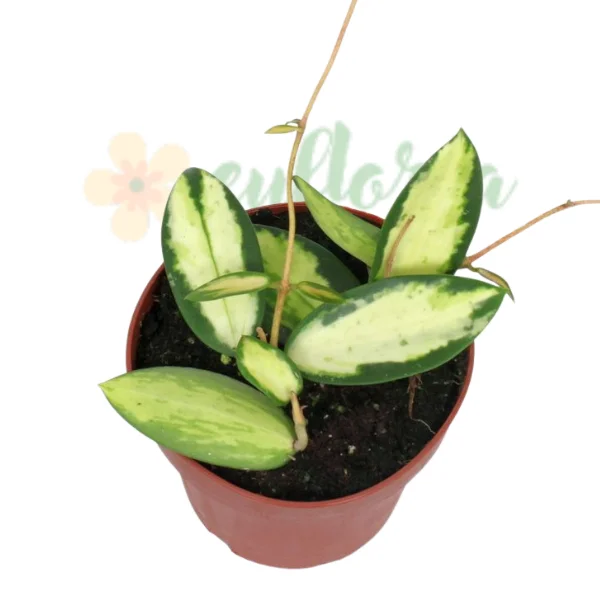
![Hoya verstegii with elliptical medium green leaves [1]](https://gomagcdn.ro/domains2/eufloria.ro/files/product/original/hoya-verstegii-270146.png "Hoya verstegii with elliptical medium green leaves [1]")
Hoya verstegii — elegant Philippine species with elliptical leaves and fragrant yellowish-white umbels with reddish corona.
Pot diameter: (no pot)
- Description
- Reviews (0)
- FAQ
🌿 Waxy Emerald Leaves — The Quiet Refinement of Hoya verstegii
Hoya verstegii is one of the classic species of the Philippines, a plant whose beauty lies in the discreet balance between glossy deep-green foliage and fragrant flowers arranged in spherical umbels. Unlike spectacular cultivars with silver variegation, verstegii catches the eye through the purity of its lines: oval-elongated leaves, perfectly symmetrical, with a slightly prominent central vein that underlines the plant's natural elegance.
This species is often recommended to collectors who appreciate Hoya in its pure form, without aesthetic modifications imposed by horticultural selection. The plant develops its vines with moderate, consistent vigor, offering a structure that gradually evolves into a climber or hanging plant, depending on the support chosen.
🌍 Origin and Botanical History
Hoya verstegii was described in 1923 by American botanist Elmer Drew Merrill, one of the most prolific taxonomists of Asian flora, who cataloged over 3,000 new plant species in his career. The description was published in the Philippine Journal of Science, the official journal of the Bureau of Science in Manila, the scientific institution of the then-American colony. The species belongs to the Apocynaceae family, subfamily Asclepiadoideae, the group of large epiphytic climbers of tropical Asia.
The name 'verstegii' honors a person bearing this surname, following classic taxonomic convention — likely a Dutch or American collector involved in collecting the original samples. The natural habitat consists of humid tropical forests in the Philippine archipelago, particularly on the islands of Luzon and Mindoro, at altitudes of 300–1,200 m, where relative humidity reaches 80–90% and temperatures oscillate in the 22–29°C range year-round.
In indoor cultivation, Hoya verstegii was introduced to Europe in the 1990s, being one of the first Philippine Hoyas available in Western collections. According to the International Hoya Association, the species ranks among the classic Hoyas recommended for beginners with collector inclinations, thanks to its relative resistance and tendency to bloom without exceptional conditions.
🌱 The Foliage
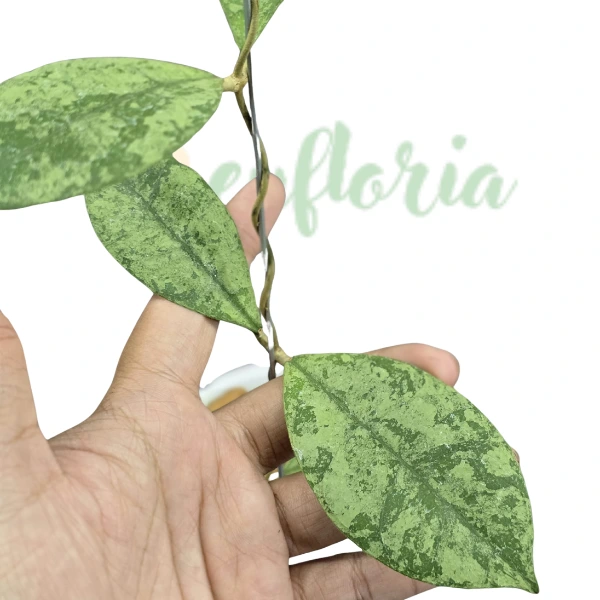
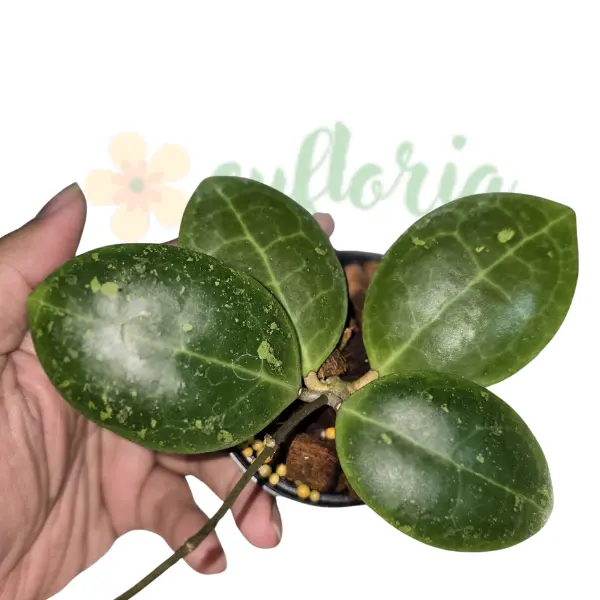
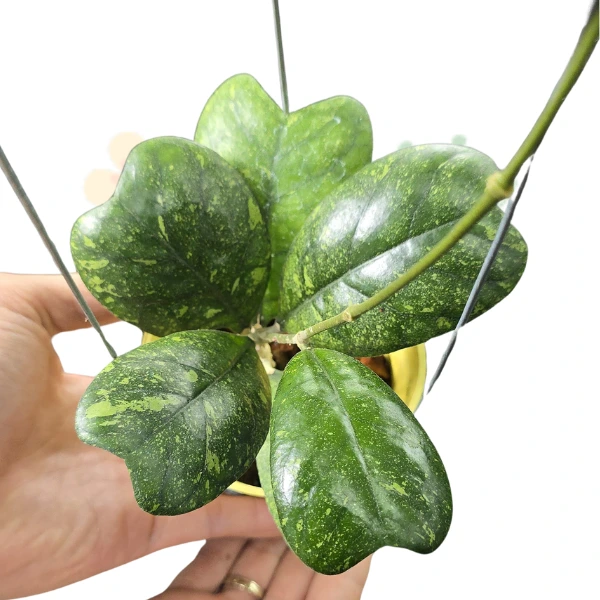
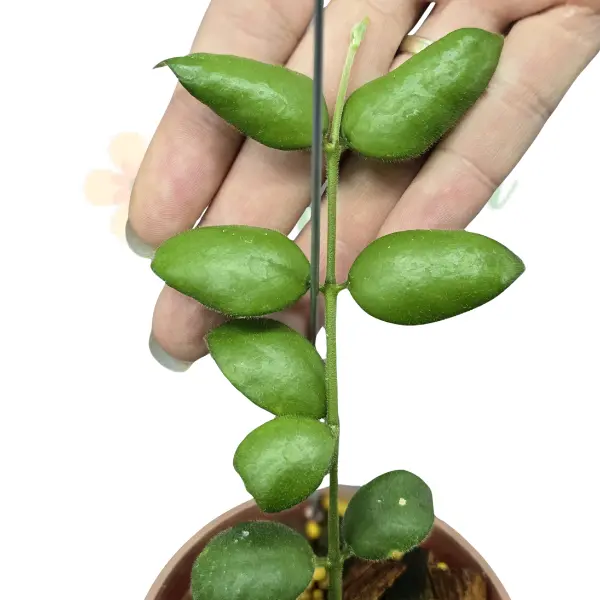
The leaves of Hoya verstegii are oval-elongated, with a slightly pointed tip and rounded base. Typical dimensions vary between 6 and 10 centimeters long and 3–4.5 centimeters wide. The texture is strongly waxy — one of the glossiest in the Hoya genus — with a thick cuticle that reflects light in a metallic, almost lacquered manner.
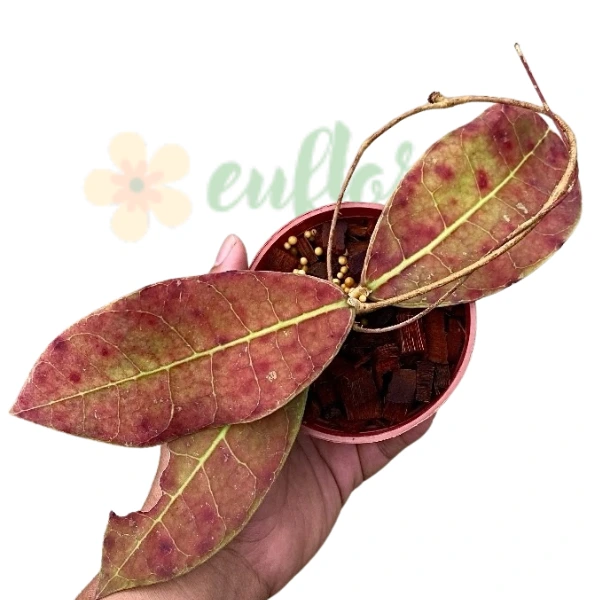
The color is a saturated emerald green, uniform across the whole surface, without spots or variegation. Under strong indirect light exposure, the leaves develop slightly pinkish margins (stress coloration), a phenomenon appreciated by collectors because it signals optimal lighting for blooming.
The central vein is visibly prominent on the ventral side, and the secondary veins form a delicate pattern of parallel rows that converge toward the margin. New leaves are initially slightly soft and pale, but within 10–14 days reach full gloss and the species' characteristic thickness.
🌸 The Flowers
Flowering is one of Hoya verstegii's strong points. At maturity (1–2 years in good conditions), the plant produces spherical umbels with 12–20 individual flowers. Each flower measures 8–12 millimeters in diameter, with five fleshy petals arranged in a star shape.
The chromatic palette is delicate — outer petals are pinkish-white to cream-white, and the inner corona is deep pink to burgundy, creating a visually striking contrast. The texture is waxy, satin-like, with the characteristic Hoya gloss. The fragrance is sweet, with floral and lightly spiced notes, more intense in the evening, when natural pollinators (moths) were active in the original habitat.
Peduncles produce flowers in successive seasons — they should never be cut. Flowering lasts 1–2 weeks on the plant, and a peduncle can bloom 3–5 times per year under optimal conditions.
🌱 Growth and Development
Hoya verstegii is a climbing plant with moderate growth, developing 25–40 centimeters of new vine annually. The plant responds very well both to training on a vertical support (moss pole, trellis) and to cultivation in suspended pots, where vines grow elegantly downward. The species is relatively tolerant of imperfect conditions, making it suitable also for beginner collectors.
- Light: Strong indirect light, east or west window. Direct morning or evening sun tolerated; midday sun burns the leaves. 10,000–20,000 lux optimal.
- Temperature: 20–28°C during the day, minimum 15°C at night. Below 12°C growth noticeably slows. Tolerates moderate fluctuations.
- Watering: Moderate — substrate dry in the top 2–3 cm before the next watering. Summer every 5–7 days; winter every 10–14 days.
- Humidity: 55–75% optimal. Also tolerates lower humidities (45–55%) but growth slows.
- Substrate: Aerated mix: 40% pine bark, 30% perlite, 20% sphagnum, 10% charcoal. pH 5.5–6.5.
- Fertilization: Orchid fertilizer, 1/4 of recommended concentration, every 3–4 weeks during the growing season.
- Propagation: Vine cuttings with 2–3 nodes, rooted in moist sphagnum at 24–26°C. Rooting time: 4–6 weeks.
How do I care for Hoya verstegii?
What do Hoya verstegii flowers look like?
Is it toxic to pets?
What substrate do you recommend?
Who was Gerard Versteg?

Ai nevoie și de un ghiveci decorativ?