EN/
EN/ Romana
Hoya stenophylla
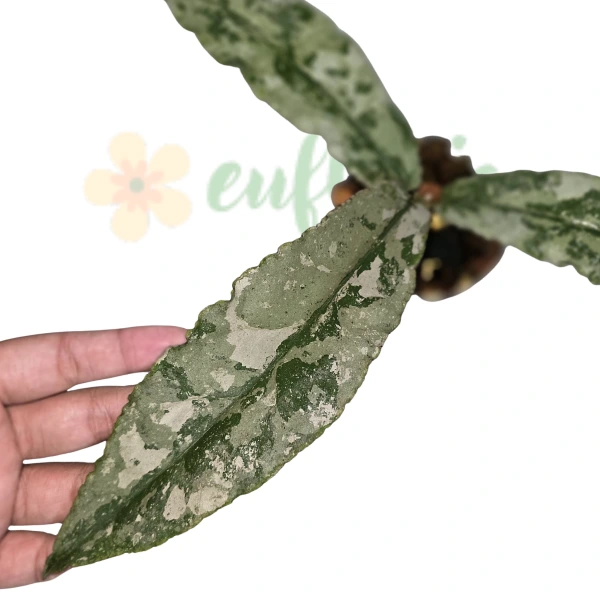
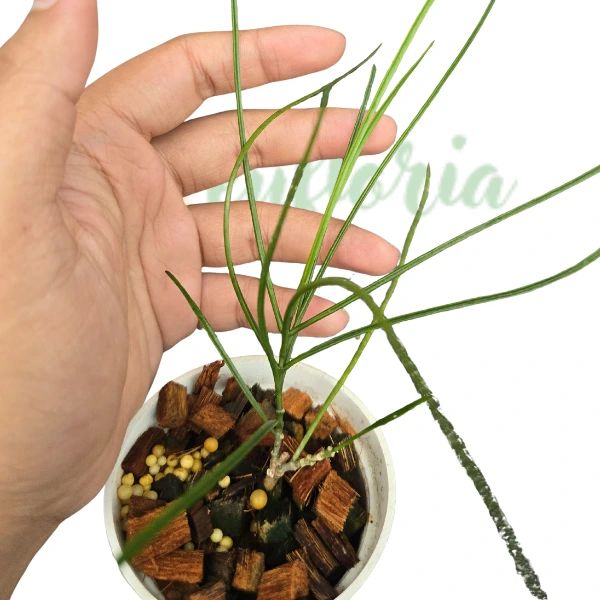
![Hoya stenophylla with long narrow lanceolate leaves [1]](https://gomagcdn.ro/domains2/eufloria.ro/files/product/original/hoya-stenophylla-799974.png "Hoya stenophylla with long narrow lanceolate leaves [1]")
Hoya stenophylla — unique species with long narrow lanceolate leaves and cream-white umbels with pink-golden corona.
Pot diameter: (no pot)
- Description
- Reviews (0)
- FAQ
🌿 Hoya stenophylla — Feather-Like Elongated Leaves, Linear Elegance
Hoya stenophylla is a rare Hoya species remarkable for its very elongated and narrow leaves, resembling feathers or the tentacles of a jellyfish. The specific name comes from Greek: steno- ("narrow") and phyllon ("leaf"), perfectly describing this plant's morphology. It is one of the most atypical Hoyas in terms of leaf shape, closer in appearance to a fern or bamboo than to a traditional Hoya.
The leaves can reach 15-25 cm in length with a width of only 1-2 cm. The plant has a minimalist appearance, with clean lines, vertically descending when grown in a hanging basket. It is a perfect choice for collectors looking for unconventional Hoya forms.
🌍 Origin and Botanical History
Hoya stenophylla is native to the Philippine archipelago, where it grows as an epiphyte on the trunks of trees in humid tropical forests. The species was botanically described in the 19th century, but remained a rare presence in European collections for a long time due to its isolated origin and propagation difficulty.
The Philippines are a biodiversity center for Hoya — over 100 endemic species are concentrated here. Hoya stenophylla belongs to the group of narrow-leaved Hoyas, alongside H. lyi, H. wayetii, and H. kentiana. The difference is in proportion: stenophylla has the most elongated leaves of all.
In its habitat, the plant lives under dense canopy, with filtered light, high humidity (70-85%), and stable temperatures between 22°C and 28°C. Aerial roots cling to tree bark, absorbing water and nutrients directly from the natural matter accumulated there.
🌱 Unique Features
- Very elongated leaves — 15-25 cm long, only 1-2 cm wide. Almost linear proportion.
- Firm, waxy texture — leaves are glossy, supple, but resistant to breaking.
- Pendant growth — ideal in hanging basket, where leaves fall freely in cascade.
- Thin, flexible stems — can be trained on support or allowed to branch freely.
- Star-shaped flowers in umbels — inflorescences of 10-15 small, waxy, fragrant flowers.
- Moderate growth — faster than many rare Hoyas, but still slow compared to common plants.
- Unconventional appearance — more decorative-tropical than "classic Hoya".
🌸 Flowering
Hoya stenophylla produces umbels of 10-15 small star-shaped flowers (1-1.5 cm diameter), in white-cream tones with a yellow or pink center. The flowers have waxy petals, an almost artificial appearance through geometric perfection, and emit a sweet floral scent perceptible in the evening and at night.
Beware of the peduncle: the short stalks supporting the umbels must be kept intact. From them, flowering will occur year after year, and these peduncles grow and become longer, supporting increasingly generous umbels. Cutting them = postponing flowering by 1-2 years.
Flowering stimulation: strong indirect light, slight cyclical drying, nitrogen reduction in fertilizer in spring, day-night temperature difference of 4-6°C in autumn.
🌱 Care Requirements
- Light: bright indirect, east/west window. Tolerates strong filtered light.
- Watering: let the substrate dry almost completely between waterings. Every 7-10 days in summer, 14-18 days in winter.
- Humidity: 50-70%. Tolerates 45% but prefers more.
- Temperature: 18-28°C optimal. Minimum 15°C in winter.
- Substrate: very airy mix — orchid bark + perlite + coco.
- Fertilization: diluted liquid 1/2, every 3-4 weeks during active season.
- Pot: prefers hanging basket — leaves fall beautifully in cascade.
- Repotting: every 2-3 years, in a pot only 2 cm larger.
🤚 Who It's Ideal For
Hoya stenophylla is perfect for collectors looking for unconventional forms — if you already have many Hoyas with oval or round leaves, stenophylla brings a strong visual contrast. It fits in modern, minimalist spaces, where the clean lines of the elongated leaves integrate aesthetically. It is also a good choice for tall spaces (hanging baskets from 2+ meters) where the leaves can reach full length without being disturbed.
In terms of care, it is more tolerant than many rare Hoyas — it tolerates humidity variations and occasional watering errors better than variegated forms or those with fragile leaves. Ideal for someone who wants a collector Hoya but is not ready for the most demanding species.
🔎 Taxonomic History and Common Confusions
Hoya stenophylla is often confused with Hoya kentiana and Hoya wayetii — all three have elongated, narrow leaves with waxy texture. Differences appear with closer attention: stenophylla has the longest and widest leaves (length-to-width ratio 12:1 for stenophylla, 8:1 for kentiana), and the green color is more intense. Kentiana tends toward bluish-green, and wayetii has reddish-brown edges.
This confusion extends to the commercial chain — many plants sold as "stenophylla" are actually kentiana or hybrids. Eufloria.ro plants are taxonomically verified before listing, come from Dutch sources with traceability, and have complete phytosanitary documentation for EU import.
💡 Practical Tips for the First Weeks
Immediately after receiving, place the plant in a space with 60%+ humidity for acclimation (2-3 weeks). Do not expose it to direct sun during this period. Water only when the substrate is dry — transport exhausts the plant and excess water in the first days is the main cause of loss for freshly imported Hoyas.
How do I care for Hoya stenophylla?
What does the name stenophylla mean?
Is it toxic to pets?
What substrate do you recommend?
Can it be grown in a hanging pot?

Ai nevoie și de un ghiveci decorativ?