EN/
EN/ Romana
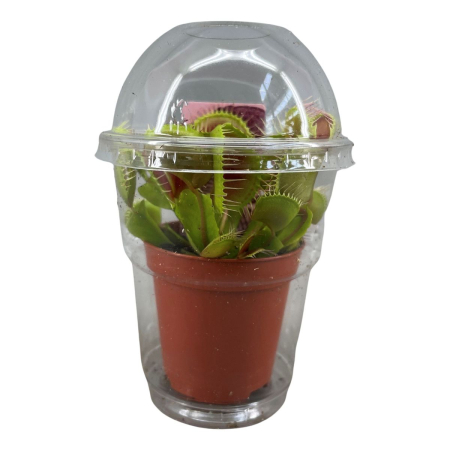
Sarracenia venosa Ø8,5cm
![Sarracenia venosa - carnivorous pitcher plant with tubular traps and pronounced red venation [1]](https://gomagcdn.ro/domains2/eufloria.ro/files/product/original/sarracenia-venosa-eufloria-821788.jpg "Sarracenia venosa - carnivorous pitcher plant with tubular traps and pronounced red venation [1]")
Sarracenia venosa is a spectacular carnivorous plant from the Sarraceniaceae family, native to the southeastern United States, distinguished by its tubular pitchers adorned with a complex network of burgundy-red veins on a lime-green background. Its tube-shaped traps attract and capture insects through nectar, slippery surfaces, and digestive enzymes. A fascinating plant for both carnivorous plant collectors and those seeking a truly unique botanical conversation piece.
Note: Product images are for guidance only. Due to different batches of imported products, there may be differences between the images on the website and the actual appearance of the products.
Approx height (including pot): 10-20 cm
Culoare flori: Rosu
Flowering state: Fara flori
Country of origin: Netherlands
Pot diameter: 8.5 cm
- Description
- Characteristics
- Reviews (0)
- FAQ
🌿 Sarracenia venosa — the living sculpture of American wetlands
There are plants that stop you in your tracks, not through dazzling blooms or impossibly large leaves, but through their sheer presence, which seems to belong to another world entirely. Sarracenia venosa is one such extraordinary vegetal being — a carnivorous plant that raises its tubular traps skyward with an almost sculptural elegance, inviting insects into a fatal dance from which there is no return. Its pitchers, those leaves metamorphosed into vertical tubes, are true masterpieces of evolution — structures that combine chromatic beauty with lethal functionality, honed over millions of years of adaptation to nutrient-poor soils.
What makes Sarracenia venosa truly memorable is its complex network of veins — from which it derives its very name — that traverse the surface of each pitcher like a topographic map of an unknown land. These reddish venations, arranged on a lime-green or yellow-green background, create a hypnotic visual contrast that captures the human eye just as irresistibly as it lures insects. It is a plant that provokes admiration and wonder in equal measure, an organism that has managed to transform an ecological handicap — mineral-depleted soil — into a spectacular evolutionary advantage.
For the collector of unconventional plants, Sarracenia venosa represents a landmark acquisition: a plant with a powerful personality that changes visibly from one season to the next, that actively hunts to survive, and that, each spring, is reborn from its rhizome with a vigour that never ceases to amaze. It is a living window into nature's most ingenious mechanisms, a tangible demonstration that beauty and functionality can coexist in sublime harmony.
🌍 Origin and Botanical History
Sarracenia venosa belongs to the family Sarraceniaceae, one of the oldest families of carnivorous plants in the Western Hemisphere, with an evolutionary history spanning at least 45 million years. The genus Sarracenia was first described by Michel Sarrazin de l’Étang, a French physician and naturalist settled in New France (present-day Quebec), who sent dried specimens to Paris around 1700. The generic name honours his contribution to the knowledge of North American flora, while the specific epithet “venosa” comes from the Latin “venosus,” meaning “with many veins” — a direct reference to the pronounced network of coloured veins that decorate the pitchers.
The species is native to the southeastern United States, with a natural distribution extending from southern Virginia and North Carolina, through South Carolina and Georgia, to northern Florida and western Mississippi. Its natural habitat comprises wet savannahs with acidic peat soil (pH 3.5–5.0), Sphagnum-dominated boggy meadows, and the margins of lakes and streams with permanently moist soil. In these environments, the soil is extremely poor in nitrogen and phosphorus, which drove the evolution of the carnivorous mechanism as an alternative strategy for obtaining essential nutrients.
Sarracenia venosa was formally described by Constantine Samuel Rafinesque-Schmaltz in 1830, although plants of this genus had been documented in botanical illustrations since the seventeenth century. Today, Sarracenia species are protected in many American states, and trade in wild-collected plants is regulated under CITES Appendix II. All commercially available specimens are nursery-propagated, contributing to the conservation of wild populations.
🌱 The Foliage
The term “foliage” takes on an entirely new dimension with Sarracenia venosa, for the leaves of this plant are not simple photosynthetic blades — they are sophisticated traps, sculpted by evolution with engineering precision. Each leaf is transformed into a pitcher (ascidium), a vertical or slightly inclined tube 2–4 cm in diameter at the opening and 15–35 cm tall at maturity, depending on growing conditions and plant age. The general form is trumpet-shaped, flaring slightly towards the apex, where an undulating peristome (the trap’s lip) secreting nectar serves as a landing platform for unsuspecting insects.
The base colour of the pitchers ranges from bright lime-green to yellow-green, depending on light intensity. Overlaid on this ground is the network of veins that defines the species — deep red to burgundy venations that branch and anastomose, creating a reticulate pattern of fascinating complexity. In some forms, the veins are so dense that the pitchers appear almost entirely red, while in others the network is sparser, allowing the green background to dominate. This variability makes each plant unique, bearing its own unrepeatable “pattern.”
Inside the pitcher, the walls are lined with microscopic downward-pointing hairs that prevent captured insects from climbing back to freedom. The upper zone, visible externally through its waxy texture, secretes digestive enzymes and symbiotic bacteria that decompose prey. The lid (operculum) that partially covers the pitcher opening prevents rainwater from diluting the digestive fluid, maintaining optimal enzymatic concentration. Touching a mature pitcher reveals a surprising texture — firm yet flexible, with a slightly waxy surface that reflects light in an almost metallic manner.
🌸 The Flowers
Sarracenia venosa produces remarkable flowers each spring, before the new pitchers have fully developed — an ingenious evolutionary strategy ensuring that pollinators are not captured by the plant’s own traps. The flowers are solitary, borne on robust scapes 20–40 cm tall that overtop the developing pitchers. Each flower is 5–7 cm in diameter and possesses a structure unique in the plant kingdom: the five petals, deep red to maroon, hang downward like curtains, concealing the reproductive organs beneath an umbrella formed by the inverted style, which broadens into a persistent disc shaped like an inverted parasol.
This floral architecture is a sophisticated adaptation to entomophilous pollination: bees and bumblebees enter through the gaps between petals, load up with pollen from the anthers, and at the next flower deposit it on the stigmas located at the margins of the stylar disc. The fragrance is subtle, mildly sweet, with olfactory notes reminiscent of violets and honey — strong enough to attract pollinators but discreet compared to the more intense scent of nectar secreted by the pitchers. Flowers persist for approximately two to three weeks, after which the petals fall, leaving the seed capsule to develop through summer. The seeds, small and black, require cold stratification (4–6 weeks at 2–5°C) to germinate, mimicking the natural winter of their native habitat.
🌱 Growth Habit and Development
Sarracenia venosa is a rhizomatous perennial with a life cycle that follows the rhythm of the seasons with almost clockwork regularity. In spring, once temperatures rise above 10°C, the rhizome first sends up the floral scape, then, through April to June, new pitchers begin to unfurl from the centre of the rosette. Growth is relatively rapid under optimal conditions — a pitcher can reach full size in four to six weeks. Throughout summer, the plant continuously produces new pitchers, each generation often larger and more colourful than the last. In autumn, as temperatures fall, the plant produces non-carnivorous leaves called phyllodia — flat, thin leaves with a purely photosynthetic role that persist through winter.
Compared to other Sarracenia species, S. venosa is considered one of the most adaptable and easiest to cultivate — an excellent entry point into the world of carnivorous plants. It does not reach the imposing dimensions of S. leucophylla or S. flava (whose pitchers can exceed 80 cm), but compensates through intense colouration, generous pitcher production, and resilience to less-than-perfect conditions. A mature plant may have ten to twenty functional pitchers simultaneously, creating a dense and visually impressive vegetal mass.
- Light: Direct sun, minimum 6–8 hours daily. One of the few houseplants that truly requires direct sunlight — insufficient light leads to pale, thin pitchers with poor colouration. A south-facing windowsill is ideal.
- Temperature: During active growth (April–October): 20–35°C. Tolerates extreme heat without issues. CRUCIAL: Requires a winter dormancy period (November–February) at 2–10°C, ideally in an unheated but frost-protected space. Without dormancy, the plant progressively weakens and dies within 2–3 years.
- Watering: Tray method: the plant sits permanently in a tray with 2–3 cm of water. Use EXCLUSIVELY distilled water, rainwater, or deionised water — tap water contains minerals that destroy the roots within months. During dormancy, keep the substrate merely moist, without water in the tray.
- Humidity: 50–80%. Tolerates normal ambient humidity (40–50%) if the substrate is kept permanently moist. Does not require foliar misting.
- Substrate: Classic mix of Sphagnum peat and perlite in a 1:1 or 2:1 ratio. NEVER use universal potting soil, compost, or fertilisers — any additional nutrients burn the sensitive roots.
- Fertilisation: NEVER fertilise through the soil. The plant obtains nutrients by capturing insects. If grown indoors without access to insects, an occasional (once or twice monthly) small dried insect or diluted foliar fertiliser granule may be placed in the pitchers.
- Propagation: By rhizome division (spring, upon emerging from dormancy), by seed (with cold stratification, 4–6 weeks), or by rhizome cuttings. Division is the fastest and most reliable method for hobbyists.
Lungime: 10-15 cm
Greutate (kg): 0.25 Kg
Denumire: Sarracenia
Diametru: 8.5 cm
Tip plantă: Planta carnivora
Utilizare: Decor interior
Tip suport: Ghiveci
Material Suport: Plastic
Ghiveci_decorativ: Nu
Cerinte Lumina: Lumina directa
How do I care for Sarracenia venosa?
Sarracenia venosa requires strong direct light (minimum 6 hours daily), a peat and perlite substrate, and watering exclusively with distilled or rainwater. Keep the tray filled with water beneath the pot at all times. Never fertilize. Provide a winter dormancy period at 2-10°C for 3-4 months.
Is Sarracenia venosa toxic to pets?
No, Sarracenia venosa is considered non-toxic to cats and dogs. Carnivorous plants from the Sarracenia genus do not contain substances toxic to mammals. Their passive traps are designed only to attract and digest small insects.
Can Sarracenia venosa tolerate cold temperatures?
Yes, Sarracenia venosa tolerates cold temperatures and requires a winter dormancy period at 2-10°C for 3-4 months. It can withstand temperatures down to -15°C with root protection. It is one of the Sarracenia species suitable for outdoor cultivation in temperate climates, provided dormancy requirements are met.
How does Sarracenia venosa catch insects?
Sarracenia venosa has tubular pitchers with arched lids that attract insects through nectar and vivid coloring. The slippery inner walls and downward-pointing hairs prevent escape. Insects fall into the digestive fluid at the base of the pitcher, where they are slowly digested with the help of enzymes and bacteria.
What type of water should I use for Sarracenia venosa?
Use only distilled water, rainwater, or reverse osmosis water. Tap water contains minerals and chlorine that can damage the plant's sensitive roots. Keep the tray with 1-2 cm of water at all times during the growing season, reducing slightly during winter dormancy.
Do I need to feed my carnivorous plant?
It is not necessary to actively feed the plant. It will catch insects on its own if available. Do not give meat or other food - only small live insects, occasionally.
Does the carnivorous plant need winter dormancy?
Yes, many carnivorous plants need a winter dormancy period at lower temperatures (5-10°C). This is essential for long-term health.
What substrate for carnivorous plants?
Use a mix of sphagnum peat and perlite (1:1). Do not use regular soil or compost - minerals are harmful to carnivorous plants.
What type of plant is Sarracenia venosa?
Sarracenia venosa is a carnivorous plant from the Sarraceniaceae family, native to the southeastern United States. It captures insects through its modified pitcher-shaped leaves (ascidiae) that secrete attractive nectar. It is distinguished by its pronounced dark red venation which gives it its name.
How does Sarracenia venosa feed?
Sarracenia venosa attracts insects through fragrant nectar secreted on the pitcher edges. Insects slide inside on the waxy surface and are digested by enzymes in the accumulated liquid. There is no need to feed the plant manually — if kept outdoors or near an open window, it will catch enough insects on its own.
What light conditions does Sarracenia venosa need?
Sarracenia venosa needs at least 4-6 hours of direct sunlight per day. It is a bog plant that in its natural habitat grows in full sun. Strong light intensifies the red colouring of the veins. A south-facing windowsill or sunny terrace are ideal locations.
How should I water Sarracenia venosa?
Use only distilled, rainwater, or deionised water — tap water contains minerals that harm the plant. Keep the substrate permanently moist using the tray method: the pot sits in a tray with 1-2 cm of water. In summer, when it is hot, you can maintain a higher water level in the tray.
Is Sarracenia venosa toxic to pets?
No, Sarracenia venosa is non-toxic to dogs, cats, and other pets. Carnivorous plants from the Sarracenia genus do not contain toxic substances dangerous to animals or humans. However, it is recommended to protect the plant from curious animals that might damage the fragile pitchers.
Ai nevoie și de un ghiveci decorativ?