EN/
EN/ Romana
Dieffenbachia 'Sterling' Ø12cm
![Dieffenbachia 'Sterling' - tropical indoor plant with silvery-green variegated foliage [0]](https://gomagcdn.ro/domains2/eufloria.ro/files/product/medium/dieffenbachia-sterling-d12cm-010901.png "Dieffenbachia 'Sterling' - tropical indoor plant with silvery-green variegated foliage [0]")
![Dieffenbachia 'Sterling' - tropical indoor plant with silvery-green variegated foliage [1]](https://gomagcdn.ro/domains2/eufloria.ro/files/product/medium/dieffenbachia-sterling-d12cm-534992.png "Dieffenbachia 'Sterling' - tropical indoor plant with silvery-green variegated foliage [1]")
![Dieffenbachia 'Sterling' - tropical indoor plant with silvery-green variegated foliage [2]](https://gomagcdn.ro/domains2/eufloria.ro/files/product/medium/dieffenbachia-sterling-d12cm-978339.png "Dieffenbachia 'Sterling' - tropical indoor plant with silvery-green variegated foliage [2]")
![Dieffenbachia 'Sterling' - tropical indoor plant with silvery-green variegated foliage [1]](https://gomagcdn.ro/domains2/eufloria.ro/files/product/original/dieffenbachia-sterling-d12cm-010901.png "Dieffenbachia 'Sterling' - tropical indoor plant with silvery-green variegated foliage [1]")
![Dieffenbachia 'Sterling' - tropical indoor plant with silvery-green variegated foliage [2]](https://gomagcdn.ro/domains2/eufloria.ro/files/product/original/dieffenbachia-sterling-d12cm-534992.png "Dieffenbachia 'Sterling' - tropical indoor plant with silvery-green variegated foliage [2]")
![Dieffenbachia 'Sterling' - tropical indoor plant with silvery-green variegated foliage [3]](https://gomagcdn.ro/domains2/eufloria.ro/files/product/original/dieffenbachia-sterling-d12cm-978339.png "Dieffenbachia 'Sterling' - tropical indoor plant with silvery-green variegated foliage [3]")
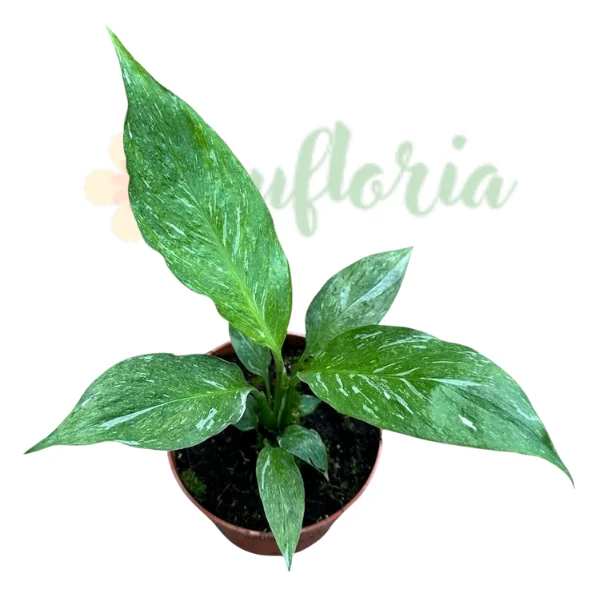
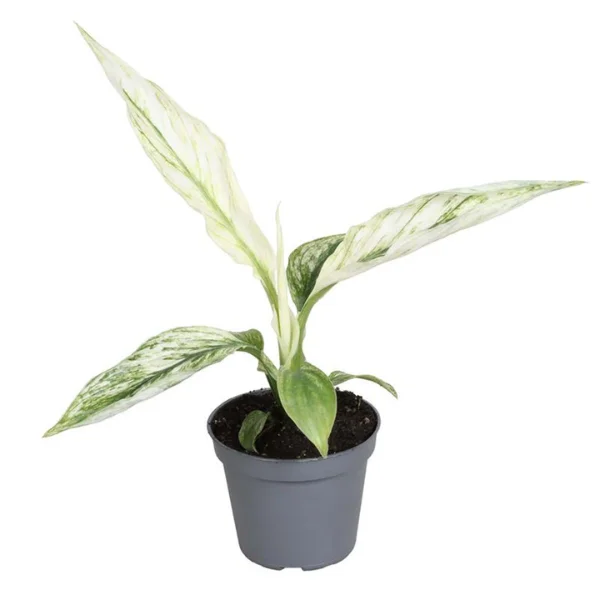
Dieffenbachia 'Sterling' is an elegant cultivar from the Araceae family, native to the tropical regions of Central and South America. Its large, glossy oval leaves are adorned with a distinctive silvery-cream pattern along the central vein and a fine sprinkle of light spots on the deep-green blade. Commonly known as Dumbcane, this tropical plant brings the exotic atmosphere of equatorial forests into modern interiors, being ideal for spaces with indirect light and moderate humidity.
Note: Product images are for guidance only. Due to different batches of imported products, there may be differences between the images on the website and the actual appearance of the products.
Approx height (including pot): 35 cm
Flowering state: No flowers
This plant will be imported after you order. It has a minim mandatory quantity.: If you want to order fewer quantities, contact us for a personalized offer
- Description
- Characteristics
- Reviews (0)
- FAQ
🌿 Silver Stars on Green Velvet — The Distinction of the Sterling Cultivar
Dieffenbachia 'Sterling' is an elegant decorative variety, obtained through horticultural selection from the species Dieffenbachia maculata, combining the vigor of erect stems with spectacular foliage marked by a distinctive silvery-cream pattern. Commonly known as Dumbcane — a name derived from the high content of calcium oxalate crystals that cause temporary tongue numbness if bitten — this tropical plant became iconic in the botanical aesthetic of the 1970s and 1980s and is now experiencing a strong revival in contemporary interiors.
The 'Sterling' cultivar stands out among the many Dieffenbachia varieties through the fine contrast between the deep green of the leaf blade and the broad, silver central vein. Like Aglaonema cultivars, the plant belongs to the aroid genera that are perfect for indirectly lit spaces. The species is recognized for its air-purifying capabilities, having been included in the famous NASA Clean Air Study alongside Spathiphyllum and Sansevieria.
🌍 Origin and Botanical History
The genus Dieffenbachia was first described in 1829 by the Austrian botanist Heinrich Wilhelm Schott, who named it in honor of Joseph Dieffenbach (1796-1863), the head gardener of the Imperial Botanical Garden of Schönbrunn in Vienna. The genus comprises about 50 species native to the tropical zones of Mexico, the Caribbean, Central America, and the Amazon Basin, where they grow in the humid understory of rainforests at altitudes up to 1,000 meters.
Dieffenbachia maculata, the parent species of the 'Sterling' cultivar, is native to Brazil and Costa Rica, where wild populations occupy forest edges and riverbanks. The epithet "maculata" comes from Latin and means "spotted", referring to the characteristic pattern of spots and streaks on the species' leaves. In its natural habitat, the plant can reach 1.5-2 meters in height.
🌱 Foliage
The leaves of Dieffenbachia 'Sterling' are its main decorative asset. Oval-elliptic, broad and elongated, they reach 25-40 cm in length and 12-18 cm in width at maturity. The blade texture is glossy, smooth to the touch, with a fleshy consistency. On the upper surface, the leaf shows a deep dark green at the margins, gradually opening toward the interior into a silvery-cream mosaic.
The distinctive characteristic of the 'Sterling' cultivar is the broad central vein, ranging from silver to light cream. Pale secondary veins branch off the main vein, creating a fine pinnate pattern. Against this background, a sprinkling of whitish spots and greenish streaks adds an almost impressionistic depth.
The stems are erect, succulent, light green with violet markings at the older nodes, giving the plant the appearance of tropical bamboo. At maturity, the stem can reach 3-5 cm in diameter and 60-90 cm in indoor cultivation.
🌸 Flowers
Although rarely flowering in indoor cultivation, Dieffenbachia can produce inflorescences typical of the Araceae family: an elongated, green-cream spathe wrapping a cylindrical spadix full of tiny unisexual flowers. The spathe is 12-20 cm long, partially open, and does not unfold as spectacularly as in Spathiphyllum, but has a discreet and botanically interesting charm.
Flowering usually occurs in mature plants over 5 years old. Many growers keep Dieffenbachia exclusively for the beauty of its foliage.
🪴 Growth and Care
Dieffenbachia 'Sterling' has moderate to rapid growth, adding 2-3 new leaves per growing season. Its erect habit, with leaves arranged in an ascending spiral, provides a vertical focal point in interior arrangements. It requires the same type of aerated substrate as Monstera deliciosa, ideal for places where natural light is filtered.
For practical care details and suitable accessories, check out the office plants category — Dieffenbachia 'Sterling' is one of the top choices for professional spaces with moderate light.
- Light: Bright, indirect light. Tolerates medium light, but the silvery variegation fades under prolonged shade. Avoid direct sunlight.
- Temperature: 18-26°C. Optimal 21-24°C.
- Watering: Constantly moist substrate, but not waterlogged. Summer: 1-2 times per week; winter: every 10-14 days.
- Humidity: 50-70%. Daily misting or humidifier.
- Substrate: Aerated, organic matter-rich: peat, perlite, pine bark (2:1:1).
- Fertilization: Monthly March-October, liquid fertilizer for green plants, half dilution.
- Propagation: Stem cuttings in water or moist substrate. Ideal in spring, above 22°C.
Lungime: 12 cm
Greutate (kg): 1 Kg
Denumire: Dieffenbachia
Diametru: 12 cm
Cerințe lumină: Strong, indirect light
Tip plantă: Decorative
Utilizare: Interior
Tip suport: Ghiveci
Material Suport: Plastic
Plante:
How is Dieffenbachia Sterling propagated?
Dieffenbachia Sterling is easily propagated through stem cuttings — cut a 10-15 cm section with at least one node, let the wound callus for 24h, then place in water (rooting in 3-4 weeks) or directly in moist substrate. Air layering is another method. Ideal in spring, at temperatures above 22°C. WARNING: wear gloves when cutting — the sap is irritating.
What substrate is suitable for Dieffenbachia Sterling?
Use an aerated substrate rich in organic matter: peat, perlite, and pine bark mix in 2:1:1 ratio. Universal substrate for green plants with added perlite is a suitable alternative. Optimal pH is slightly acidic, 5.5-6.5. Like Monstera deliciosa, the plant cannot tolerate compact, overly wet substrate which can cause root rot.
How much light does Dieffenbachia Sterling need?
Dieffenbachia Sterling prefers bright, indirect light — ideal near an east or west window, 1-2 meters away. The distinctive silvery variegation is accentuated in good light but fades in prolonged shade. Avoid direct sunlight, which burns the leaves. For other plants with similar requirements, see Aglaonema.
How often should Dieffenbachia Sterling be watered?
In summer, water every 5-7 days, keeping the substrate slightly moist but not waterlogged. In winter, reduce to every 10-14 days. Let the top 2-3 cm layer dry between waterings. Use water at room temperature. For other plants with similar moisture needs, see Spathiphyllum.
Is Dieffenbachia Sterling toxic to cats and children?
Yes, Dieffenbachia is TOXIC to humans and pets. It contains calcium oxalate crystals that cause severe mucous membrane irritation — burning of the mouth, swelling of the tongue, excessive salivation. It is NOT safe for households with small children or curious cats. For non-toxic plants safe for pets, choose Sansevieria (mild toxicity only) or other pet-safe species.
Recommendations
Ai nevoie și de un ghiveci decorativ?