EN/
EN/ Romana
Philodendron bipennifolium 'Aurea' Ø12cm
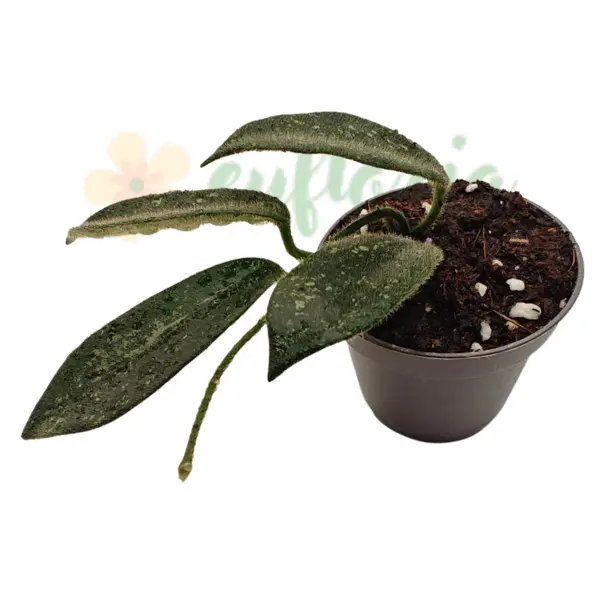
![Philodendron bipennifolium 'Aurea' — golden-chartreuse horse-head lobed leaves, Ø12cm pot Eufloria [1]](https://gomagcdn.ro/domains2/eufloria.ro/files/product/original/philodendron-bipennifolium-aurea-433518.png "Philodendron bipennifolium 'Aurea' — golden-chartreuse horse-head lobed leaves, Ø12cm pot Eufloria [1]")
Philodendron bipennifolium 'Aurea' — golden cultivar of the species known as Golden Horsehead or Golden Violin, with large asymmetrically lobed horse-head-shaped leaves in lime-green and golden chartreuse shades. Climbing plant for moss pole. Humidity 60-80%, bright indirect light, 18-28°C. Luminous choice for collectors.
Approx height (including pot): 35 cm
Pot diameter: 12 cm
- Description
- Characteristics
- Reviews (0)
- FAQ
🌿 Philodendron bipennifolium 'Aurea' — the golden horsehead, the gilded jewel of collectors
Philodendron bipennifolium 'Aurea', popularly known as Golden Violin Philodendron or Golden Horsehead, is a spectacular variety of the species Philodendron bipennifolium, famous for its large, deeply lobed horse-head-shaped leaves, wrapped in a brilliant golden-chartreuse hue. This cultivar is one of the most desired colored forms in the Philodendron world, a truly luminous botanical presence that transforms any space into a golden tropical corner.
Its leaves have the distinctive asymmetric-lobed shape, with 3-5 main lobes reminiscent of a horse's head silhouette or a musical violin shape. As the plant matures and gains vertical support, the leaves become larger and more deeply lobed, reaching 30-50 cm in length in mature plants. The golden-chartreuse color, obtained through genetic selection, contrasts spectacularly with the medium green of new leaves, offering a dynamic and unique chromatic palette.
Like all climbing Philodendrons, 'Aurea' benefits enormously from a moss pole — with support, the leaves grow to impressive sizes and shapes, and the plant develops the sculptural character that makes it so sought after by collectors. It is the perfect choice for enthusiasts who want a plant with a luminous and distinctive character, capable of bringing light and life to any corner of the home.
🌍 Botanical origin and history
Philodendron bipennifolium is an authentic species native to the humid tropical forests of southeastern Brazil, especially from the Mata Atlântica regions, where it grows as a hemiepiphytic climbing plant on tall tree trunks. It was discovered and scientifically described by Austrian botanist Heinrich Wilhelm Schott, pioneer of aroid studies in the 19th century, and the name "bipennifolium" translates from Latin as "with leaves in two feathers", referring to the distinctive deeply lobed shape.
The 'Aurea' (golden) cultivar is a selected color form of the species, appeared through spontaneous genetic mutation or through oriented selection in ornamental horticulture. The golden-chartreuse color is stable and transmissible through vegetative propagation, making this variety highly appreciated by collectors.
The Araceae family, to which the Philodendron genus belongs, comprises over 3,700 species distributed predominantly in tropical areas. The Philodendron genus includes approximately 500 species native to Central and South America. In its natural Brazilian habitat, P. bipennifolium grows in forests with humidity above 80% and constant temperatures between 20-28°C, clinging to tree trunks and developing increasingly impressive leaves as it climbs.
🌱 The distinctive golden foliage
The 'Aurea' foliage is its unique visual signature. Young leaves appear in shades of brilliant lime-green or intense chartreuse, and as they mature, they develop deeper golden tones with subtle green accents. The shape is distinctive — asymmetrically lobed, with 3-5 main lobes that give it the appearance of a "horse's head" or violin. Juvenile leaves are 10-15 cm, mature ones reach 30-50 cm in length.
The central vein is prominent and lighter in color than the rest of the leaf, drawing an elegant graphic pattern. The lateral veins are fine and curved, following the main lobes. The texture is slightly leathery and glossy, and the golden surface reflects light in a spectacular way, giving the plant an air of antique gold.
The petioles are robust and yellowish-green, sometimes with slight copper hues at the base. The plant develops aerial roots at nodes, essential for climbing and capturing moisture. Growth is moderate, with new leaves appearing every 3-5 weeks during the growing season.
🌸 The flowers
Philodendron bipennifolium 'Aurea' blooms very rarely in indoor culture. The flowers are typical Araceae — a cylindrical spadix wrapped in a cream-greenish or slightly violet spathe, appearing only on very mature plants.
The plant's attraction is exclusively the spectacular golden foliage, and flowering is considered a rare bonus. Reproduction is done exclusively by vegetative propagation to preserve the 'Aurea' color.
Natural pollination in the wild is carried out by specialized beetles of the Scarabaeidae family, but this process does not reproduce in apartment culture.
🌱 Growth habit and care
Philodendron bipennifolium 'Aurea' is a moderately demanding plant, suitable for intermediate collectors. The plant is a climber and BENEFITS enormously from a moss pole for optimal development of large leaves with distinctive shape.
Essential requirements for golden color and healthy foliage:
- Light: BRIGHT indirect — essential for maintaining the golden color. East or south-east windowsill. Weak light makes leaves appear more green. Avoid direct sun.
- Temperature: 18-28°C optimal; does not tolerate below 15°C.
- Watering: moderate — when the top 3-4 cm of substrate are dry. Every 7-10 days in summer, every 10-14 days in winter.
- Humidity: 60-80% ideal — humidifier recommended.
- Substrate: well-drained, airy — universal substrate + perlite (25%) + pine bark (15%).
- Support: moss pole essential for optimal development.
- Fertilization: every 3-4 weeks during growing season with balanced fertilizer diluted by half. Avoid excessive nitrogen fertilization which can diminish the golden color.
- Propagation: by tip cuttings with aerial roots and golden leaves to preserve the cultivar.
🌿 Why choose Philodendron bipennifolium 'Aurea'
It is the perfect choice for collectors who appreciate Philodendrons with distinctive color and sculptural character. The combination between the unique "horse's head" shape and the brilliant golden color makes this plant an immediate visual statement, suitable for modern, tropical-luxury or boho-chic arrangements. With proper care and appropriate support, the plant will develop increasingly larger and more golden leaves, becoming a luminous piece of pride in your botanical collection.
Lungime: 20 cm
Greutate (kg): 0.5 Kg
Denumire: Philodendron
Cerințe lumină: Partial umbra
Tip plantă: Decorative
Utilizare: Interior
Tip suport: Ghiveci
Material Suport: Plastic
Why is it called Golden Horsehead?
How to maintain the golden color?
How to water Golden Horsehead?
Is Golden Horsehead toxic?
How to make a cutting from 'Aurea'?
Ai nevoie și de un ghiveci decorativ?