EN/
EN/ Romana
Hoya parasitica 'Black Edge' Ø12cm
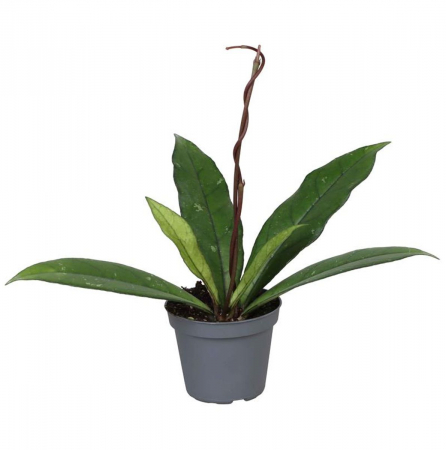
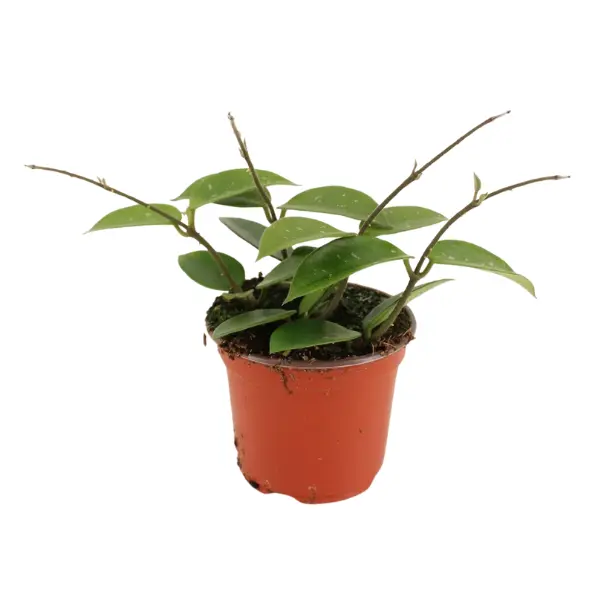
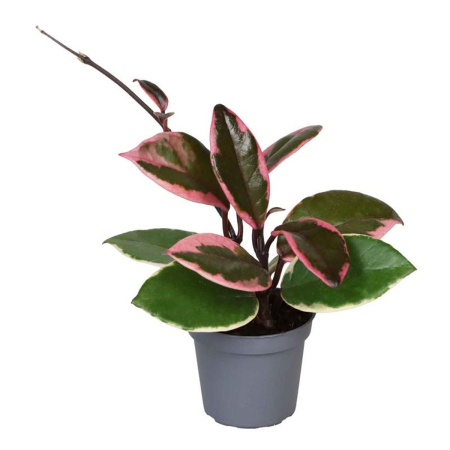
![Hoya parasitica 'Black Edge' — rare cultivar with oval-elongated intense-green leaves and dramatic dark edges, umbels of cream-white star-shaped flowers, collector Hoya [1]](https://gomagcdn.ro/domains2/eufloria.ro/files/product/original/hoya-parasitica-black-edge-716027.png "Hoya parasitica 'Black Edge' — rare cultivar with oval-elongated intense-green leaves and dramatic dark edges, umbels of cream-white star-shaped flowers, collector Hoya [1]")
Hoya parasitica 'Black Edge' is a refined cultivar from the Apocynaceae family, selected for its oval-elongated intense-green foliage with dramatic almost-black dark edges. Umbels of cream-white star-shaped flowers with dark pink corona subtly perfume rooms in the evening. A robust species native to Southeast Asia, perfect for collectors who appreciate graphic chromatic contrast.
Approx height (including pot): 15 cm
Flowering state: No flowers
Pot diameter: 12 cm
- Description
- Characteristics
- Reviews (0)
- FAQ
🌿 Hoya parasitica 'Black Edge' — The Dark Elegance of Contrasting Foliage
Hoya parasitica 'Black Edge' is a refined cultivar of one of the most widespread and variable Hoya species in Southeast Asia. What makes this variety truly remarkable is its chromatic signature — oval-elongated leaves of intense green, outlined by fine, dark edges in a nearly black deep-green tone, giving each leaf the appearance of a fine-ink botanical illustration. The visual effect is both dramatic and refined, turning the plant into a powerful decorative element in any tropical plant collection.
The vining stems, firm and flexible, support opposite pairs of waxy leaves with thick, semi-succulent texture. Each leaf measures between 8 and 13 centimeters in length and 4–6 centimeters in width, and the dark edge can vary in intensity from a thin brownish line to a prominent black contour, depending on the light received and the maturity of the leaf. Under optimal light conditions, the edges become even darker, intensifying the contrast with the green center.
At the offered size — Ø12cm pot — the plant is mature, with already developed stems and rich foliage, ready to be integrated into a serious collection or become the focal point of a tropical arrangement. It is a plant that immediately impresses through its elegance, without needing tricks — the foliage alone is enough to draw admiring glances.
🌍 Origin and Botanical History
Hoya parasitica is one of the most widely distributed species in the Hoya genus, with a remarkable range extending from India and Bangladesh, through Thailand, Peninsular Malaysia, Indonesia and southern China. It was scientifically described in 1834 by the British botanist William Roxburgh, nicknamed the "father of Indian botany", in his monumental work "Flora Indica". The species name — parasitica — is a historical designation describing the plant's epiphytic habit (which "lives on" other plants), although Hoya is not parasitic in the strict sense, but an autonomous epiphyte.
The Hoya genus was established in 1810 by the Scottish botanist Robert Brown, who named it in honor of his friend Thomas Hoy, head gardener to the Duke of Northumberland. Today the genus comprises over 200 recognized species, spread from India and the Himalayas to the Malay Archipelago, Australia and the Pacific Islands, all being epiphytic or hemi-epiphytic plants with waxy, fragrant flowers.
The 'Black Edge' cultivar is a modern horticultural selection, particularly appreciated by collectors for its distinct chromatic contrast. Unlike the typical form of the species, which features uniformly green leaves, 'Black Edge' constantly retains its dark signature, making it a safe choice for those seeking a plant with immediate visual personality.
🌱 The Foliage
The foliage is the defining characteristic of this cultivar. The oval-elongated leaves, with subtly pointed tip and rounded base, have impressive dimensions (8–13 cm length, 4–6 cm width) and a thick, waxy-succulent texture characteristic of robust Hoyas. The upper surface is smooth, slightly glossy, and the base color varies between medium green and deep green, sometimes with discrete olive hues in strong light.
The dark edge, the feature that gives the cultivar its name, clearly stands out from the green center of the leaf — a thin line to a band of 2–4 millimeters wide, of very deep green to nearly black tone. In the right light (indirect but bright), this edge visibly intensifies, giving the plant a graphic, almost stylized look. Young leaves often appear with a slightly pinkish tint at the tip, which gradually disappears as the leaf matures and consolidates its pigmentation.
The central venation is slightly prominent on the underside, and secondary veins are discrete but visible in oblique light. The leaves grow in opposite pairs, evenly spaced along the stems, creating a balanced architectural silhouette.
🌸 The Flowers
The flowers of Hoya parasitica 'Black Edge' appear in spherical umbels consisting of 15–30 small star-shaped flowers, of delicate cream-white with a dark pink or reddish-brown central corona, creating a subtle but refined contrast. Each flower measures approximately 1 centimeter in diameter and has the waxy surface characteristic of the genus, as if sculpted from porcelain.
The fragrance is sweet and floral, with discreet notes of honey and caramel, more intense in the evening and during the night. A blooming umbel can persist in decorative state for 5–10 days, subtly perfuming well-ventilated rooms. The flowering period typically extends between late spring and autumn, and mature plants can produce several umbels simultaneously on different stems.
The flower peduncles (also called "spurs") are perennial — DO NOT cut them after flowers fall, as the plant will produce new umbels on the same structure in subsequent years. A mature, well-cared-for plant forms its collection of peduncles over time, becoming ever more generous with flowers.
🌱 Growth Habit and Development
Hoya parasitica 'Black Edge' is a plant with moderately fast growth for the genus, more vigorous than many other collector Hoyas due to the robustness of the parent species. It develops vining stems that can reach 1–2 meters in a few years of cultivation, naturally clinging to supports or flowing elegantly over the edge of the pot. It is ideal for hanging pots, wall baskets, minimalist trellises or vertical moss supports.
The roots are adapted to epiphytism — they prefer airy, well-drained substrates and slightly snug pots. Frequent repotting is not necessary; once every 2–3 years is sufficient, with a pot only slightly larger than the previous one.
For a healthy plant with a well-accentuated edge, follow these requirements:
- Light: bright indirect, essential both for intensifying the dark edge and for inducing flowering. East- or west-facing windowsill ideal. Insufficient light diminishes the chromatic contrast.
- Temperature: 18–28°C optimal; does not tolerate below 12°C. Night/day difference of 3–5°C in spring stimulates flowering.
- Watering: moderate; let the substrate dry almost completely between waterings. Once every 7–10 days in summer, every 2–3 weeks in winter. Overwatering is the main cause of mortality.
- Humidity: 50–70% ideal; adapts to 40% as well. Weekly misting keeps leaves clean and stimulates growth.
- Substrate: airy, well-drained, for epiphytic or orchid plants — pine bark + perlite + sphagnum + activated charcoal.
- Fertilization: every 3–4 weeks during the growing season with balanced liquid fertilizer diluted by half. Higher phosphorus in spring stimulates flowering.
- Propagation: via stem cuttings with 2–3 nodes, rooted in water, moist sphagnum or perlite; spring and summer are the optimal periods.
🌸 Why Choose the 'Black Edge' Cultivar
Hoya parasitica 'Black Edge' is a plant for collectors who appreciate chromatic contrast and graphic elegance. The distinct foliage — intense green with dark edges — offers immediate visual impact, perfect for compositions with variegated plants or light-foliage plants, where the black edge creates a point of interest through contrast. Add to this the characteristic resilience of the Hoya parasitica species (one of the most robust in the genus), fragrant flowers and elegant vining silhouette, and the result is a specimen that will enrich any serious tropical plant collection.
Lungime: 35 cm
Greutate (kg): 1 Kg
Denumire: Hoya
Diametru: 12 cm
Cerințe lumină: Lumina indirectă
Tip plantă: Plantă agățătoare
Utilizare: Interior
Tip suport: Ghiveci
Material Suport: Plastic
Why does Hoya parasitica Black Edge have dark edges?
Is Hoya parasitica Black Edge suitable for beginners?
Is Hoya parasitica Black Edge toxic?
When does Hoya parasitica Black Edge bloom?
How do you propagate Hoya parasitica Black Edge?
What makes the 'Black Edge' cultivar distinct?
How do I intensify the black edge of the leaves?
How often should it be watered?
Is Hoya parasitica 'Black Edge' toxic?
When and how does it flower?
Ai nevoie și de un ghiveci decorativ?