
 EN/
EN/ Romana
Hoya 'Mathilde Splash' Ø6cm
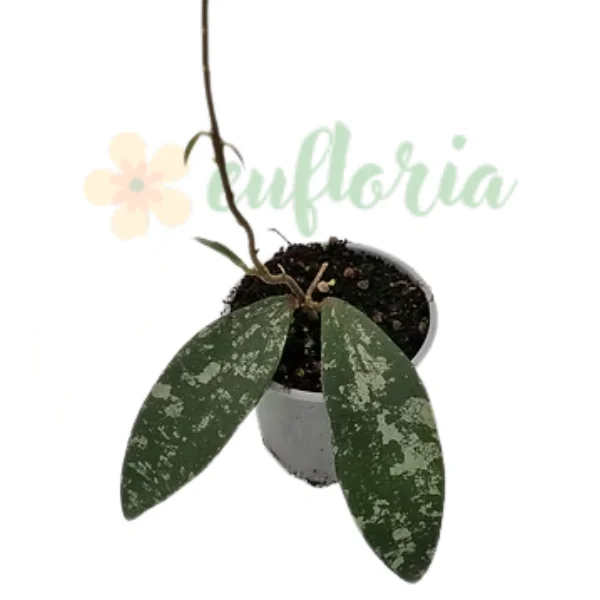
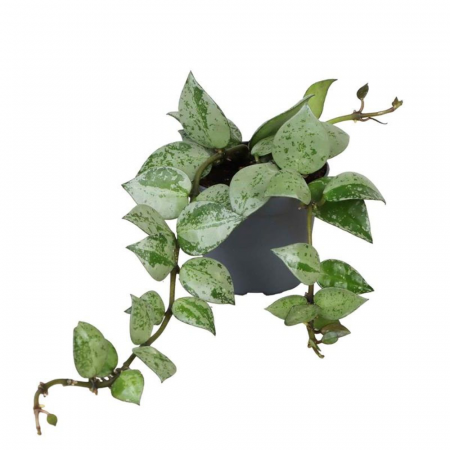
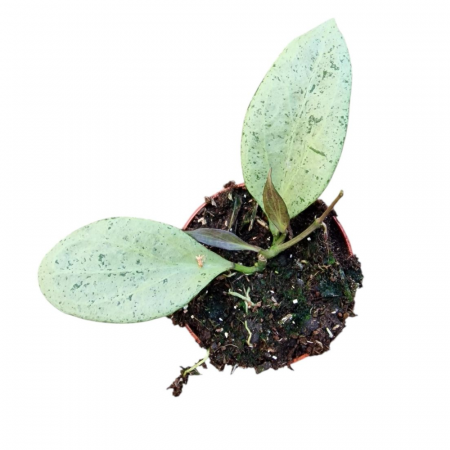
![Hoya 'Mathilde Splash' — Hoya with small round leaves covered in shimmering silver splashes [1]](https://gomagcdn.ro/domains2/eufloria.ro/files/product/original/hoya-mathilde-splash-d6-266709.png "Hoya 'Mathilde Splash' — Hoya with small round leaves covered in shimmering silver splashes [1]")
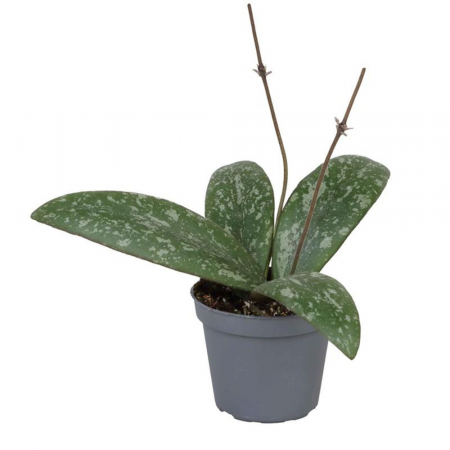
Hoya 'Mathilde Splash' is a rare and exceptionally decorative Hoya variety, obtained through natural hybridisation between Hoya carnosa and Hoya serpens. It stands out for its small, round leaves covered with shimmering silver splashes that give it a remarkably elegant appearance. Compact and easy to care for, ideal for hanging pots or shelves.
Approx height (including pot): 20 cm
Flowering state: No flowers
Country of origin: Netherlands
- Description
- Characteristics
- Reviews (0)
- FAQ
🌿 Hoya 'Mathilde Splash' — the elegance of silver leaves in a miniature Hoya
Some plants captivate through imposing dimensions, others through spectacular flowers, but Hoya 'Mathilde Splash' belongs to an entirely different category: plants that fascinate through the refinement of every detail. Its small, perfectly round leaves, covered with shimmering silver splashes that appear hand-painted, transform this Hoya into a true botanical jewel. It is the kind of plant that makes you stop and admire it every time you walk past.
Hoya 'Mathilde Splash' is a fascinating natural hybrid, resulting from the spontaneous crossing of two very different species: Hoya carnosa, robust and vigorous, and Hoya serpens, delicate and miniature. This genetic combination has produced a plant that blends the best of both worlds: the resilience and easy care of Hoya carnosa with the delicacy and compact dimensions of Hoya serpens. The 'Splash' variant is distinguished from the standard Hoya Mathilde by the abundant silver spots covering the leaf surface, a spectacular visual effect known among collectors as the 'splash pattern'.
Initially discovered in cultivation rather than in nature, this Hoya quickly earned a special place in collectors' hearts worldwide. The name 'Mathilde' was given to this hybrid in honour of a passionate European grower's daughter, while the 'Splash' variant represents a selection with more pronounced silvering than the standard form. It is a plant with personality that grows slowly but surely, rewarding patience with an increasingly impressive vegetal display as it matures.
🌍 Origin and Botanical History
Hoya 'Mathilde' is not a natural species but a spontaneous hybrid that appeared in cultivation from the crossing of Hoya carnosa and Hoya serpens. Hoya carnosa, one of the most widespread species in the genus, is native to East Asia (southern China, Taiwan, Japan), where it grows as an epiphyte in subtropical forests at altitudes of 200-1,500 m. Hoya serpens, the other parent, originates from the montane forests of the Himalayas (Nepal, Bhutan, northeastern India), at altitudes of 1,200-2,500 m — a significantly cooler and wetter environment.
According to the World Checklist of Selected Plant Families (WCSP) maintained by Kew Gardens, the Hoya genus comprises over 500 described species, belonging to the Apocynaceae family (subfamily Asclepiadoideae). Natural and artificial hybrids are relatively common in this genus due to the high genetic compatibility between species. Hoya Mathilde was first documented in European collections in the 1990s, and the 'Splash' variant was subsequently selected for its more pronounced silver pattern.
The dual genetic heritage explains this plant's remarkable adaptability: from Hoya carnosa it inherited tolerance to varied temperature (15-28°C) and light conditions, while from Hoya serpens it took the compact leaf dimensions and semi-trailing habit that make it ideal for hanging pots. Climatologically, the two parent species cover a broad spectrum: from Hoya carnosa's tropical-subtropical range (20-30°C, 1,000-2,000 mm/year rainfall) to Hoya serpens' temperate montane range (15-25°C, 2,000-3,000 mm/year).
🌱 The Foliage — silver paintings on a green canvas
The leaves are without doubt the defining element of Hoya 'Mathilde Splash', setting it apart from thousands of other species and hybrids in the Hoya genus. Measuring 2-4 cm in length and 1.5-3 cm in width, they are remarkably small compared to most Hoya species — a clear inheritance from Hoya serpens, which has some of the smallest leaves in the entire genus. The shape is round to slightly ovate, with a discreetly pointed tip, and the surface presents a slight convexity that gives them a full, healthy appearance.
The defining trait of the 'Splash' variant is the silver pattern covering the upper leaf surface. These silver spots, caused by air pockets between the cellular layers of the epidermis (a botanical phenomenon known as 'splash' or 'fleck'), reflect light in a way that makes each leaf appear dusted with stardust. The splash intensity varies from leaf to leaf and is influenced by light conditions: in strong indirect light, the silver spots become more visible and luminous.
The leaf texture is thick and semi-succulent, with a protective waxy layer (cuticle) that lends a subtle natural sheen. To the touch, they feel firm, smooth, and pleasantly cool. The base colour is a medium to dark green that serves as the perfect backdrop for the silver splashes. Young leaves typically emerge with less splash, which intensifies as the leaf matures and hardens — a fascinating process to observe.
The petioles are short and thin, 3-5 mm, holding the leaves close to the vine. This compact arrangement creates a dense, rich visual effect, especially on mature specimens with long vines completely covered in leaves. Compared to standard Hoya Mathilde (without splash), the Splash variant has the same morphology and dimensions but with the added silver effect that makes it significantly more sought after and valuable on the collectors' market.
🌸 The Flowers — miniature perfumed stars
Like all species and hybrids in the Hoya genus, Hoya 'Mathilde Splash' produces waxy flowers grouped in spherical umbels — but on a miniature scale befitting its compact dimensions. Each umbel contains 5-15 individual flowers, each measuring just 8-12 mm in diameter. The floral structure is typically Hoya: a white to pale pink outer corolla, waxy and gleaming, with a pink-reddish inner corona that provides a delicate contrast.
The fragrance is sweet and pleasant, with notes of vanilla and honey, more intense in the evening and night when the flowers attract their natural pollinators. Though more subtle than the scent of large species such as Hoya imperialis, the aroma of Hoya Mathilde Splash is strong enough to be detected from 1-2 metres away, especially in an enclosed space. The abundant nectar secreted by the flowers glistens like crystal droplets on the corolla surface.
Flowering requires patience: the plant must be mature (minimum 2 years from rooting), receive strong indirect light, and benefit from a cooler period of 4-6 weeks at 16-18°C during winter to stimulate floral bud initiation. The peduncles are perennial — do NOT cut them after flowering! They will produce new series of flowers year after year. The flowering period typically extends from April to September. A mature plant can simultaneously produce 2-5 umbels, offering a prolonged display lasting several weeks.
🌱 Growth, care and development
Hoya 'Mathilde Splash' has a slow to moderate growth rate, adding approximately 10-20 cm of new vine per year under optimal conditions. Its habit is trailing-climbing: the thin, flexible vines can wind around a support or trail freely from a hanging pot, creating a particularly decorative vegetal cascade effect. At maturity, a well-tended plant can develop vines 1-2 metres in length, completely covered with silver leaves.
Thanks to its genetic inheritance from Hoya carnosa, this Hoya is one of the most tolerant and forgiving in indoor plant collections. It tolerates occasional neglect in watering, adapts to varied light conditions, and does not require extremely high humidity — making it accessible to both experienced collectors and passionate beginners.
Branching is moderate: vines produce lateral branches spontaneously, but the process can be stimulated through light tip pruning. Each node can emit adventitious roots if it comes into contact with a moist substrate, making propagation extremely simple.
Detailed care requirements:
- Light: Bright indirect light, equivalent to 8,000-20,000 lux. Ideally near east or west-facing windows. In strong light, the silver splashes become more visible and luminous. Tolerates moderate light (5,000-8,000 lux) but growth will be slower and splash less pronounced. Direct summer sun can scorch the delicate leaves.
- Temperature: Optimal 18-28°C daytime, 15-20°C nighttime. Tolerates minimums of 10°C for short periods (Hoya serpens heritage, which grows at high altitudes). A cooler period of 4-6 weeks at 16-18°C during winter stimulates flowering the following season.
- Watering: Moderate — allow the substrate to dry 80% between waterings. Summer: once every 7-10 days; winter: every 14-21 days. The semi-succulent leaves store water, making the plant tolerant of neglect. Use filtered water at room temperature. Avoid stagnant water in the saucer.
- Humidity: 50-70% ideal, but tolerates 40-50% without visible problems. The waxy leaves reduce water loss. A humidifier helps during winters with central heating but is not strictly necessary.
- Substrate: Airy and well-draining: 40% pine bark (5-10 mm), 25% perlite, 20% sphagnum moss, 15% horticultural charcoal. pH 5.5-6.5. Small pots (6-9 cm) in terracotta or plastic with good drainage. Do not oversize the pot — Hoyas prefer being slightly root-bound.
- Fertilisation: Balanced liquid fertiliser (NPK 20-20-20) diluted to half strength, once monthly during the growing season (March-September). A higher-phosphorus fertiliser (NPK 10-30-20) in March-April stimulates flowering.
- Propagation: Via vine cuttings of 5-10 cm with 2-3 nodes. Roots appear in 2-4 weeks at 22-25°C and 70% humidity. One of the easiest Hoya species to propagate — success rate exceeds 90% under correct conditions.
Hoya 'Mathilde Splash' is a plant of excellent longevity: well-cared-for specimens can live 10-15 years or more, becoming increasingly spectacular as vines lengthen and branch. It is one of the few Hoyas that looks impressive both as a young plantlet with a few perfect silver leaves and as a mature specimen with cascades of shimmering foliage that catch the light in ever-new ways.
Lungime: 10 cm
Greutate (kg): 0.25 Kg
Denumire: Hoya
Diametru: 6 cm
Cerințe lumină: Partial umbra
Tip plantă: Decorative
Utilizare: Interior
Tip suport: Ghiveci
Material Suport: Plastic
How often should I water Hoya Mathilde Splash?
Allow substrate to dry 80% between waterings. Water every 7-10 days in summer, 14-21 days in winter. Semi-succulent leaves store water, making the plant tolerant of neglect. Use filtered water at room temperature.
Is Hoya Mathilde Splash toxic to cats and dogs?
No. According to ASPCA, the Hoya genus is not listed among plants toxic to dogs, cats, or horses. Hoya Mathilde Splash is considered non-toxic, though ingestion of any plant may cause minor gastric discomfort.
What is the ideal substrate for Hoya Mathilde Splash?
Airy substrate: 40% pine bark, 25% perlite, 20% sphagnum, 15% horticultural charcoal. pH 5.5-6.5. Small pots with good drainage — Hoyas prefer being slightly root-bound. Avoid compact universal mix.
Why is my Hoya Mathilde Splash not flowering?
Possible causes: plant not mature enough (minimum 2 years), insufficient light, lack of cool winter period (4-6 weeks at 16-18°C), or cutting old peduncles. Peduncles are perennial and will produce new flowers — do not cut them.
How do I propagate Hoya Mathilde Splash?
Via vine cuttings of 5-10 cm with 2-3 nodes. At 22-25°C and 70% humidity, roots appear in 2-4 weeks. Success rate exceeds 90%. Optimal period: April-May. One of the easiest Hoyas to propagate.
Ai nevoie și de un ghiveci decorativ?







