EN/
EN/ Romana
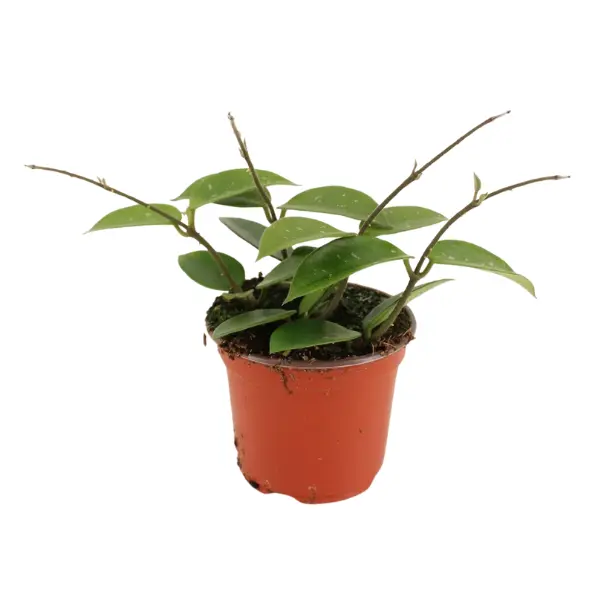
Hoya lacunosa 'Green Flame'
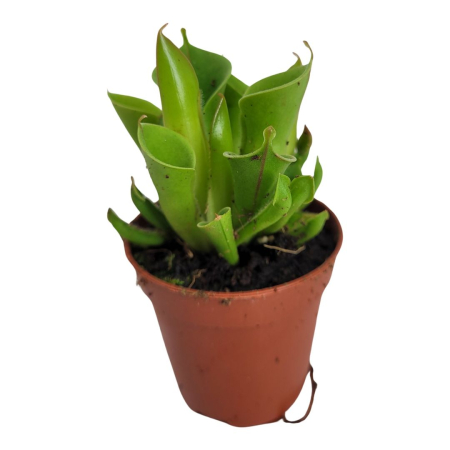
![Hoya lacunosa ‘Green Flame’ — silver-marbled leaves with central green flame pattern, rare wax plant cultivar [1]](https://gomagcdn.ro/domains2/eufloria.ro/files/product/original/hoya-lacunosa-golden-flame-copie-918581.webp "Hoya lacunosa ‘Green Flame’ — silver-marbled leaves with central green flame pattern, rare wax plant cultivar [1]")
Hoya lacunosa ‘Green Flame’ is a rare cultivar from the Apocynaceae family, prized by collectors for small, elliptical leaves decorated with silver marbling and a central lime-green flame-shaped pattern. Its waxy, cream-white flowers, gathered in compact umbels, release a sweet-spicy fragrance in the evening with notes of cinnamon.
Note: this plant is imported from Indonesia strictly on a prepaid pre-order basis. It is dispatched as soon as it arrives, packed in moist sphagnum moss, without pot or substrate; minor cosmetic flaws may appear due to transit duration.
Flowering state: No flowers
Country of origin: Indonesia
Pot diameter: (no pot)
Nodes: 5+
- Description
- Characteristics
- Reviews (0)
- FAQ
🌿 Silver Flame of the Tropical Jungle
Hoya lacunosa ‘Green Flame’ is a rare cultivar of the species Hoya lacunosa, one of the most beloved miniature-leaved hoyas in contemporary collections. This selection stands out through its small, elliptical leaves arranged alternately on slender vines, each leaf carrying a dense silver marbling layered over a deep emerald canvas, crossed in the centre by a flame-shaped lime-green pattern that gives the cultivar its name.
Naturally epiphytic, ‘Green Flame’ grows slowly but steadily, forming fine cascades of foliage that perform magnificently in hanging baskets, on moss poles, or in tall pots from which the vines can drape freely. Its airy, almost miniature appearance makes it a centrepiece of any serious botanical collection, and the combination of graphic foliage and waxy fragrant flowers transforms it into a plant for which collectors worldwide pay considerable prices.
Within the species Hoya lacunosa, several cultivated selections exist — ‘Royal Flush’, ‘Eskimo’, ‘Pallidiflora’ — but ‘Green Flame’ is particularly prized for its strong chromatic contrast and the stability of its pattern from leaf to leaf. Unlike unstable variegations, the silver marbling of this cultivar remains constant on every new leaf, making it a safe acquisition for enthusiasts who pursue strict aesthetic standards.
🌍 Origin and Botanical History
The species Hoya lacunosa was first described by the German botanist Karl Ludwig Blume in 1826, in his fundamental work Bijdragen tot de flora van Nederlandsch Indië, which documented the flora of the Indonesian archipelago under Dutch administration. The species name derives from the Latin lacuna, meaning ‘gap’ or ‘cavity’, a reference to the small depressions visible on the surface of mature leaves.
In its natural habitat, Hoya lacunosa is widely distributed along the Malay Peninsula, across the islands of Sumatra, Java, Borneo, and the Philippines, extending into Thailand and southern Vietnam. It grows epiphytically, clinging to the bark of tall trees in humid tropical forests, at altitudes between 200 and 1,200 metres, in conditions of high humidity and dappled light filtered through the dense jungle canopy.
The ‘Green Flame’ cultivar is a recent horticultural selection, identified in Indonesian nurseries and propagated vegetatively to preserve its distinctive traits — the dense silver marbling and the central lime-green flame. Unlike the species type, which has uniformly green leaves with slightly impressed veins, this cultivar shows a vivid expression of silver pigments resulting from a special distribution of mesophyll cells.
🌱 The Foliage
The leaves of ‘Green Flame’ are small and delicate, averaging 2-4 centimetres in length and 1-2 centimetres in width, with an elongated elliptical shape and a slightly pointed tip. The texture is firm and semi-succulent, with a matte-glossy surface that reflects light differently depending on the angle — under direct light, the silver marbling shines metallically, while in diffused light it acquires a silky, almost velvety quality.
The chromatic pattern is what makes this cultivar exceptional: a deep, almost emerald-green background is covered almost entirely by silver speckles arranged like a starry sky, while a lime-green flame-shaped line descends through the centre of each leaf, branching towards the tip in the silhouette of a fire. This central flame is the unmistakable signature of the cultivar and the criterion by which authentic plants are distinguished from similar selections sold under the same name.
Young leaves emerge initially in a pale green hue with subtle marbling, but develop their full silver pigmentation as they mature over a period of roughly two to three months. On mature vines, the leaves are arranged opposite, in regular pairs at intervals of 2-4 centimetres, giving the vines an orderly, almost architectural look.
A fascinating peculiarity is how the marbling responds to light and seasonality: in summer months with intense light, the silver becomes almost metallic and takes on slightly bluish reflections, while in winter, when days are short, the marbling appears denser, as if the plant concentrated its aesthetic resources during the months of vegetative rest. This behaviour of silver pigments is likely linked to the layer of calcium crystals in the leaf mesophyll, which diffracts light differently depending on cellular hydration.
🌸 The Waxy Fragrant Flowers
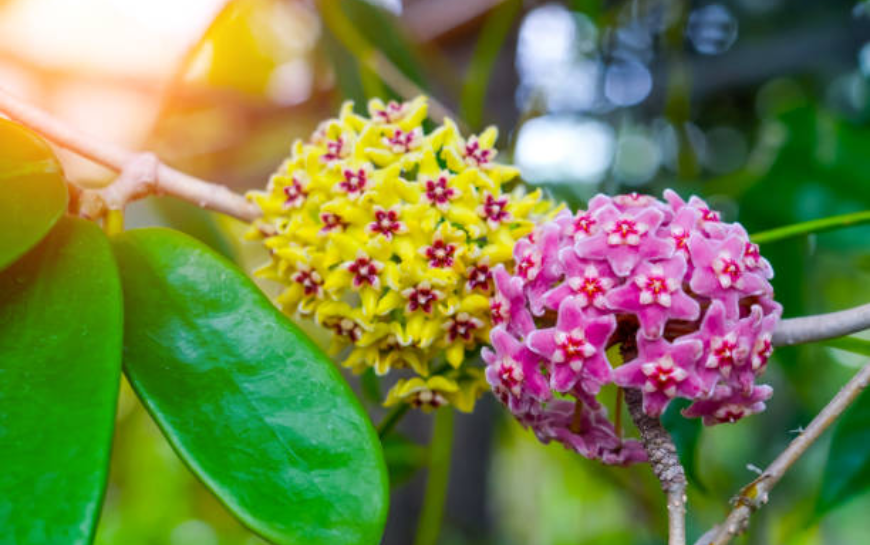
At maturity, ‘Green Flame’ produces compact clusters, botanically known as umbels, made up of 15 to 25 small flowers, each measuring approximately 7-10 millimetres in diameter. The flowers are star-shaped, with five waxy petals in cream-white or pale yellow, arranged symmetrically around a central pinkish-cream corona, lending them that distinctive ‘wax-sculpted’ appearance characteristic of the genus Hoya.
The fragrance of the flowers is one of the most surprising qualities of this species — a sweet-spicy bouquet with clear notes of cinnamon, vanilla, and orange blossom, intensifying dramatically in the evening after sunset. This nocturnal olfactory strategy attracts moth pollinators in the natural habitat and turns a single blooming umbel into a memorable sensory experience for the home grower.
Flowering typically occurs in late summer and autumn, on short, perennial peduncles that should not be cut after the flowers fade — the same structure will produce flowers year after year. A mature plant grown in optimal conditions can bloom several times in a season and produce multiple umbels simultaneously on different vines.
🌱 Growth and Development
‘Green Flame’ is a slow- to moderate-growing hoya with a slender, semi-climbing habit that suits both hanging pots and moss poles or bark totems. In optimal conditions, the plant can produce 30-50 centimetres of new growth per year, developing branched vines that, over time, form a dense cascade of marbled foliage.
The species is among the most accessible hoyas for beginners, but to obtain maximum expression of the silver marbling and consistent flowering, attention to light, humidity, and watering rhythm is required. Unlike hoyas with larger and more succulent leaves, ‘Green Flame’ appreciates extremely well-drained substrates and a slight drying period between waterings.
Indoors, ‘Green Flame’ benefits enormously from a brief, controlled period of water stress before flowering — a reduction in watering for 2-3 weeks, followed by resumption of the normal regime, stimulates the production of new flower peduncles. The technique is frequently used by experienced collectors to synchronise blooming across several specimens at the same time.
- Light: bright, indirect; ideally near an east- or west-facing window with sheer curtains. Prolonged direct sun fades the silver marbling.
- Temperature: optimal range 18-28°C, avoid exposure below 15°C; the species is intolerant of cold drafts.
- Watering: moderate; allow the substrate to dry on the surface between waterings; reduce frequency by about half in winter.
- Humidity: 60-70%, ideally a slightly humid environment; tolerates short periods of drier air without visible effects.
- Substrate: highly aerated mix of coconut fibre, perlite, fine pine bark, and sphagnum moss; slightly acidic pH, 6.0-6.5.
- Fertilisation: flowering-plant or orchid fertiliser, monthly in spring-summer, diluted to half strength; no fertilisation in winter.
- Propagation: stem cuttings with 2-3 nodes, rooted in moist sphagnum moss or water within 3-5 weeks at 22-26°C.
The full collection of hoya plants on Eufloria reflects our passion for rare and authentic cultivars, and ‘Green Flame’ is one of the most graphic specimens currently available.
📚 Related blog articles
Denumire: Hoya
Diametru: (fără ghiveci)
Cerințe lumină: Partial umbra
Tip plantă: Decorative
Utilizare: Interior
How are Hoya lacunosa plants imported from Indonesia packaged?
What is the ideal substrate for Hoya lacunosa ‘Green Flame’?
When and how does Hoya lacunosa ‘Green Flame’ bloom?
Is Hoya lacunosa toxic to cats and dogs?
How is Hoya lacunosa ‘Green Flame’ propagated?
Ai nevoie și de un ghiveci decorativ?