EN/
EN/ Romana
Begonia 'Indian Summer' Ø12cm
![Begonia 'Indian Summer' — Rex leaves with coral pink and metallic silver patterns, Ø12cm pot Eufloria [0]](https://gomagcdn.ro/domains2/eufloria.ro/files/product/medium/begonia-indian-summer-448060.png "Begonia 'Indian Summer' — Rex leaves with coral pink and metallic silver patterns, Ø12cm pot Eufloria [0]")
![Begonia 'Indian Summer' — Rex leaves with coral pink and metallic silver patterns, Ø12cm pot Eufloria [1]](https://gomagcdn.ro/domains2/eufloria.ro/files/product/medium/planta-naturala-de-interior-begonia-indian-summer-d12-001277.png "Begonia 'Indian Summer' — Rex leaves with coral pink and metallic silver patterns, Ø12cm pot Eufloria [1]")
![Begonia 'Indian Summer' — Rex leaves with coral pink and metallic silver patterns, Ø12cm pot Eufloria [2]](https://gomagcdn.ro/domains2/eufloria.ro/files/product/medium/planta-naturala-de-interior-begonia-indian-summer-d12-795188.png "Begonia 'Indian Summer' — Rex leaves with coral pink and metallic silver patterns, Ø12cm pot Eufloria [2]")
![Begonia 'Indian Summer' — Rex leaves with coral pink and metallic silver patterns, Ø12cm pot Eufloria [1]](https://gomagcdn.ro/domains2/eufloria.ro/files/product/original/begonia-indian-summer-448060.png "Begonia 'Indian Summer' — Rex leaves with coral pink and metallic silver patterns, Ø12cm pot Eufloria [1]")
![Begonia 'Indian Summer' — Rex leaves with coral pink and metallic silver patterns, Ø12cm pot Eufloria [2]](https://gomagcdn.ro/domains2/eufloria.ro/files/product/original/planta-naturala-de-interior-begonia-indian-summer-d12-001277.png "Begonia 'Indian Summer' — Rex leaves with coral pink and metallic silver patterns, Ø12cm pot Eufloria [2]")
![Begonia 'Indian Summer' — Rex leaves with coral pink and metallic silver patterns, Ø12cm pot Eufloria [3]](https://gomagcdn.ro/domains2/eufloria.ro/files/product/original/planta-naturala-de-interior-begonia-indian-summer-d12-795188.png "Begonia 'Indian Summer' — Rex leaves with coral pink and metallic silver patterns, Ø12cm pot Eufloria [3]")
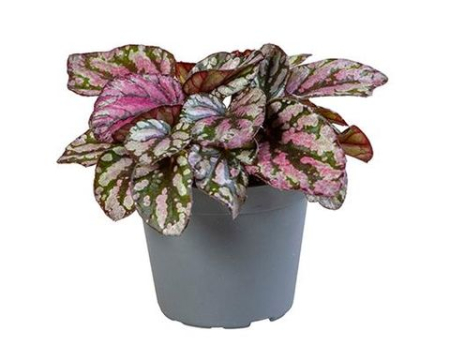
Begonia 'Indian Summer' — Rex cultivar with spectacular foliage in shades of coral pink, metallic silver and deep green. Asymmetrical velvety leaves, seemingly hand-painted. Prefers high humidity (60-80%), bright indirect light and constant temperatures (18-24°C). Rhizomatous plant perfect for collectors and large terrariums.
Approx height (including pot): 20 cm
Pot diameter: 12 cm
- Description
- Characteristics
- Reviews (0)
- FAQ
🌿 Begonia 'Indian Summer' — a living painting in tropical sunset hues
Begonia 'Indian Summer' is one of the most spectacular Begonia Rex cultivars, celebrated in the world of ornamental plant collectors for its stunning foliage, seemingly hand-painted in shades of coral pink, brilliant silver, deep purple and metallic dark green. This hybrid variety brings to our homes a vibrant chromatic explosion, a botanical scene that seems lifted from a tropical sunset over the jungles of Southeast Asia, the homeland of its parent species.
Its asymmetrical leaves, twisted heart-shaped, are true works of natural art — each vein is outlined by strong contrasts between warm and cool tones, with the upper surface covered in a velvety texture that reflects light like satin. In morning light, the leaves take on a metallic silver sheen, and in the evening, as the light fades, the pink and purple shades become deeper and more dramatic, creating a visual spectacle that changes with the time of day.
Begonia 'Indian Summer' is not just a decorative plant, but a style statement — a presence that transforms any corner of the house into a living art space. Rhizomatous by nature, the plant develops thick, fleshy stems on the surface of the substrate, giving rise to progressively larger and more colorful leaves as the plant matures. For plant lovers who appreciate spectacular foliage more than flowers, this is one of the most rewarding choices.
🌍 Botanical origin and history
The 'Indian Summer' cultivar belongs to the Begonia Rex-Cultorum group, a group of hybrids developed in the 19th century in Europe from the wild species Begonia rex, discovered by British botanists in 1856 in the Assam mountains of northeastern India. The original species was transported to England and crossed with other Asian Begonia species, including Begonia diadema and Begonia decora, giving rise to thousands of modern cultivars with spectacular foliage.
The Begoniaceae family comprises over 2,000 Begonia species, distributed in tropical and subtropical regions of the Americas, Africa and Asia, making this genus one of the most diverse in the plant kingdom. The genus name was given in 1690 by the French botanist and explorer Charles Plumier, who honored the memory of his friend Michel Bégon, governor of the French colony of Saint-Domingue (now Haiti) and a passionate collector of exotic plants.
The natural habitat of the parent species Begonia rex is the humid and dense tropical forest, where the plant grows on humus-rich soils, often on shaded slopes or at the base of old trees, where atmospheric humidity frequently exceeds 80% and light filtered through the canopy creates a gentle microclimate. The 'Indian Summer' cultivar has inherited these preferences, which is why it thrives best in conditions of high humidity, bright indirect light and constant temperatures, reproducing as much as possible the ancestral habitat from the Indian Himalayas.
🌱 The foliage
The foliage is the absolute star of Begonia 'Indian Summer' — an explosion of colors reminiscent of a tropical sunset over the forest. The leaves are large, measuring between 10 and 20 centimeters, asymmetrical like all Rex Begonias, twisted heart-shaped or spiral, with a velvety and slightly granular texture on the upper side. The underside of the leaf usually has an intense reddish-purple hue, with a fine pubescence that catches the light.
The upper part of the leaf is where the real chromatic magic unfolds — a complex design where the central area near the main vein is a deep, almost black green with metallic reflections; the median ring shines with a silky silver with pinkish iridescence; and the edge of the leaf ends in a gray-green with coral and purple accents. Under proper lighting, these areas gain brilliance and depth, and the plant appears to glow from within.
The central and lateral veins are slightly raised and outlined by darker tones, giving the leaf the appearance of a miniature topographic map. As the leaves age, the pink and silver shades may deepen, and the edge of the leaf may ripple slightly, adding extra texture. Young leaves grow from the thick, reddish-brown rhizome that extends horizontally on the surface of the substrate and represents the vegetative backbone of the plant.
🌸 The flowers
Although Begonia 'Indian Summer' is cultivated mainly for its foliage, the plant also produces delicate flowers under optimal growing conditions. The flowers usually appear in spring and summer, on long flower stalks that rise above the foliage, bearing small clusters of pale pink or pinkish-white flowers with a golden-yellow center. Each flower measures 1-2 centimeters and is formed of 4 petals (2 large and 2 small), the distinctive feature of Begonia flowers.
The flowers are monoecious — meaning both male and female flowers exist on the same plant, distinguished by the tricolonous winged ovary of the female flowers. The flowering period can last several weeks, and some growers prefer to remove the flower stalks to conserve the plant's energy for foliage development, which is the true attraction of the cultivar.
The flowers have no significant fragrance, but add a note of contrasting delicacy to the dramatic foliage. When allowed to develop, they can be hand-pollinated to produce seeds, although seed propagation is laborious and the 'Indian Summer' cultivar does not always come true from seed — vegetative propagation remains the preferred method for preserving distinctive characteristics.
🌱 Growth habit and care
Begonia 'Indian Summer' is a moderately demanding plant that rewards careful care with spectacular foliage. Growth is medium-fast under optimal conditions, with the plant developing new leaves monthly in spring and summer. The final size in indoor culture is approximately 30-45 cm in height and 40-50 cm in width, with foliage arranged in elegant cascades over the edge of the pot.
For healthy development and vibrantly colored foliage, strictly respect the following requirements:
- Light: bright indirect light is essential — completely avoid direct sun, which immediately burns the delicate leaves. An east-facing windowsill or 1-2 meters from a bright window is ideal. Vibrant colors develop only with adequate light.
- Temperature: optimal range 18-24°C; does not tolerate temperatures below 13°C nor cold drafts or sudden variations. Maintain constant temperature throughout the year.
- Watering: moderate — water when the top 2-3 cm of substrate has dried. Once every 4-5 days in summer, once every 10-14 days in winter. Avoid direct watering on the leaves, which can cause spots and rot. Standing water is the enemy of Begonias.
- Humidity: 60-80% is ideal — use a humidifier or place the pot on a tray with moist pebbles. Misting the air around the plant (NOT on the leaves) helps in winter months when heating dries the air.
- Substrate: well-drained mix, rich in natural matter — universal indoor plant substrate + perlite (30%) + sphagnum moss (15%). The rhizome must remain on the surface, never buried deeply.
- Fertilization: once every 3-4 weeks during the growing period (March-September) with balanced liquid fertilizer diluted by half; suspend fertilization in winter. Excess nitrogen causes poorly colored foliage.
- Propagation: by leaf cuttings (the traditional method for Rex Begonias) — cut a healthy leaf, make some incisions on the main veins, then place it on moist substrate. New plantlets will appear in 4-8 weeks.
🌿 Why choose Begonia 'Indian Summer'
This plant is an ideal choice for enthusiasts looking for something more than an ordinary green plant. Its spectacular foliage makes it the focal point of any room, and the chromatic changes according to light give it a dynamic, almost living appearance. Suitable for large terrariums, for shaded areas of the home where other plants don't thrive, and for collectors who want a plant that looks hand-painted. With a little attention to humidity and watering, Begonia 'Indian Summer' will be one of the most satisfying plants in your collection.
Lungime: 15 cm
Greutate (kg): 0.5 Kg
Denumire: Begonia
Diametru: 12 cm
Cerințe lumină: Partial umbra
Tip plantă: Decorative
Utilizare: Interior
Tip suport: Ghiveci
Material Suport: Plastic
Why are Begonia 'Indian Summer' leaves multicolored?
How to water Begonia 'Indian Summer' correctly?
How to make a leaf cutting from a Rex Begonia?
Why does Begonia 'Indian Summer' lose color?
Is Begonia 'Indian Summer' toxic to children and pets?
Ai nevoie și de un ghiveci decorativ?