EN/
EN/ Romana
Begonia 'Inca Night' Ø12cm
![Begonia 'Inca Night' — dark violet Rex leaves with silver reflections, Ø12cm pot Eufloria [0]](https://gomagcdn.ro/domains2/eufloria.ro/files/product/medium/begonia-inca-night-639841.png "Begonia 'Inca Night' — dark violet Rex leaves with silver reflections, Ø12cm pot Eufloria [0]")
![Begonia 'Inca Night' — dark violet Rex leaves with silver reflections, Ø12cm pot Eufloria [1]](https://gomagcdn.ro/domains2/eufloria.ro/files/product/medium/begonia-inca-night-891630.png "Begonia 'Inca Night' — dark violet Rex leaves with silver reflections, Ø12cm pot Eufloria [1]")
![Begonia 'Inca Night' — dark violet Rex leaves with silver reflections, Ø12cm pot Eufloria [1]](https://gomagcdn.ro/domains2/eufloria.ro/files/product/original/begonia-inca-night-639841.png "Begonia 'Inca Night' — dark violet Rex leaves with silver reflections, Ø12cm pot Eufloria [1]")
![Begonia 'Inca Night' — dark violet Rex leaves with silver reflections, Ø12cm pot Eufloria [2]](https://gomagcdn.ro/domains2/eufloria.ro/files/product/original/begonia-inca-night-891630.png "Begonia 'Inca Night' — dark violet Rex leaves with silver reflections, Ø12cm pot Eufloria [2]")
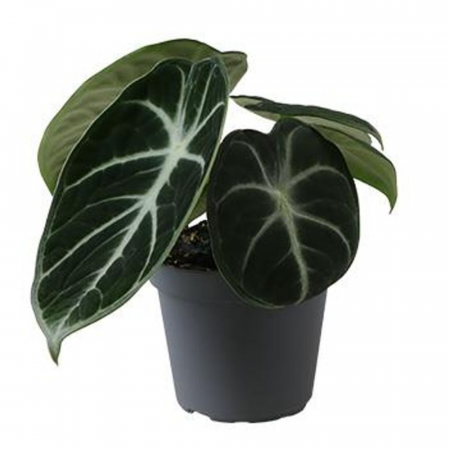
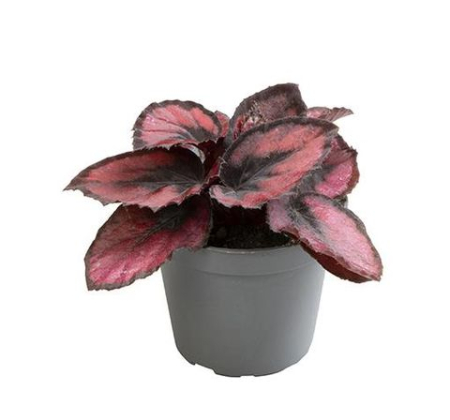
Begonia 'Inca Night' — dramatic Rex cultivar with foliage in deep almost black violet, with metallic silver reflections and burgundy edges. Velvety texture. Mysterious nocturnal palette. Humidity 60-80%, indirect light, 18-24°C. Plant with gothic-tropical character.
Approx height (including pot): 25 cm
Pot diameter: 12 cm
- Description
- Characteristics
- Reviews (0)
- FAQ
🌿 Begonia 'Inca Night' — the mystery of the Andean night
Begonia 'Inca Night' is a dramatic and mysterious Rex cultivar, named after the deep and starry nights of the South American Andes. Its leaves, an almost black purple with metallic silver reflections, evoke the depth of the night sky over the ancient stones of Machu Picchu, creating a somber and elegant vegetal presence that immediately captivates the eye.
Each leaf is a geode of the night — the deep violet center, almost black, is pierced by silvery iridescences reminiscent of the twinkling of stars in the clear sky of the high mountains. On the edges, the leaf takes on shades of deep cherry or burgundy, and the velvety texture catches light in an almost magical way, making the plant appear to change colors depending on angle and ambient light.
Begonia 'Inca Night' is the perfect choice for lovers of plants with a gothic-tropical character, for eclectic interiors and for collectors who appreciate rare cultivars with a dark chromatic palette. It brings a mysterious and refined note to any space, transforming the corner where it is placed into a contemplative place with a nocturnal air.
🌍 Botanical origin and history
The 'Inca Night' cultivar is part of the 'Inca' series of modern Rex Begonias, developed in the United States by hybridizers specialized in cultivars with foliage in intense and contrasting colors. It belongs to the Begonia Rex-Cultorum group, derived from the wild species Begonia rex, discovered in 1856 in the Assam mountains of northeastern India.
The Begoniaceae family comprises over 2,000 species distributed in tropical and subtropical areas of the globe, representing one of the most diverse genera of flowering plants. The genus name was established in 1690 by French botanist Charles Plumier, honoring the memory of his friend Michel Bégon, governor and passionate collector of exotic plants.
The natural habitat of these hybrids' ancestors is the Asian humid tropical forest, where plants grow on humus-rich soils, in shaded areas with atmospheric humidity above 80%. 'Inca Night' thrives in similar conditions, with high humidity, indirect light and stable temperatures, faithfully reproducing the ancestral microclimate of its parents.
🌱 The nocturnal foliage
The foliage of Begonia 'Inca Night' is defined by its dark and mysterious tones. The leaves are asymmetrical, twisted heart-shaped, measuring 10-18 centimeters. The dominant color is an extremely deep violet, almost black, which under certain light conditions reveals metallic silver or subtle burgundy reflections — like stars twinkling in the night sky.
The center of the leaf is the darkest, and as it moves away from the main vein, fine silver sparkles may appear, distributed unevenly on the surface, creating the impression of a starry sky. The edges of the leaf are slightly lighter, with shades of deep cherry or burgundy, completing the dramatic palette. The velvety texture catches light in a way that accentuates the depth of the color.
The underside of the leaf is an intense red-purple, almost burgundy, with a fine pubescence that shines like silk. The veins are slightly raised and darker than the general surface, tracing an elegant pattern reminiscent of gothic ornaments. The leaves grow directly from the thick, reddish-brown rhizome that extends horizontally on the substrate.
🌸 The flowers
Begonia 'Inca Night' produces delicate flowers in spring and summer, offering a poetic contrast with the dark foliage. The flowers appear on long flower stalks that rise above the foliage, bearing small clusters of pale pink or pinkish-white flowers, each with 4 petals (2 large and 2 small) and a golden-yellow center.
The plant is monoecious — male and female flowers grow on the same plant, distinguished by the tricolonous ovary of the female ones. The flowering period lasts several weeks. Many growers remove the flower stalks to concentrate the plant's energy in developing the dramatic foliage.
The flowers have no perceptible fragrance, but bring a delicate point of light against the dark background of the foliage, creating a sublime chromatic effect — like white flowers on the nocturnal plain. Hand pollination can produce viable seeds, but vegetative propagation by leaf cuttings remains the preferred method for preserving the cultivar's characteristics.
🌱 Growth habit and care
Begonia 'Inca Night' is a moderately demanding plant that rewards careful care with impressive and dramatic foliage. Growth is medium under optimal conditions, with new leaves appearing every 3-4 weeks. The final size reaches approximately 25-40 cm in height and 35-45 cm in width.
For healthy foliage and deep colors, respect the requirements:
- Light: bright indirect light. Avoid direct sun which can burn the delicate leaves. East-facing windowsill or 1-2 meters from a bright window. Dark colors absorb more light, so pay attention to leaf temperature in summer.
- Temperature: 18-24°C optimal; does not tolerate below 13°C. Maintain constant conditions.
- Watering: moderate — when the top 2-3 cm of substrate are dry. Every 5 days in summer, every 10-14 days in winter. Water at the base, never on leaves or rhizome.
- Humidity: 60-80% ideal — humidifier or tray with moist pebbles.
- Substrate: well-drained — universal substrate + perlite (30%) + sphagnum (15%). Rhizome on the surface.
- Fertilization: every 3-4 weeks during growing season with balanced fertilizer diluted by half.
- Propagation: by leaf cuttings with vein incisions, on moist substrate with cover. Plantlets in 4-8 weeks.
🌿 Why choose Begonia 'Inca Night'
It is a spectacular choice for lovers of plants with dramatic and mysterious character. The dark foliage creates an impressive contrast with ordinary green plants, adding depth and refinement to any collection. Ideal for eclectic, gothic, modern or tropical-dramatic arrangements, 'Inca Night' is a statement plant that communicates sophistication and taste for unusual beauty.
Lungime: 20 cm
Greutate (kg): 0.5 Kg
Denumire: Begonia
Cerințe lumină: Partial umbra
Tip plantă: Decorative
Utilizare: Interior
Tip suport: Ghiveci
Material Suport: Plastic
Why does Begonia 'Inca Night' have such dark leaves?
Does Begonia 'Inca Night' need more light than other Begonias?
How to water Begonia 'Inca Night' correctly?
Can 'Inca Night' be combined with 'Inca Flame' in an arrangement?
Is Begonia 'Inca Night' toxic?

Ai nevoie și de un ghiveci decorativ?