EN/
EN/ Romana
Anthurium villenaorum Ø6cm
![Anthurium villenaorum — rare Peruvian species with large elongated cordate dark-green leaves with spectacular palmate silver-white veins, collector aroid [1]](https://gomagcdn.ro/domains2/eufloria.ro/files/product/original/anthurium-villenaorum-721772.jpg "Anthurium villenaorum — rare Peruvian species with large elongated cordate dark-green leaves with spectacular palmate silver-white veins, collector aroid [1]")
Anthurium villenaorum is a rare species from the Araceae family, native to the Peruvian Amazon, renowned for large cordate leaves with spectacular silver-white veins on a deep-green background. A species scientifically described in 2009, rare in cultivation, appreciated by collectors for sculptural appearance and rarity. An epiphytic plant, requires high humidity and airy substrate.
Approx height (including pot): 15 cm
Country of origin: Netherlands
- Description
- Characteristics
- Reviews (0)
- FAQ
🌿 Anthurium villenaorum — The Peruvian Species with Spectacular Silver Veins
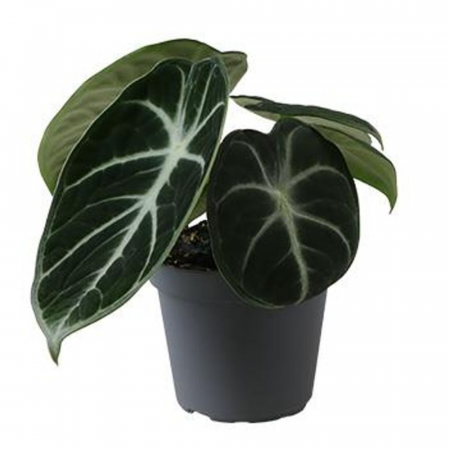
Anthurium villenaorum is a rare and collector-appreciated species, native to the Peruvian tropical forests, renowned for its large, cordiform leaves with pronounced silver-white veins that dramatically contrast with the deep green of the lamina. It is a species with distinctive sculptural silhouette — each leaf being an autonomous botanical work of art, with nearly perfect, geometrically balanced venation patterns.
Unlike Anthurium clarinervium (which it resembles at first glance), villenaorum has more elongated leaves, with more pronounced pointed tips and more open cordate bases. The silver veins are equally visible but arranged in a more extensive pattern that branches elegantly from the central vein to the leaf edges. Texture is firm, slightly velvety, with a subtle shine under suitable light.
Offered in three size variants: Ø6cm (young plant), Ø9cm (mature plant) or Ø21cm (spectacular specimen with large leaves, for collectors). Each variant has its own charm, and larger plants are true botanical art pieces, with leaves that can reach 30-40 cm at maturity.
🌍 Origin and Botanical History
Anthurium villenaorum was scientifically described in 2009 by botanists Thomas B. Croat and Guanghua Zhu, being a relatively recently discovered species. It is endemic to the Peruvian Amazon region, where it grows epiphytically on tree trunks in humid tropical forests, at medium altitudes. The name honors the Villena family, Peruvian botanical collectors who contributed to the species' discovery.
The Araceae family (aroids) includes some of the most spectacular indoor plants — Monstera, Philodendron, Anthurium, Alocasia, Spathiphyllum. Anthurium villenaorum belongs to the Cardiolonchium section, which groups Anthurium species with large, cordiform leaves with contrasting veins — other species in this section include Anthurium clarinervium, A. magnificum, A. crystallinum.
🌱 The Foliage with Silver Veins
Anthurium villenaorum leaves are its visual signature. Cordate-elongated (cordi-sagittate) in shape, with pronounced pointed tips and deeply lobed bases, they measure 15-25 cm length and 10-18 cm width at maturity (can reach 30-40 cm on mature plants in optimal cultivation). Upper surface is deep, almost lacustrine dark-green, with firm, slightly velvety texture.
Central and secondary veins are colored in bright silver-white, creating a dramatic contrast with the leaf's green. The central vein is prominent and bifurcates into secondary veins that branch palmately, following natural leaf lines. This pattern is visible from a distance and accentuates under bright indirect light.
The petiole (leaf stem) is long, rigid, supporting the leaf in an upright position characteristic of epiphytic aroids. The plant grows compactly, with new leaves emerging from a central terminal bud, in a radial rosette that develops gradually.
🌸 The Flowers
Like all aroids, Anthurium villenaorum produces typical flowers — a cylindrical, thin spadix wrapped in a greenish or cream spathe (modified leaf), sometimes with purple hues. Flowers are visually modest compared to the spectacular foliage and are grown for leaves, not flowers. Mature plants may produce inflorescences occasionally, followed by small red berries, decorative.
🌱 Growth Habit and Care
Anthurium villenaorum is an epiphytic plant from humid tropical forests. It requires specific conditions to thrive — indirect light, high humidity, airy substrate.
- Light: moderate to bright indirect. NO direct sun — burns velvety leaves. East-facing windowsill ideal, or 1-2 m from a south-facing window with filtering curtain.
- Temperature: 20-28°C optimal; does not tolerate below 16°C. Authentic tropical plant.
- Watering: regular, keep substrate slightly moist (but not soggy). Every 3-5 days in summer, every 7-10 days in winter. Avoid complete drying — leaves quickly lose turgor.
- Humidity: 70-90% ideal. PERFECT for terrariums or humid rooms. At humidity below 60%, leaf tips turn brown.
- Substrate: very airy, well-drained — specialized aroid mix (large pine bark + perlite + sphagnum + activated charcoal). NOT regular potting soil!
- Fertilization: every 2-3 weeks during growing season with aroid fertilizer, diluted to a quarter of the dose.
- Propagation: via adult plant division (separating aerial roots with attached rosettes) or seeds (rare).
🌿 Safety and Toxicity
Warning: Like all Anthuriums, villenaorum contains insoluble calcium oxalates, toxic if ingested by humans and pets. Symptoms: intense mouth irritation, excessive drooling, swallowing difficulties, vomiting. Moderate toxicity. Place out of reach of small children and curious pets. Use gloves when repotting.
🌸 Why Choose Anthurium villenaorum
Anthurium villenaorum is a plant for authentic collectors who appreciate sculptural foliage and botanical rarities. Being a relatively recently described species (2009), it is less frequently encountered on the European market than its better-known cousins (clarinervium, magnificum). The visual impact of leaves with silver veins is immediate and memorable, making the plant a true focal point in a tropical collection.
🌱 Difference Between villenaorum and clarinervium
The two species are often confused. Villenaorum has more elongated leaves, with more pointed tips, and more palmately spread silver-white veins. Clarinervium has more rounded, classically cordate leaves, with more centrally concentrated veins and a more regular pattern. Both are epiphytic aroids with similar requirements, but villenaorum is considered rarer in cultivation and has a premium price.
🌱 Common Problems
Brown tips: low humidity. Increase humidity to 70%+, mist daily.
Yellow leaves: overwatering or substrate too dense. Switch to airy aroid mix.
Slow growth: insufficient light or temperature too low.
Leaf burn: direct sun. Move to filtered light.
Lungime: 15 cm
Greutate (kg): 0.25 Kg
Denumire: Anthurium
Diametru: 6 cm
Cerințe lumină: Partial umbra
Tip plantă: Decorative
Utilizare: Interior
Tip suport: Ghiveci
Material Suport: Plastic
How does villenaorum differ from clarinervium?
Why high humidity?
What substrate should I use?
Is it toxic?
How to propagate?
Ai nevoie și de un ghiveci decorativ?