EN/
EN/ Romana
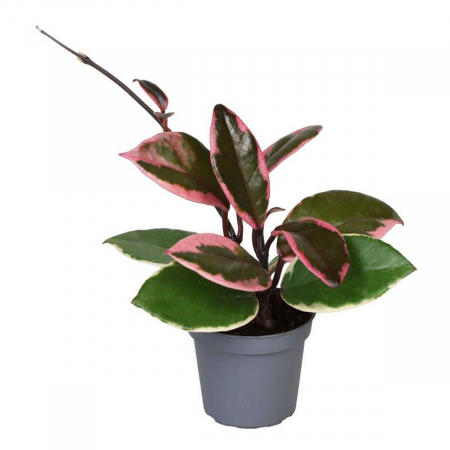
Hoya bella 'Anneke Buis' Ø6cm
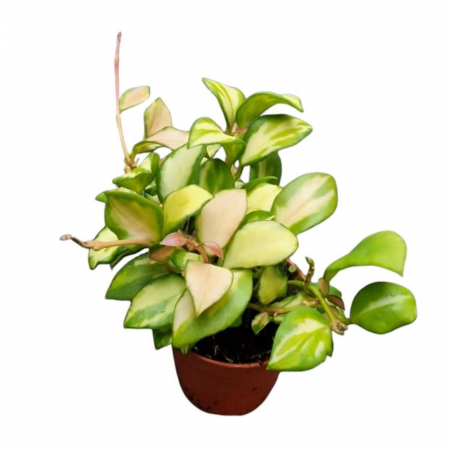
![Hoya bella Anneke Buis - indoor plant with variegated waxy foliage and white-cream margins [1]](https://gomagcdn.ro/domains2/eufloria.ro/files/product/original/hoya-bella-anneke-buis-d6cm-786268.jpg "Hoya bella Anneke Buis - indoor plant with variegated waxy foliage and white-cream margins [1]")
Hoya bella ’Anneke Buis’, also known as Hoya bella albomarginata, is a collector’s plant from the Apocynaceae family, remarkable for its waxy foliage with wide white-cream margins framing a deep green centre. Native to South-East Asia, this rare variety emerged as a spontaneous mutation in the Buis family greenhouses in Aalsmeer, Netherlands. Its star-shaped flowers, white with a pink-purple corona, emit a sweet fragrance of honey and vanilla.
Note: Product images are for guidance only. Due to different batches of imported products, there may be differences between the images on the website and the actual appearance of the products.
Approx height (including pot): 15 cm
Flowering state: No flowers
- Description
- Characteristics
- Reviews (0)
- FAQ
🌿 Hoya bella ’Anneke Buis’ — The Silver-Margined Jewel of Hoya Collectors
Hoya bella ’Anneke Buis’, also known as Hoya bella albomarginata, is one of the most sought-after variegated forms of Hoya lanceolata subsp. bella. This fascinating plant owes its name to the Dutch Buis family from Aalsmeer, in whose greenhouse this spontaneous mutation appeared during the 1980s. Unlike the typical form with uniform green leaves, ’Anneke Buis’ features a wide white-cream margin framing the deep green centre of each leaf, creating an exceptionally elegant visual contrast.
It belongs to the Apocynaceae family and is native to tropical regions of South-East Asia, specifically Myanmar, north-eastern India (Assam), and Thailand, where it grows epiphytically on tree trunks and branches at altitudes of 300–1,500 metres. In its natural habitat, the plant develops beneath the tropical forest canopy, receiving light filtered through the foliage of mature trees. This origin explains its preference for indirect light and high humidity.
What makes ’Anneke Buis’ a truly special plant is its rarity. The albomarginata variegation does not propagate easily and is genetically unstable — some shoots may revert to the all-green form. It is precisely this fragility of the mutation that transforms it into a coveted collector’s item, prized both for its refined aesthetics and its exclusive character.
🌍 Origin and Botanical History
The species Hoya bella was first described by Joseph Dalton Hooker in 1848, under the name Hoya bella, in his work “Botanical Magazine.” Later, taxonomists reclassified it as a subspecies of Hoya lanceolata, making it Hoya lanceolata subsp. bella. Nevertheless, in trade and within the collector community, the name Hoya bella remains the most widely used and recognised.
The generic name “Hoya” honours Thomas Hoy, the personal gardener of the Duke of Northumberland at Syon House in the 18th century. The epithet “bella” means “beautiful” in Latin — a perfect description for this species of remarkable charm. The cultivar ’Anneke Buis’ was named after Anneke Buis, a member of the famous family of plant growers from Aalsmeer, Netherlands, where the mutation was first observed and carefully stabilised.
The natural distribution of the species covers the tropical belt of South and South-East Asia: from the Indian state of Assam, through Myanmar, to Thailand and possibly southern China. The plant grows in humid evergreen forests, clinging to tree bark with its adventitious roots. It favours areas with abundant rainfall and constant temperatures, without extreme fluctuations.
🌱 The Foliage
The leaves of Hoya bella ’Anneke Buis’ are the plant’s main decorative feature. Small and delicate, measuring 2–4 cm in length and 1–2 cm in width, they have an oval-lanceolate shape with a slightly pointed tip. Their texture is waxy and semi-succulent, with a glossy surface that reflects light in a subtle manner, almost like fine enamel.
What distinguishes this variety from the typical form is the wide white-cream margin surrounding each leaf. The centre remains deep green, and the transition zone between green and white is diffuse, creating a natural gradient effect. In bright indirect light conditions, the margins may develop a slight pink tinge, adding an additional layer of colour and refinement.
The leaves are arranged opposite on thin, flexible stems, forming symmetrical pairs that give the plant a tidy and harmonious appearance. New leaves emerge in a shade of light green with nearly white margins, gradually maturing towards a more pronounced contrast between centre and periphery. To the touch, the leaves have a firm and pleasant consistency, characteristic of the waxy plants in the genus Hoya.
🌸 The Flowers
The flowers are, without a doubt, the crowning jewel of Hoya bella. Grouped in pendulous umbels of 7–12 blooms, they resemble miniature porcelain stars: each flower has five white, waxy, perfectly symmetrical petals with a pink-purple central corona containing nectar. The individual diameter of each flower is approximately 1–1.5 cm, and an entire umbel can reach 3–4 cm.
The fragrance of the flowers is sweet and delicate, with notes of honey and vanilla, more intense in the evening and morning hours. The flowers secrete fine droplets of nectar, glistening like dewdrop pearls, adding a hypnotic visual effect. Under optimal growing conditions, Hoya bella can bloom multiple times a year, especially during the warm months from late spring to early autumn.
To stimulate flowering, the plant needs a rest period during the cold season with reduced watering and slightly lower temperatures (15–18°C). It is essential not to cut the peduncles (flower stalks) after wilting, as new umbels will bloom from the same peduncle in subsequent seasons. The ’Anneke Buis’ cultivar flowers just as generously as the green form, though some growers report that the variegation may slightly delay the first flowering.
🌱 Growth Habit and Development
Hoya bella ’Anneke Buis’ has a compact, semi-trailing habit, making it ideal for hanging pots or placement on high shelves where branches can cascade freely. Growth is moderate, with the plant adding 10–20 cm of new shoots per season under optimal conditions. Compared to other Hoya species, it is relatively compact and never becomes invasive — an advantage for smaller spaces.
The branches are thin and flexible, with short internodes giving the plant a dense, full appearance. Over time, a mature plant can form an elegant “curtain” of variegated foliage, particularly decorative in the natural morning light.
Care requirements:
- Light: Bright indirect or filtered light. Avoid direct midday sun which can burn the white margins, but ensure enough light to maintain variegation.
- Temperature: Optimum 18–25°C. Absolute minimum 12°C. Avoid cold draughts and sudden temperature changes.
- Watering: Allow the substrate to dry 60–70% between waterings. In winter, reduce frequency by half. Use room-temperature water.
- Humidity: Prefers 50–70%. A pebble tray with damp gravel or a humidifier are ideal.
- Substrate: Airy mix: 50% perlite/pumice, 30% pine bark, 20% peat/coco coir. Excellent drainage is essential.
- Fertilisation: Balanced liquid fertiliser (NPK 20-20-20) diluted to half-strength, twice a month during the growing season (March–September).
- Propagation: By stem cuttings with at least 2 nodes, in moist substrate or water. Optimal rooting temperature: 22–26°C.
Lungime: 6 cm
Greutate (kg): 0.15 Kg
Denumire: Hoya
Diametru: 6 cm
Cerințe lumină: Strong, indirect light
Tip plantă: Decorative
Utilizare: Interior
Tip suport: Ghiveci
Material Suport: Plastic
How often should I water Hoya bella ‘Anneke Buis’?
Hoya bella ‘Anneke Buis’ prefers a substrate that dries out almost completely between waterings. During the warm season, watering every 7–10 days is sufficient, while in winter it should be reduced to once every 2–3 weeks. Overwatering causes root rot.
Is Hoya bella ‘Anneke Buis’ toxic to cats or dogs?
No, Hoya bella ‘Anneke Buis’ is considered non-toxic for both humans and pets. The mild latex it produces does not contain dangerous substances, though it is still recommended to place the plant where pets cannot damage it.
What is the best substrate for Hoya bella ‘Anneke Buis’?
An airy and well-draining mix is ideal: 40% pine bark, 30% perlite, 20% coco coir, and 10% horticultural charcoal. Hoya bella grows naturally as an epiphyte, so the roots need excellent air circulation and drainage.
When does Hoya bella ‘Anneke Buis’ bloom indoors?
Hoya bella can bloom in spring and summer, usually after 2–3 years from planting. The flowers are grouped in fragrant umbels, white with a pink center. To encourage flowering, provide bright indirect light and a winter rest period with reduced watering.
What makes Hoya bella ‘Anneke Buis’ special compared to other Hoyas?
Hoya bella ‘Anneke Buis’ is a variegated variety, with creamy-white margins on the green leaves, making it particularly decorative. Unlike the standard Hoya bella, the ‘Anneke Buis’ variety has a brighter appearance and is rarer in ornamental cultivation.
Ai nevoie și de un ghiveci decorativ?