EN/
EN/ Romana
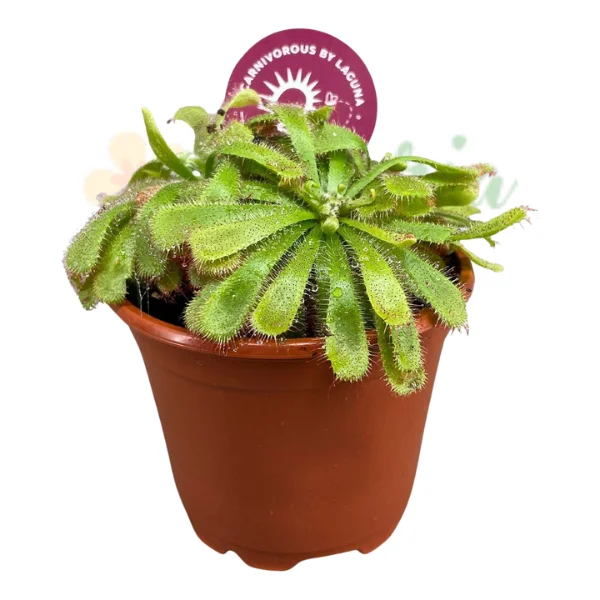
Drosera capensis Ø8,5cm
![Drosera capensis Cape Sundew — red sticky tentacles, pot Ø 8.5 cm [1]](https://gomagcdn.ro/themes/fashion/gfx/no-image.png "Drosera capensis Cape Sundew — red sticky tentacles, pot Ø 8.5 cm [1]")
Drosera capensis (Cape Sundew) is a fascinating carnivorous plant native to South Africa, featuring leaves covered in glistening sticky tentacles that capture insects. It thrives in bright light, moist peat substrate, and requires watering only with distilled or rainwater. Non-toxic to humans and pets.
Pot diameter: 8.5 cm
- Description
- Reviews (0)
- FAQ
🌿 Drosera capensis – The Cape Sundew from South Africa
Drosera capensis, commonly known as the Cape Sundew, is one of the most captivating carnivorous plants in the world. Native to the Cape region of South Africa, this remarkable plant attracts and captures small insects using its tentacle-covered leaves adorned with glistening, sticky droplets that resemble morning dew.
🌍 Origins & Botanical History
Drosera capensis belongs to the Droseraceae family, one of the largest families of carnivorous plants. The species is native to South Africa, particularly the Cape region, where it thrives in wet, marshy habitats. First described by Carl Linnaeus in 1753, it has become one of the most widely cultivated Drosera species due to its adaptability and stunning appearance.
🌿 Leaves – Tentacles Adorned with Glistening Droplets
The long, narrow leaves of Drosera capensis are covered with glandular tentacles that secrete a sticky, translucent mucilage. This substance glistens in the light, luring insects that become trapped upon contact. Once an insect touches the tentacles, the leaf slowly curls around the prey to maximize digestion. The leaves range from light green to reddish hues, depending on the intensity of light the plant receives.
🌱 Growth Habit & Development
Drosera capensis is a perennial plant that forms compact rosettes of leaves. It thrives in bright, indirect or even direct light and requires constantly moist substrate made of peat and perlite. It is essential to water the plant only with distilled or rainwater, as minerals from tap water can damage its sensitive roots. No fertilization is needed – nutrients are obtained from captured insects. The plant periodically produces tall flower stalks bearing small, pink-purple flowers.
How do I care for Drosera capensis?
Drosera capensis needs strong direct light (minimum 4-6 hours daily), a substrate of equal parts peat and perlite, and distilled or rainwater. Keep a water tray under the pot permanently — never let the substrate dry out. Do not fertilize and never use tap water. Ideal temperature is 15-30°C (59-86°F).
Do I need to feed Drosera capensis with insects?
Not mandatory. Drosera capensis can survive without supplemental feeding if it receives enough light. However, occasional feeding with small insects (flies, mosquitoes) improves the plant's growth and vigour. Do not use meat, cheese, or other processed foods. If placed near a window, it will catch insects on its own.
Is Drosera capensis toxic to pets?
Drosera capensis is generally considered non-toxic to dogs and cats. The sticky mucilage produced by the tentacles is designed to catch insects and does not contain substances harmful to mammals. However, as with any plant, ingestion in large quantities may cause mild gastric discomfort.
Why has my Drosera lost the sticky droplets on its tentacles?
The lack of mucilage droplets usually indicates insufficient light or low humidity. Drosera capensis actively produces mucilage only under bright light conditions. Ensure it gets at least 4-6 hours of direct light daily. Also check that you are using distilled water — minerals from tap water can damage the plant.
Why are my Drosera capensis leaves turning black?
Blackening of old leaves is a natural process — individual leaves have a limited lifespan and die after a few months. The plant constantly produces new leaves from the centre of the rosette. If all leaves are blackening, check: water (must be distilled), light (must be strong), and substrate (must not contain fertilizers).
What water should I use for carnivorous plants?
Use only distilled, demineralized, or rainwater. Tap water contains minerals that can kill carnivorous plants. Keep the substrate permanently moist.
Do I need to feed my carnivorous plant?
It is not necessary to actively feed the plant. It will catch insects on its own if available. Do not give meat or other food - only small live insects, occasionally.
Does the carnivorous plant need winter dormancy?
Yes, many carnivorous plants need a winter dormancy period at lower temperatures (5-10°C). This is essential for long-term health.
What substrate for carnivorous plants?
Use a mix of sphagnum peat and perlite (1:1). Do not use regular soil or compost - minerals are harmful to carnivorous plants.
Ai nevoie și de un ghiveci decorativ?