EN/
EN/ Romana
Nidularium schultesianum 'Striped Fireball' Ø12cm
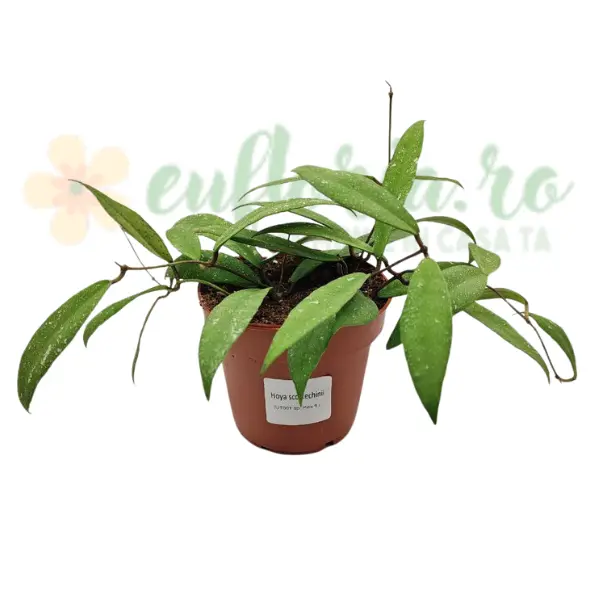
![Nidularium schultesianum 'Striped Fireball' — Brazilian bromeliad with lanceolate emerald-green leaves striped white-cream in compact rosette with bright red-orange center like a fireball [1]](https://gomagcdn.ro/domains2/eufloria.ro/files/product/original/nidularium-schultesianum-striped-fireball-759098.png "Nidularium schultesianum 'Striped Fireball' — Brazilian bromeliad with lanceolate emerald-green leaves striped white-cream in compact rosette with bright red-orange center like a fireball [1]")
Nidularium schultesianum 'Striped Fireball' is a spectacular bromeliad from Brazil (Bromeliaceae family). Lanceolate emerald-green leaves striped with white-cream, arranged in a compact rosette. At maturity, the rosette center ('cup') becomes bright red-orange like a fireball. The inflorescence with red-pink bracts and small bluish-violet flowers persists 2-4 months.
Pot diameter: 6 cm
- Description
- Reviews (0)
- FAQ
🌿 Nidularium schultesianum 'Striped Fireball' — Tropical Fire with Stripes
Nidularium schultesianum 'Striped Fireball' is a spectacular bromeliad, known for its striped leaves and for the rosette center that becomes bright red at maturity, like a fireball — hence the name 'Fireball'. The leaves are emerald-green, crossed by longitudinal white-cream or light-green stripes, arranged in a compact, dense rosette.
As the plant approaches flowering, the rosette center (called the 'cup') dramatically colors bright red-orange, a visual spectacle lasting for weeks. The inflorescence appears in the center of the cup — small bluish-violet flowers, protected by colored bracts. It is one of the most decorative indoor bromeliads, combining striped foliage with a fiery center.
At the offered size — Ø12cm pot — the plant is mature, with developed rosette and reddish center visible or forming. Ideal for bright windowsills, tropical corners or as a focal plant in a bromeliad composition.
🌍 Origin and Botanical History
Nidularium schultesianum is native to the Atlantic forests of Brazil, where it grows epiphytically on tree trunks in humid zones at moderate altitudes. The 'Striped Fireball' cultivar was developed through horticultural selection for the combination of decorative stripes and dramatic center coloring.
The Nidularium genus belongs to the Bromeliaceae family (same as Cryptanthus, Tillandsia, Vriesea, pineapple), comprising approximately 45 species, all endemic to the Brazilian region. The name comes from Latin nidulus ("small nest"), referring to the nest shape formed by the rosette where water and plant material collect.
🌱 Striped Foliage and Red Cup
The leaves are lanceolate-elongated, with dimensions of 25-40 cm length and 4-6 cm width, with firm texture and edges with fine teeth. Base color is rich emerald-green, crossed longitudinally by white-cream or light-green stripes (hence 'Striped'). Leaves are arranged in a compact, dense, symmetrical rosette.
The spectacular characteristic appears at maturity: central leaves (the youngest, forming the central 'cup') dramatically color bright red-orange, like a fireball. This coloring precedes and accompanies the flowering period, persisting for weeks or months. It's the signal that the plant enters the reproductive phase.
🌸 Flowers from the Cup
The inflorescence appears in the center of the cup — a small rosette of strongly colored red-pink bracts, from which emerge small bluish-violet flowers. They are visually discrete compared to the spectacular bracts. The entire structure (red cup + bracts + flowers) persists 2-4 months in decorative state.
🌱 Growth Habit and Care
- Light: bright indirect. Avoid strong direct sun. Good light intensifies coloring.
- Temperature: 18-28°C; not below 15°C.
- Watering: keep central cup FILLED with water (change every 1-2 weeks). Also water the substrate lightly. Filtered/still water, not hard water.
- Humidity: 50-80% ideal. Occasional misting.
- Substrate: airy, well-drained, for bromeliads.
- Fertilization: rare (every 8 weeks), very diluted, in cup water.
- Propagation: by pups after flowering.
🌿 Non-toxic
Nidularium schultesianum is non-toxic for humans and pets. A safe plant.
🌸 Why 'Striped Fireball'
The combination of striped foliage and fire-red center makes 'Striped Fireball' one of the most distinctive bromeliads available. It is an immediate focal point in any collection, with a dramatic coloring cycle offering months of spectacular decor. Unlike short-flowering plants, the bromeliad offers constant decor through persistent bracts and foliage stripes.
🌱 The Central Cup — Important Rule
Bromeliads like Nidularium have evolved to collect water in the central cup formed by the rosette. In nature, this water comes from rain. In cultivation, fill the cup with filtered water and change it every 1-2 weeks to prevent salt accumulation and bacterial development. Water standing too long causes rot.
🌱 Common Problems
Red center fades: normal after flowering — the plant redirects energy to pups.
Yellow leaves: overwatering in substrate or hard water in cup.
Stripes less visible: insufficient light.
Plant declines after flowering: NORMAL — bromeliads flower once and produce pups at the base.
Why does the center turn red?
How to water the bromeliad correctly?
Does it die after flowering?
Is it toxic?
How long does the decor last?
Recommendations
Ai nevoie și de un ghiveci decorativ?