EN/
EN/ Romana
Alocasia 'Polly' Ø12cm
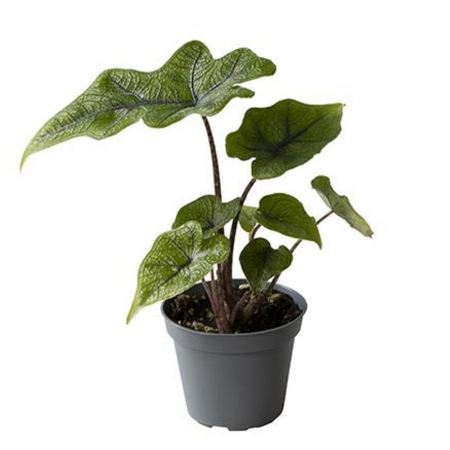
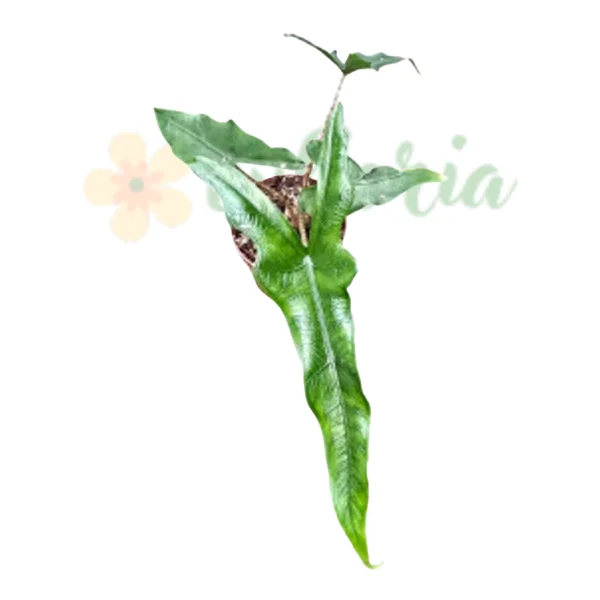
![Alocasia Polly - houseplant with metallic dark green leaves and silvery veins in African mask shape [1]](https://gomagcdn.ro/domains2/eufloria.ro/files/product/original/alocasia-polly-d6-872236.png "Alocasia Polly - houseplant with metallic dark green leaves and silvery veins in African mask shape [1]")
Alocasia 'Polly' (Alocasia × amazonica 'Polly') is a compact and spectacular hybrid from the Araceae family, prized for its arrow-shaped leaves of an intense metallic dark green with contrasting silvery veins. Also known as the "African Mask" due to the dramatic profile of its leaves, this tropical plant adds an exotic and elegant accent to any indoor space.
Approx height (including pot): 35 cm
Grower:

- Description
- Characteristics
- Reviews (0)
- FAQ
🌿 Alocasia 'Polly' — The African Mask of the plant world
Few houseplants manage to capture attention with as much visual force as Alocasia 'Polly'. Its leaves, of a dark green so intense they appear almost black in certain lights, are etched with silvery-white veins that create a dramatic, mesmerising contrast. Their shape — sagittate, with deeply undulating margins and pointed tips — evokes a ceremonial mask carved from ebony wood, hence the popular nickname "African Mask Plant".
Alocasia 'Polly' is the compact, indoor-adapted version of the Alocasia × amazonica hybrid, one of the most popular and accessible Alocasia in the world. Although the name suggests Amazonian origins, this is actually a horticultural hybrid created in the 1950s, likely through crossing Alocasia longiloba and Alocasia sanderiana, both native to Southeast Asia. The 'Polly' cultivar was selected for its compact size, dense habit, and the strong visual contrast of its foliage.
At Eufloria.ro, we offer it in 12 cm pots — a size at which the plant has already reached maturity and displays several developed leaves, providing from day one the imposing visual presence for which it is so highly valued. Delivery across the EU.
🌍 Origin and Botanical History
Alocasia × amazonica is a hybrid created by plant breeder Salvadore Mauro at his greenhouse named "Amazon Nursery" in Miami, Florida, in the 1950s. The name "amazonica" does not refer to the Amazon River but to the nursery's name. The hybrid results from crossing two Southeast Asian species: Alocasia longiloba from Malaysia and Alocasia sanderiana from the Philippines. The 'Polly' cultivar was subsequently selected for its more compact habit and more intensely coloured foliage.
Although an artificial hybrid, its parents originate from the humid tropical forests of Southeast Asia, where they grow as terrestrial plants in the forest understorey, on humus-rich, well-drained soils. Alocasia sanderiana, one of the parents, is a species endemic to the Philippines, classified as vulnerable in the wild, making its hybrid descendant 'Polly' an ambassador of tropical biodiversity in our home collections.
The genus Alocasia was established by botanist Heinrich Wilhelm Schott in 1832 and includes over 90 species, all native to tropical and subtropical Asia, Australia, and Oceania. The name derives from the negative prefix "a-" and "Colocasia", suggesting a distinction from the related genus Colocasia (taro).
🌱 The Foliage
The leaves of Alocasia 'Polly' are the element that gives the plant its status as an icon of botanical interior design. At maturity, they reach 25-40 cm in length and 15-25 cm in width, with a classic sagittate shape — the basal lobes are well-developed and pointed, while the laminar tip is acuminate and elegant. The margins are undulate, with regular lobations that create a distinctive ornamental effect.
The colour is a very dark green, almost black in diffuse light, with a subtle metallic sheen on the adaxial surface. The main veins are a brilliant silvery-white, exceptionally prominent, creating a geometric pattern reminiscent of art deco works. The abaxial surface (underside of the leaf) is an intense deep purple, visible when the leaf moves in air currents or when viewed from an angle.
The petiole is long, rigid, and dark green with purple tones, supporting the leaf in a slightly inclined position, as if it were a natural screen oriented to capture maximum diffuse light. The leaf texture is waxy, thick, and hydrophobic — water droplets roll across its surface as on a lotus leaf, a hypnotic and extremely photogenic phenomenon.
🌸 The Flowers
Alocasia 'Polly' may occasionally produce spadix-spathe type inflorescences, typical of the Araceae family. The spathe is light green, elongated, 8-12 cm long, and protects the central cream-coloured spadix. The inflorescence is not particularly decorative compared to the spectacular foliage and usually appears during active growth periods in spring or summer.
Most growers recommend removing the inflorescence to conserve the plant's energy and direct it towards producing new leaves. If left to develop, the inflorescence may be followed by small orange-reddish fruits containing seeds — though seed propagation is slow and results are unpredictable, as the hybrid is not genetically stable.
🌱 Growth Habit and Development
Alocasia 'Polly' has a moderate growth rate and a compact habit, reaching 40-60 cm in height and 30-50 cm in width at maturity. It typically maintains 5-8 active leaves simultaneously, giving it a dense, lush appearance. Like all Alocasia, it sheds the oldest leaves as it produces new ones — a natural process that should not alarm the grower.
The root system consists of a central corm and fibrous roots. The corm may produce lateral offsets that can be separated for propagation. The active growth period is spring through autumn, and in winter the plant may enter semi-dormancy, with reduced growth or even the loss of several leaves. This does not signal the plant's death — the corm remains viable and will produce new leaves in spring.
- Light: Bright, indirect light. Also tolerates medium intensity. Avoid direct sun which can burn leaves. An east or north-facing window is ideal. Insufficient light reduces vein contrast.
- Temperature: Optimal range 18-27°C. Does not tolerate below 15°C. Sensitive to cold draughts and sudden fluctuations. In winter, maintain at least 16-18°C.
- Watering: Keep substrate slightly moist but not waterlogged. Allow top 2-3 cm to dry between waterings. Reduce frequency in winter. Use room-temperature filtered or dechlorinated water.
- Humidity: Prefers humidity above 60%. A humidifier is the optimal solution. Alternatively, grouping with other tropical plants or a tray of wet pebbles helps.
- Substrate: Well-draining, airy mix: perlite (30%) + pine bark (30%) + peat or coco coir (30%) + humus (10%). Excellent drainage prevents corm rot.
- Fertilisation: Balanced liquid fertiliser diluted to half strength, once every 2 weeks during growing season. Do not fertilise in winter or during dormancy.
- Propagation: By separating lateral offsets from around the corm in spring. Each offset should have at least 2 leaves and visible roots. Cut with a sterilised knife, allow wound to heal for a few hours, then plant in moist substrate.
Lungime: 12 cm
Greutate (kg): 1 Kg
Denumire: Alocasia
Diametru: 12 cm
Cerințe lumină: Strong, indirect light
Tip plantă: Decorative
Utilizare: Interior
Tip suport: Ghiveci
Material Suport: Plastic
How do I care for Alocasia 'Polly'?
Alocasia 'Polly' prefers bright indirect light — avoid direct sunlight which can burn the leaves. Water regularly, keeping the soil slightly moist but not waterlogged. The plant loves high humidity, so frequent misting or a humidifier is recommended. The ideal temperature range is 18–26°C. Use a well-draining substrate with peat, perlite, and pine bark.
Is Alocasia 'Polly' toxic to pets or children?
Yes, Alocasia 'Polly' is toxic to pets and children. It contains insoluble calcium oxalates in all parts of the plant. If ingested, symptoms may include mouth irritation, difficulty swallowing, excessive drooling, and nausea. It is recommended to place the plant out of reach of small children and pets. In case of ingestion, consult a doctor or veterinarian immediately.
What sizes is Alocasia 'Polly' available in?
Alocasia 'Polly' is available in two size variants: 6 cm pots (approximate height 15 cm, including pot) and 12 cm pots (approximate height 25–35 cm, including pot). The 12 cm variant is ideal for those who want a more impressive plant with larger, more developed leaves.
Why are the leaves of my Alocasia 'Polly' turning yellow?
Yellowing leaves on Alocasia 'Polly' can be caused by several factors: overwatering (the most common cause), insufficient light, low air humidity, or temperatures that are too low. Check that the soil is well-drained and doesn't stay too wet. Make sure the plant receives bright indirect light and adequate humidity. It is normal for older leaves to gradually yellow as the plant grows new ones.
Recommendations
Ai nevoie și de un ghiveci decorativ?