EN/
EN/ Romana
Hoya nummularioides Ø10.5cm
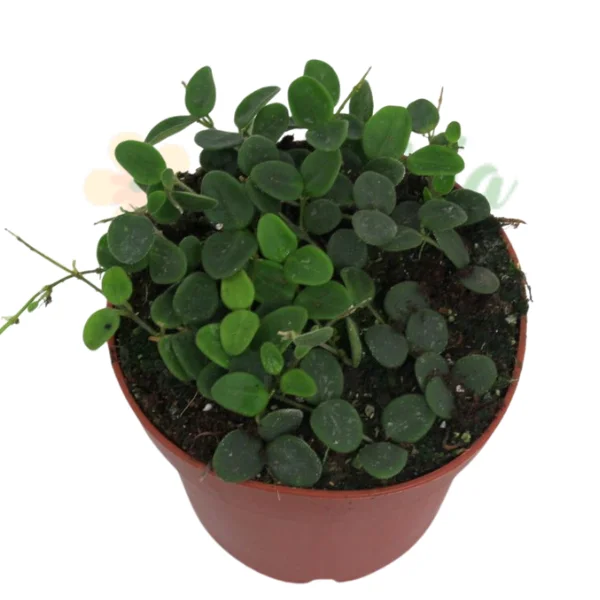
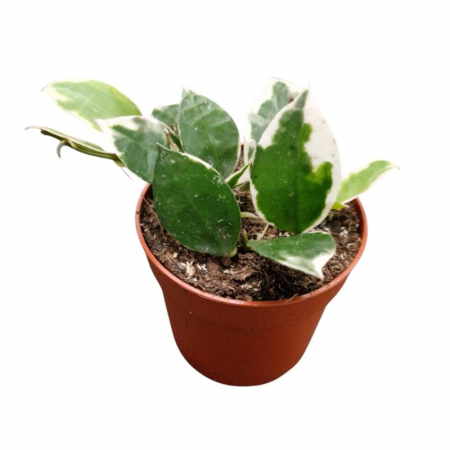
![Hoya nummularioides — Thai species with small round medium-green coin-like leaves densely arranged on vining stems, with umbels of fragrant cream-white star-shaped flowers [1]](https://gomagcdn.ro/domains2/eufloria.ro/files/product/original/hoya-nummularioides-506195.png "Hoya nummularioides — Thai species with small round medium-green coin-like leaves densely arranged on vining stems, with umbels of fragrant cream-white star-shaped flowers [1]")
Hoya nummularioides is a charming species from the Apocynaceae family, native to Thailand and Laos, known for small round leaves resembling coins (hence the name 'nummularioides' = 'coin-shaped'). White-cream star-shaped flowers with intense fragrance, considered among the most beautiful in the genus — notes of vanilla, honey and gardenia.
Flowering state: No flowers
Pot diameter: 10.5 cm
- Description
- Characteristics
- Reviews (0)
- FAQ
🌿 Hoya nummularioides — Coin-Like Leaves and Fragrant White Flowers
Hoya nummularioides is a charming Hoya species, renowned for its small, round leaves resembling coins — hence the specific name, derived from the Latin nummus ("coin"). Native to the tropical forests of Thailand and Laos, this species combines the beauty of compact leaves with umbels of star-shaped white flowers, with an especially sweet fragrance that makes it a special plant among collector Hoyas.
The leaves, densely arranged along vining stems, have modest dimensions — 1.5-3 cm diameter, round-oval, with waxy texture and medium to dark green color. At maturity, the plant develops long, elegant stems that flow like cascades of living coins over the edge of a hanging pot.
At the offered size — Ø10.5cm pot — the plant is mature, with developed stems and numerous leaves. Ideal for hanging pots or bright windowsills where stems can flow freely.
🌍 Origin and Botanical History
Hoya nummularioides was scientifically described in 1905 by Costantin, from specimens collected in Thailand. The specific name — nummularioides — literally means "resembling coins", referring to the round-oval shape of the leaves. It is endemic to the tropical regions of Southeast Asia, especially central and northern Thailand, as well as Laos.
The Apocynaceae family includes the Hoya genus with over 200 species. Hoya nummularioides belongs to the group of Hoyas with small, compact leaves, alongside H. curtisii, H. lacunosa and H. bilobata — all remarkable for their delicate silhouette.
🌱 Coin-Like Foliage
The leaves are small, round to oval, with dimensions of 1.5-3 cm diameter, with waxy and firm texture. Color is medium to dark green, sometimes with a slightly olive hue in strong light. They are arranged very densely, in opposite pairs, at small intervals along the stems (1-2 cm between nodes), creating an extremely dense and decorative silhouette.
Under strong light, leaf edges can develop delicate coppery reflections — a sign that the plant is receiving optimal light. The small leaves make the plant appear delicate, almost like strings of green jewelry when stems grow long enough.
🌸 The Fragrant Flowers
Hoya nummularioides is renowned for its especially fragrant flowers — the most fragrant in the entire Hoya genus, according to many collectors. Umbels are small (5-15 flowers), with star-shaped white-cream flowers, with a more yellow central corona. Fragrance is intense, sweet, with notes of vanilla, honey and gardenia, stronger in the evening and at night.
A single blooming umbel can intensely perfume an entire room for 5-7 days. Flowering period: summer-autumn, on mature plants (2-3 years from rooting). Flower peduncles are perennial — DO NOT cut them after flowers fall.
🌱 Growth Habit and Care
- Light: bright indirect, essential for flowering.
- Temperature: 18-28°C; not below 12°C.
- Watering: moderate; let substrate dry almost completely. Every 7-10 days in summer, every 2-3 weeks in winter.
- Humidity: 50-70% ideal.
- Substrate: airy, for epiphytes (pine bark + perlite + sphagnum).
- Fertilization: every 3-4 weeks during growing season.
- Propagation: stem cuttings with 3-4 nodes (small leaves mean cuttings need more nodes).
🌿 Non-toxic
Hoya nummularioides is non-toxic for humans and pets according to ASPCA. The milky sap may cause minor skin irritation.
🌸 Why Choose Hoya nummularioides
Hoya nummularioides is a distinctive choice for Hoya collectors — it combines the delicate silhouette of small leaves with the intense fragrance of flowers, considered among the most beautiful in the genus. It is ideal for small hanging pots, tropical terrariums or as a precious collector plant. Its unique "coin" leaves make it easy to recognize among other Hoyas.
🌱 Fragrance — The Defining Characteristic
If you're looking for a fragrant Hoya, Hoya nummularioides is one of the most intense. Fragrance is sweet, complex, with layers of vanilla, honey and gardenia. It is released in the evening and at night, weaker in the morning. A mature plant with multiple simultaneous umbels can intensely perfume an entire home. The combination of small discreet leaves and strong fragrance is almost paradoxical — and exactly what makes this species unique.
🌱 Common Problems
Yellow leaves: overwatering. Lack of flowers: young plant or insufficient light. Long stems without leaves: light too low — move to brighter light.
Greutate (kg): 0.5 Kg
Denumire: Hoya
Cerințe lumină: Partial umbra
Tip plantă: Decorative
Utilizare: Interior
Tip suport: Ghiveci
Material Suport: Plastic
Why is it called 'nummularioides'?
The name derives from the Latin 'nummus' (coin) + suffix 'oides' (shaped like). It perfectly describes the small, round leaves of 1.5-3 cm diameter, resembling small green coins densely arranged on stems.
What makes the fragrance special?
Hoya nummularioides is considered among the most fragrant Hoyas. The fragrance is intense, complex, with distinct olfactory layers — vanilla, honey, gardenia. It is released in the evening and at night, being perceptible in entire rooms from a single umbel.
How to water?
Moderately. Let substrate dry almost completely. Every 7-10 days in summer, every 2-3 weeks in winter. Waxy leaves store water — the plant tolerates dryness much better than overwatering.
Is it toxic?
No. The Hoya genus is non-toxic according to ASPCA. The milky sap may cause minor skin irritation.
How to propagate?
Via stem cuttings with 3-4 nodes (more than for large-leaved Hoyas). Small leaves mean each node has less energy, so more nodes = more reserve for rooting.
Ai nevoie și de un ghiveci decorativ?