EN/
EN/ Romana
Syngonium podophyllum 'Red Spot' (Pink Splash) Ø6cm
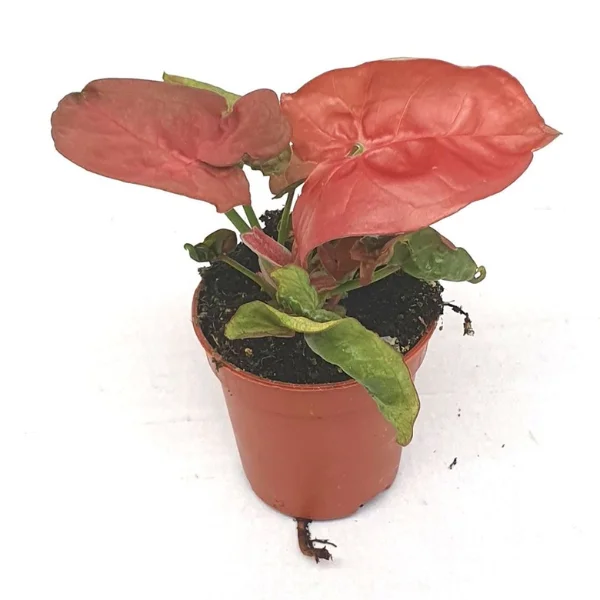
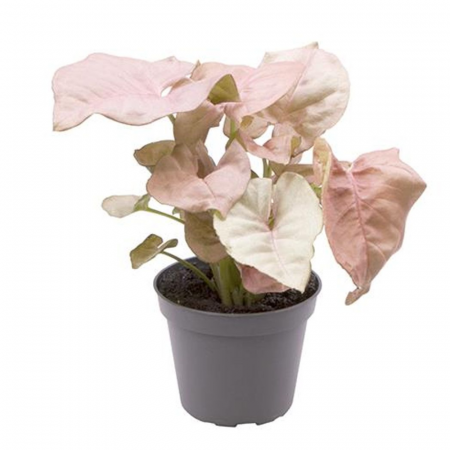
![Syngonium podophyllum 'Red Spot' Pink Splash — rare variegated cultivar with medium-green arrow-shaped leaves splashed with powdery-pink patches and pink-magenta zones [1]](https://gomagcdn.ro/domains2/eufloria.ro/files/product/original/syngonium-podophyllum-red-spot-pink-splash-169472.png "Syngonium podophyllum 'Red Spot' Pink Splash — rare variegated cultivar with medium-green arrow-shaped leaves splashed with powdery-pink patches and pink-magenta zones [1]")
Syngonium podophyllum 'Red Spot' (Pink Splash) is a rare variegated cultivar from the Araceae family, with medium-green arrow-shaped leaves with powdery-pink to pink-magenta splashes, patches and zones. Each leaf unique. Rare and romantic variegation, preferred by collectors. Climbing plant.
Approx height (including pot): 15 cm
Country of origin: Netherlands
Pot diameter: 6 cm
- Description
- Characteristics
- Reviews (0)
- FAQ
🌿 Syngonium 'Red Spot' (Pink Splash) — Pink Splashes on Green Arrows
Syngonium podophyllum 'Red Spot' (also known as 'Pink Splash') is one of the most sought-after variegated Syngoniums of recent years, selected for its medium-green foliage sprinkled with powdery pink splashes, patches and full zones. Each leaf is a unique painting, and the combination of green and pink tones creates a romantic, almost fairy-tale visual impact that has turned this plant into a coveted collector's piece across Europe and North America.
Unlike the classic white variegation found in cultivars such as Syngonium 'Albo' or 'Mojito', 'Red Spot' develops pink pigmentation — a rarer, more unstable and therefore more highly prized genetic trait among aroid enthusiasts. Pink intensity varies from a few delicately powdery-pink splashes to large vibrant pink-magenta zones, producing highly individual plants; no two specimens are alike, and this degree of uniqueness is an essential part of the cultivar's charm.
At the offered size — Ø6cm pot — the plant is young, with three to five variegated leaves already formed and a well-established root system. It grows moderately fast under optimal conditions, developing climbing stems that, when trained onto a moss pole or left to trail from a hanging basket, can reach one to two metres in length within two to three years. Ideal for aroid collectors who appreciate a romantic palette and accept the challenge of a plant that demands generous light to keep its pink pigment.
🌍 Botanical Origin
Syngonium podophyllum is a species native to the moist tropical forests of Central and South America, found in the wild from southern Mexico down through Bolivia and Brazil. In its natural habitat it grows as a semi-epiphytic vine, climbing the trunks of tall trees and using aerial roots to anchor itself firmly. This hemi-epiphytic behaviour explains why, in cultivation, the plants grow dramatically better when given a vertical support — a moss pole, a piece of tree bark or a bamboo trellis wrapped in coconut fibre.
The 'Red Spot' cultivar (also marketed as 'Pink Splash') is a horticultural selection that arose from a spontaneous somatic mutation, subsequently propagated by cuttings to fix the variegation traits and lend them genetic stability. Membership in the Araceae family makes it a close relative of Monstera, Philodendron, Anthurium and Alocasia — plants that all share a preference for bright indirect light, high humidity and aerated substrates rich in decomposed plant matter.
🌱 Pink Variegation
The pink colouration in 'Red Spot' comes from the partial absence of chlorophyll in certain leaf zones, combined with the presence of anthocyanins — pink-magenta pigments that, in the absence of dominant green, become visibly expressed. This chemistry places the plant in a delicate position: pink zones cannot photosynthesise efficiently, meaning that the plant depends entirely on the green zones for its metabolic energy. The more extensive the variegation, the slower the plant grows — a trade-off that collectors gladly accept in exchange for its singular beauty.
Variegation stability is the hardest characteristic to manage. Unlike white variegation, which is relatively stable in Syngonium, the pink pigment responds directly to the amount of light received. A plant moved to shade will gradually lose its pink, with new leaves emerging fully green; moved back to bright indirect light, the plant can recover the pigment — though not instantly, but over the course of two to three months, through leaves that will eventually emerge from the pigmented nodes.
🌱 Care
Light is the single most important factor for this plant. It needs bright indirect light, ideally beside an east-facing window, or by a west- or south-facing window filtered through a thin white curtain. Direct sun, especially summer midday sun, will scorch the pink zones within hours, leaving dry brown patches that do not recover. In winter, during the low-light periods typical of Eastern Europe, supplementation with a full-spectrum LED grow lamp run 10-12 hours per day significantly helps maintain the pigment.
Watering should be moderate and consistent. Allow the top two to three centimetres of substrate to dry out between waterings — roughly once every 5-7 days in summer, once every 10-14 days in winter. Use room-temperature water, ideally left to stand for 24 hours so the chlorine evaporates. Avoid cold tap water and never let the plant sit in a saucer of standing water — the roots rot rapidly under prolonged sogginess.
The ideal substrate is an aerated "aroid mix": 40% peat or coconut coir, 30% medium pine bark, 20% coarse perlite, 10% horticultural charcoal. This blend ensures air circulation around the roots and rapid drainage, both essential for any Araceae plant. Repot the plant once a year, in spring, into a pot only 2-3 cm larger in diameter than the previous one — oversizing the pot can lead to root rot.
The ideal humidity is 60-80%. In the dry winter air of centrally heated apartments, when humidity drops below 30%, new leaves may emerge with brown edges or remain small and deformed. A cool-mist humidifier, grouping the plant with other tropical plants, or placing a pebble tray with water beneath the pot all help maintain a healthy environment. Occasional misting with distilled water is welcome, but is not a substitute for an actual humidifier.
Optimal temperature is 18-28°C. Below 15°C growth slows dramatically and the plant becomes vulnerable to root rot. Avoid cold drafts from windows in winter and from air-conditioning vents in summer — sudden temperature changes stress the plant and can trigger leaf drop.
Fertilising is done during the growing season (March-October) with a balanced liquid fertiliser (NPK 10-10-10 or similar) diluted to half the recommended concentration, applied once every 3-4 weeks. In winter, fertilising is stopped or reduced to once a month at quarter strength. Over-fertilising causes root burn and brown leaf margins.
🌿 Toxicity and Safety
Like all plants in the Araceae family, Syngonium 'Red Spot' contains insoluble calcium oxalates throughout all parts of the plant — leaves, stems, roots and sap. Ingestion causes severe oral irritation, excessive salivation, difficulty swallowing and, in rare cases, swelling of the tongue and throat. Contact between the sap and skin can cause irritation in sensitive or allergy-prone individuals.
Place the plant out of reach of small children and pets — cats and dogs are particularly attracted to young, tender leaves. Wear gloves when repotting and wash your hands after handling foliage or stems. Toxicity is considered moderate; in case of ingestion, consult a veterinarian or family doctor immediately and remain calm, as symptoms usually subside within a few hours.
🌸 Why 'Red Spot'
There are dozens of variegated Syngonium cultivars — Albo Variegata, Mojito, Mottled, Confetti, Strawberry Ice, Neon Robusta — but 'Red Spot' (Pink Splash) holds a special place thanks to the rare combination of pink pigment and moderate stability under optimal growing conditions. It first appeared in European collections around 2018 and quickly became a centrepiece for lovers of the pink-violet palette, who prize it for the subtle contrast between deep green and powdery pink.
Compared with 'Strawberry Ice', which has much stronger pink pigmentation but is almost impossible to maintain indoors long-term (the variegation often reverts even under good care), 'Red Spot' offers a happy compromise: visible variegation, a unique pattern on every leaf and enough stability that it can be grown successfully in a regular apartment, as long as it gets the light it needs.
🌱 Maintaining Pink
To preserve and intensify variegation, the plant must receive the maximum amount of indirect light possible, with no direct sun. An east-facing window provides perfect morning light; a south- or west-facing window works only with a thin white curtain to filter the harsh midday rays. In winter, during months such as November through February, natural light drops below the minimum threshold required and LED supplementation becomes effectively mandatory to prevent new leaves from "greening out".
Selective pruning helps stimulate variegation. Cut back stems that produce fully green (reverted) leaves, just above a node with visible pink pigment. New growth will emerge from that node and stands a much higher chance of retaining the pigment. Cuttings with pink nodes propagate easily in water or moist perlite and produce variegated plants. To maximise your chances, choose cuttings with at least one node and one variegated leaf.
🌱 Common Problems
New leaves entirely green — a classic sign of insufficient light. Move the plant to a brighter spot or add artificial lighting. Cut the stem back below a node with visible variegation to stimulate pigmented growth from that node.
Brown patches on pink zones — sunburn caused by direct sun. Move the plant to filtered indirect light and remove affected leaves; new ones will grow healthy if the light is now correct.
Dry brown leaf edges — sign of air that is too dry, typical in winter in centrally heated apartments. Raise humidity with a humidifier or group the plant with other tropical plants to create a humid microclimate.
Yellowing leaves with soft petioles — overwatering or root rot. Check the roots, cut away rotten sections with a disinfected blade, repot in aerated substrate and reduce watering frequency.
Slow growth, small leaves — a combination of insufficient light, lack of fertilising and/or a pot that is too small. Check all three factors and correct as needed; spring is the optimal time for repotting and resuming fertilisation.
Lungime: 15 cm
Greutate (kg): 0.15 Kg
Denumire: Syngonium
Diametru: 6 cm
Cerințe lumină: Partial umbra
Tip plantă: Decorative
Utilizare: Interior
Tip suport: Ghiveci
Material Suport: Plastic
How to maintain pink variegation?
Is it toxic?
How to propagate for pink?
Does it revert easily?
How to water?
Ai nevoie și de un ghiveci decorativ?