
 EN/
EN/ Romana
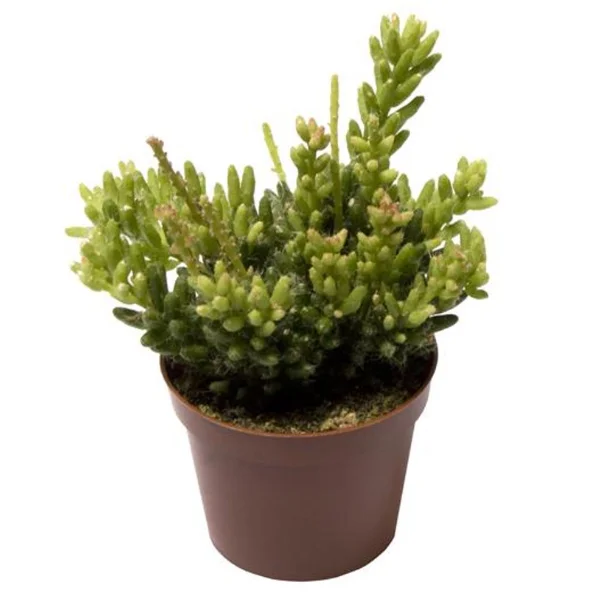
Sedum nussbaumerianum Ø6.5cm
![Sedum nussbaumerianum [1]](https://gomagcdn.ro/domains2/eufloria.ro/files/product/original/sedum-nussbaumerianum-794129.webp "Sedum nussbaumerianum [1]")
Sedum nussbaumerianum is a compact succulent from the Crassulaceae family, native to Veracruz, Mexico. It stands out for its rosettes of fleshy leaves that transition from golden green to intense orange-bronze under bright light. Extremely drought-resistant and easy to care for, ideal for beginners and succulent arrangements.
Approx height (including pot): 10 cm
Country of origin: Italy
Pot diameter: 6.5 cm
- Description
- Characteristics
- Reviews (0)
- FAQ
🌿 Liquid Gold from the Mexican Desert
Sedum nussbaumerianum is a succulent that seems to have captured in its leaves the light of Mexican sunsets — that magical transition from the warm gold of day to the deep bronze of dusk. Native to the limestone cliffs of Veracruz state, Mexico, this Crassulaceae species has won over succulent collectors worldwide with its unique ability to change colour depending on light intensity.
Under bright light, the leaves transform into a chromatic spectacle: from the golden green of shade to the dazzling orange-bronze of direct sun. It is as though the plant were a living indicator of light intensity, changing its garments according to season and positioning. This chromatic metamorphosis results from the accumulation of carotenoid and anthocyanin pigments as a response to light stress — a protective mechanism transformed by nature into art.
The genus Sedum comprises approximately 400–500 species distributed across the Northern Hemisphere, according to WCSP (Kew). S. nussbaumerianum was described by Bitter in 1923 and named in honour of Ernst Nussbaumer, a German succulent collector. In indoor cultivation, it behaves as an extremely tolerant plant — enduring neglect with almost stoic grace.
For plant enthusiasts across Europe, Sedum nussbaumerianum is an accessible and rewarding acquisition: it grows quickly, propagates easily, and offers a continuous chromatic display that adds warmth and colour to any sunny windowsill.
🌍 Origin and Botanical History
Sedum nussbaumerianum (Bitter, 1923) is native to Veracruz state, Mexico, where it grows on limestone rocks and in rock crevices at elevations of 500–1,500 m. The natural climate is subtropical, with dry winters and wet summers, temperatures of 15–30°C, and rainfall of 800–1,500 mm/year concentrated in the rainy season (June–October).
Etymology: the specific name “nussbaumerianum” honours Ernst Nussbaumer, a passionate German succulent collector from the first half of the 20th century. Botanical synonyms include Sedum adolphi Raym.-Hamet (with which it is frequently confused), and it is sometimes sold under the trade names “Golden Sedum,” “Coppertone Sedum,” or “Sedum adolphi Firestorm.”
The taxonomic distinction between S. nussbaumerianum and S. adolphi remains disputed. Some taxonomists consider them synonyms, others distinct species. The Missouri Botanical Garden treats them as separate entities, with S. nussbaumerianum having narrower leaves and a more pronounced tendency toward warm colours (orange-bronze).
The plant entered the European horticultural circuit in the second half of the 20th century, quickly becoming popular thanks to its robustness, rapid growth, and exceptional aesthetic qualities. Today it is one of the most widespread succulents in global horticultural trade.
🌱 The Foliage — Rosettes of Gold and Bronze
The leaves of Sedum nussbaumerianum are arranged in loose rosettes at the stem tips, each leaf measuring 2–4 cm in length and 1–1.5 cm in width. They are fleshy, with a semicircular cross-section, slightly curved with a pointed tip. The 3–5 mm thickness gives them that satisfying succulent substance to the touch.
The chromatic magic of this species lies in the leaves' ability to radically change colour. In shade or low light, leaves are lime-green to golden-green. As light exposure increases, carotenoid and anthocyanin pigments activate, transforming the leaves into a spectacular gradient of golden yellow, orange, copper, and reddish bronze.
Leaf tips are frequently coloured pink to red — a phenomenon called “stress colouring” that occurs in response to intense light, low temperature, or drought. This chromatic stress is not harmful; on the contrary, it signals a healthy plant actively adapting to its environment.
The leaf surface has a thin pruinose (waxy) coating that gives it a matte, satiny appearance. When touched gently, the leaves convey a sensation of coolness and pleasant firmness.
🌸 The Flowers — White Winter Stars
Sedum nussbaumerianum blooms in early spring, producing terminal cyme-type inflorescences with small, white, star-shaped flowers with five petals. Each flower measures just 8–12 mm in diameter, but grouped in dense clusters of 15–30 flowers, the visual effect is significant.
The fragrance is subtle, slightly sweet, perceptible at close range. The flowers attract pollinators — particularly small bees and butterflies — and produce small quantities of nectar. Indoor flowering is possible if the plant receives sufficient direct light and a winter cooling period.
After flowering, the flower stalk can be cut at the base without affecting the plant — unlike Hoya, Sedum does not have permanent peduncles. The plant compensates by producing new lateral branches from the node below the cut.
🌱 Growth Habit and Care Guide
Sedum nussbaumerianum grows as a semi-shrubby succulent, producing branched stems of 15–30 cm in length that spread horizontally or trail slightly from pots. The growth rate is fast for a succulent: 10–20 cm per year under optimal conditions. Stems become semi-woody at the base as they age.
Propagation is extremely simple: individual leaves or stem cuttings placed on dry substrate root within 1–3 weeks. Success rate for leaf propagation: 80–90%. The Cactus and Succulent Society of America recommends allowing the leaf to dry for 1–2 days before planting.
Care requirements:
- Light: Direct sun 4–6 hours/day for optimal colours. Tolerates indirect light but with colour loss. South/west windows ideal.
- Temperature: 10–35°C, optimum 18–26°C. Tolerates down to 0°C briefly. Cold temperatures stimulate colouring.
- Watering: Only when substrate is completely dry. Summer: every 10–14 days, winter: every 21–30 days. Extremely drought-resistant.
- Humidity: 30–50% (prefers dry air). Do NOT mist leaves.
- Substrate: Cactus mix: 50% mineral soil (coarse sand/perlite), 30% nutritive soil, 20% pumice. pH: 6.0–7.0. Excellent drainage mandatory.
- Fertilising: Diluted cactus fertiliser, once a month in the warm season. Do NOT fertilise in winter.
- Propagation: Leaves (allow 1–2 days drying) or stem cuttings. 80–90% success. Any growing period.
Lungime: 10 cm
Greutate (kg): 0.25 Kg
Denumire: Sedum
Diametru: 6.5 cm
Cerințe lumină: Soare
Tip plantă: Suculente
Utilizare: Interior
Tip suport: Ghiveci
Material Suport: Plastic
How often should I water Sedum nussbaumerianum?
Water Sedum nussbaumerianum using the soak and dry method: thoroughly drench the soil and wait for complete drying. In summer, this means once every 7–14 days, while in winter once every 3–4 weeks. Overwatering is the leading cause of succulent death.
Is Sedum nussbaumerianum toxic to pets?
No, Sedum nussbaumerianum is considered non-toxic to cats and dogs according to the ASPCA. It is a safe choice for homes with pets, although ingestion in large quantities may cause mild gastric discomfort.
Why is my Sedum nussbaumerianum losing its copper colour?
Loss of copper colour indicates insufficient light. Sedum nussbaumerianum needs a minimum of 4–6 hours of direct light daily to produce the carotenoids responsible for its copper colouration. Move the plant to a brighter spot and the colour will return within 2–4 weeks.
How do you propagate Sedum nussbaumerianum?
Propagation is done through stem cuttings (5–8 cm) or individual leaves. Stem cuttings root in 10–21 days and leaves in 2–4 weeks. Allow the cut to dry for 2–3 days before planting to prevent rot.
Can Sedum nussbaumerianum be grown outdoors in Romania?
Yes, in milder climate zones of Romania. It tolerates temperatures down to -5°C for short periods. In colder areas, the plant must be brought indoors for winter (November–March). In summer it can be kept on a balcony or terrace.
Ai nevoie și de un ghiveci decorativ?







