EN/
EN/ Romana
Orhidee VANDA cu flori roz și cu suport H55
![Orhidee VANDA cu flori roz și cu suport [0]](https://gomagcdn.ro/domains2/eufloria.ro/files/product/medium/planta-naturala-de-interior-orhidee-vanda-cu-suport-196317.png "Orhidee VANDA cu flori roz și cu suport [0]")
![Orhidee VANDA cu flori roz și cu suport [1]](https://gomagcdn.ro/domains2/eufloria.ro/files/product/medium/planta-naturala-de-interior-orhidee-vanda-cu-suport-865410.png "Orhidee VANDA cu flori roz și cu suport [1]")
![Orhidee VANDA cu flori roz și cu suport [1]](https://gomagcdn.ro/domains2/eufloria.ro/files/product/original/planta-naturala-de-interior-orhidee-vanda-cu-suport-196317.png "Orhidee VANDA cu flori roz și cu suport [1]")
![Orhidee VANDA cu flori roz și cu suport [2]](https://gomagcdn.ro/domains2/eufloria.ro/files/product/original/planta-naturala-de-interior-orhidee-vanda-cu-suport-865410.png "Orhidee VANDA cu flori roz și cu suport [2]")
Orhideea Vanda este una dintre cele mai spectaculoase și elegante specii de orhidee, renumită pentru florile sale mari, colorate și de lungă durată. Originară din regiunile tropicale ale Asiei de Sud-Est, această plantă epifită impresionează prin frumusețea sa exotică și farmecul său distinct, fiind adorată de colecționarii de orhidee din întreaga lume.
Approx height (including pot): 55 cm
Culoare flori: Roz
Flowering state: With flowers
Pot diameter: (no pot)
- Description
- Characteristics
- Reviews (0)
- FAQ
🌸 The Queen of Tropical Orchids — Large, Round Flowers of Bright Pink
The Vanda orchid with pink flowers is one of the most spectacular and imposing orchids in the world, a true queen of tropical beauty. Its flowers are large, round and flat, of a bright, velvety pink, often with a fine reticulated pattern that gives them depth and an almost painted look. Grouped on generous stems, they float above the foliage like a living bouquet, offering a chromatic spectacle of rarely seen intensity among houseplants.
Unlike ordinary orchids grown in pots, Vanda is an epiphytic orchid that grows with its roots free, in the air, suspended in a basket or on a support. These thick, silvery-green roots are not only functional but also decorative, part of the plant's exotic charm. Offered with a support, this Vanda is ready to be admired and to begin its life in your home.
At a height of around 55 cm, it is a plant of stature, with an overwhelming presence, perfect as a focal point in a bright living room, beside a generous window or in an apartment greenhouse. Its flowers are long-lasting and, with the right care, the plant can bloom several times a year.
For the plant lover dreaming of a truly regal orchid with large flowers and an exotic presence, the pink Vanda is an unforgettable choice — a jewel of a plant that turns any space into a corner of flowering jungle and, as a precious bonus, is perfectly safe around pets.
🌍 Origin and Botanical History
The genus Vanda belongs to the Orchidaceae family, the great orchid family, the largest family of flowering plants in the world. Vanda is native to the tropical regions of South-East Asia, from India, Thailand, the Philippines and southern China to northern Australia, where it grows epiphytically, clinging to the trunks and branches of trees in the humid, bright forests, with its roots exposed to the air.
The name "Vanda" comes from Sanskrit, the ancient language of India, being the local name for one of the genus's species, Vanda tessellata. These orchids have been beloved for centuries in Asia for the beauty of their flowers and have become, in modern horticulture, one of the most prized collector's orchids, intensively cultivated and hybridised for an astonishing palette of colours — from pink and mauve to blue, yellow and orange.
Unlike many orchids, Vanda has a monopodial growth: the plant grows vertically, from a single growth point, adding new leaves at the top and aerial roots along the stem. This structure, together with its habit of growing with free roots, explains the special way it is cultivated — without substrate, suspended or on a support.
Its origin as an epiphyte of the bright tropical forests explains all its needs: the need for very strong light, high humidity, frequent watering of the roots and good air circulation around them.
🌸 The Flowers
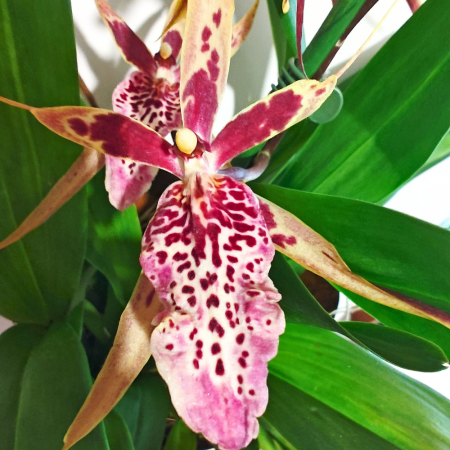
The flowers are, without doubt, the absolute glory of this plant. Large, round and flat, they can reach an impressive diameter and are carried on erect stems that rise from among the leaves, each stem bearing several flowers open at once. The colour is a bright, velvety pink, often with a fine reticulated or spotted pattern that adds depth and an almost watercolour look to each flower.
One of the most prized qualities of Vanda flowers is their longevity: a single bloom can last for weeks, and the plant, well cared for, can flower several times a year, offering an almost continuous spectacle. Some Vandas also emit a delicate fragrance, more pronounced in the warm hours of the day.
To encourage flowering, the plant needs very strong light — Vanda is one of the most light-loving orchids — and consistent care. The reward, however, is well worth it: few houseplants can rival the visual impact of a Vanda in flower, with its bouquet of large, bright blooms floating in the air.
After the flowers fade, the stem can be removed, and the plant will resume its growth, preparing for the next bloom. With patience and good conditions, the cycle repeats, offering you year after year the beauty of these sovereign flowers.
🌱 The Foliage and Roots
Although the flowers are the star, the foliage and roots of the Vanda also have a special exotic charm. The leaves are elongated, strap-shaped, set alternately on either side of the vertical stem, of a fresh, healthy green. They grow at the top of the plant, while the older leaves remain along the stem, creating an orderly, graphic silhouette.
The roots are one of the most fascinating features of this orchid: thick, fleshy and silvery-green, they grow freely in the air, hanging from the basket or the support. These roots are covered with a special layer, called velamen, which rapidly absorbs water and humidity from the air and turns an intense green when watered. They should not be hidden or buried — they are part of the beauty and natural way of life of the plant.
This combination of vertical, orderly foliage and silvery aerial roots gives the Vanda a sculptural, exotic look even when not in flower, making it an interesting presence all year round.
🌱 Growth and Care
Vanda is an orchid cultivated differently from most houseplants: without a pot and without substrate, with its roots free, suspended in a basket or fixed on a support. This growing method imitates its natural epiphytic life and allows the roots to breathe and dry between waterings. It is a plant for orchid lovers who appreciate a spectacular species with specific needs.
The key to success with Vanda lies in three things: plenty of light, frequent watering and high humidity. With these met, the plant becomes a generous source of flowers; neglected, however, flowering will be delayed. It is worth the effort, because few plants reward care with such splendour.
- Light: very strong, bright light — Vanda is one of the most light-loving orchids; a bright window with filtered sun or a few hours of gentle sun is ideal.
- Temperature: prefers warmth, 18–30 °C; keep it away from cold below 15 °C and from cold draughts.
- Watering: water the free roots frequently — daily or almost daily in the warm season — by abundant misting or by soaking the roots in water for a few minutes until they turn green; then let them dry.
- Humidity: essential and high; frequent misting of the roots and a humid environment keep it healthy and encourage flowering.
- Air circulation: the roots need moving air to dry between waterings and avoid rot; avoid closed, stagnant spaces.
- Fertilising: feed regularly, weekly or fortnightly in the growing season, with a diluted orchid fertiliser applied to the roots along with watering.
- Support: keep the plant fixed on its support or suspended in a basket, so the roots hang freely.
Thanks to its spectacular flowers and exotic character, the pink Vanda orchid looks superb as a solitary focal point or alongside other orchids and light- and humidity-loving plants, bringing into the home a touch of the splendour of the flowering tropical forests.
Lungime: 30 cm
Greutate (kg): 0.25 Kg
Denumire: Orhidee
Diametru: 15 cm
Cerințe lumină: Partial umbra
Tip plantă: Decorative
Utilizare: Interior
Tip suport: Ghiveci
Material Suport: Metal
How do I water a Vanda orchid?
Why is my Vanda not blooming?
Why is Vanda grown without a pot?
How long do Vanda flowers last?
Is the Vanda orchid toxic to pets?
Ai nevoie și de un ghiveci decorativ?