EN/
EN/ Romana
Sarracenia purpurea venosa 'Clementina' Ø12cm
![Sarracenia purpurea venosa Clementina - carnivorous pitcher plant with lime green pitchers and red veins [0]](https://gomagcdn.ro/domains2/eufloria.ro/files/product/medium/sarracenia-purpurea-venosa-clementina-d12cm-353359.jpg "Sarracenia purpurea venosa Clementina - carnivorous pitcher plant with lime green pitchers and red veins [0]")
![Sarracenia purpurea venosa Clementina - carnivorous pitcher plant with lime green pitchers and red veins [1]](https://gomagcdn.ro/domains2/eufloria.ro/files/product/medium/sarracenia-purpurea-venosa-clementina-d12cm-387706.jpg "Sarracenia purpurea venosa Clementina - carnivorous pitcher plant with lime green pitchers and red veins [1]")
![Sarracenia purpurea venosa Clementina - carnivorous pitcher plant with lime green pitchers and red veins [1]](https://gomagcdn.ro/domains2/eufloria.ro/files/product/original/sarracenia-purpurea-venosa-clementina-d12cm-353359.jpg "Sarracenia purpurea venosa Clementina - carnivorous pitcher plant with lime green pitchers and red veins [1]")
![Sarracenia purpurea venosa Clementina - carnivorous pitcher plant with lime green pitchers and red veins [2]](https://gomagcdn.ro/domains2/eufloria.ro/files/product/original/sarracenia-purpurea-venosa-clementina-d12cm-387706.jpg "Sarracenia purpurea venosa Clementina - carnivorous pitcher plant with lime green pitchers and red veins [2]")
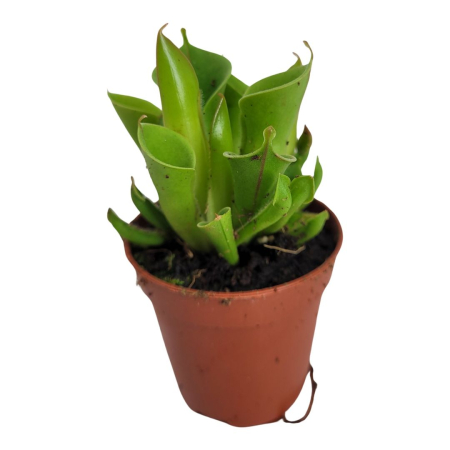
Sarracenia purpurea venosa 'Clementina' is a spectacular carnivorous plant from the Sarraceniaceae family, native to the southeastern United States. Its pitchers — leaves transformed into pitfall traps — display a unique coloration of lime green with burgundy-red veins, attracting and capturing insects through a passive trap mechanism with digestive liquid. This variety, selected for its exceptional chromatic intensity, is ideal for both carnivorous plant collectors and lovers of unconventional plants.
Approx height (including pot): 20 cm
Flowering state: No flowers
Pot diameter: 12 cm
- Description
- Characteristics
- Reviews (0)
- FAQ
🌿 Sarracenia purpurea venosa 'Clementina' — The Pitcher Plant Queen of the New World
Among the most extraordinary organisms in the plant kingdom exist those that defy our fundamental expectations of what a plant should be. Sarracenia purpurea venosa 'Clementina' is one such marvel — a carnivorous plant that has transformed its leaves into sophisticated pitfall traps, deep pitchers that gleam in shades of lime green and burgundy red, attracting unsuspecting insects with an almost hypnotic grace. This variety, selected for its exceptionally vibrant coloration and compact form, carries the name 'Clementina' as a tribute to its delicate beauty, contrasting with its nature as a botanical predator.
The grower who chooses to bring a Sarracenia purpurea venosa 'Clementina' into their home is not merely acquiring an ornamental plant — they are adopting an organism that has traversed millions of years of evolution to become one of the most ingenious life forms on the planet. Its pitchers, those characteristic modified leaves, function as passive traps, secreting nectar along their rims to lure insects, which then slide down the smooth interior wall and fall into the digestive liquid pooled at the pitcher's base.
🌍 Origin and Botanical History
Sarracenia purpurea was first described by Carl Linnaeus in 1753, in his monumental work "Species Plantarum", under the name it still bears today. The genus Sarracenia is named after French physician and naturalist Michel Sarrazin de l'Étang (1659–1734), who sent the first specimens from Canada to botanist Joseph Pitton de Tournefort in Paris. The subspecies venosa, native to the southeastern United States, is distinguished by the pronounced venation of its pitchers — the network of reddish veins that traverse the exterior wall, creating a spectacular visual effect.
In its natural habitat, Sarracenia purpurea venosa grows in acidic bogs and peatlands along the coastal regions of North and South Carolina, Georgia, and Florida. These nutrient-poor environments drove the evolution of the carnivorous mechanism — the plant supplements the nitrogen and phosphorus obtained from the soil with those extracted from captured insect bodies. The 'Clementina' variety was selected by European cultivators for its unique chromatic palette, where the intense lime green of the pitcher bases blends harmoniously with the deep red of the veins and margins.
🌱 The Pitchers — Nature's Pitfall Traps
The modified leaves of Sarracenia purpurea venosa 'Clementina' are, without question, the defining element of this plant's entire aesthetic experience. The pitchers develop from the centre of the basal rosette, growing vertically or slightly inclined, reaching heights of 15-25 cm under optimal cultivation conditions. Their shape evokes a medieval pitcher or an ancient cornucopia — wide at the base, narrowing slightly through the middle, then flaring open at the pitcher mouth, where a lateral wing (ala) guides insects toward the interior.
The coloration of 'Clementina' is truly special. The base of the pitchers displays a fresh, luminous lime green that in strong light takes on almost fluorescent reflexes. As the eye travels upward toward the pitcher mouth, the green enriches with veins of intense burgundy red, creating a natural stained-glass effect. The upper margin, called the peristome, is often coloured in deep red tones, contrasting dramatically with the base green. This chromatic combination is not merely decorative — it serves a precise evolutionary purpose: the vivid colours attract pollinating insects and prey, while nectar secreted on the peristome lures them inward.
The exterior texture of the pitchers is fine, slightly waxy, while the interior presents distinct zones: an upper zone covered with downward-pointing hairs (preventing insects from climbing back out) and a lower smooth, slippery zone that directs prey toward the digestive liquid at the pitcher's base.
🌸 The Flowers
While Sarracenia's fame rests primarily on its spectacular pitchers, the flowers of this plant are equally remarkable and often underestimated. Sarracenia purpurea venosa 'Clementina' produces in spring, typically in April-May, a robust flower stalk that rises above the rosette of pitchers, bearing at its tip a single large, pendulous flower, 5-8 cm in diameter. The flower has a structure unique in the plant world — the five petals, reddish-brown in colour, curve downward like an exotic canopy, while the style extends into an inverted umbrella shape covering the stamens, protecting them from rain.
This ingenious floral architecture serves a precise purpose: it allows pollination by insects (especially bumblebees) that enter beneath the style's "umbrella", become covered with pollen, and transport it to the next flower. Paradoxically, the carnivorous plant protects its pollinators — the capture mechanism in the pitchers operates independently of the flowers, and the flower stalk, raised well above the traps, ensures pollinating insects do not accidentally become prey.
🌱 Growth Habit and Development
Sarracenia purpurea venosa 'Clementina' grows as a compact rosette, with pitchers arranged radially around the central growing point. Under optimal conditions, the rosette can reach 25-35 cm in diameter, with 5-10 active pitchers simultaneously. The plant has a moderate growth rate — producing 2-4 new pitchers per growing season (spring and summer), while older pitchers gradually brown and are naturally replaced.
The annual cycle of Sarracenia includes a winter dormancy period, essential for the plant's long-term health. During this period, old pitchers wither, and the plant concentrates its energy in the rhizome. Spring brings first the flower stalk, followed by new pitchers that slowly unfurl like green cornets, progressively colouring as they mature.
- Light: Direct sun or very bright light — minimum 4-6 hours of direct sun daily. Sarracenias develop their most intense coloration in strong sunlight. On a south or west-facing windowsill, pitchers will display the most beautiful green-red contrast.
- Temperature: 15-30°C during growing season. Tolerates temperatures down to -10°C during dormancy (winter), when the plant should be kept at 2-10°C for 3-4 months to stimulate the natural cycle.
- Watering: Permanently moist substrate. Tray method: place the pot in a tray with 2-3 cm of distilled or rainwater. Never use tap water — minerals can damage the sensitive roots.
- Humidity: 50-80%. Adapts to normal room humidity but benefits from higher levels.
- Substrate: Sphagnum peat mixed with perlite in 1:1 ratio. Never use universal potting soil or compost — these contain too many nutrients and will kill the plant.
- Fertilisation: Never fertilise through substrate or water! Sarracenia obtains its nutrients from captured insects. If kept in an insect-free environment, you may occasionally introduce a dead fly into a pitcher.
- Propagation: Through rhizome division during dormancy (late autumn or winter), or by seeds (requiring cold stratification for 6-8 weeks). Delivery across the EU.
Lungime: 12 cm
Greutate (kg): 1 Kg
Denumire: Sarracenia
Diametru: 12 cm
Cerințe lumină: Direct sunlight
Tip plantă: Decorative
Utilizare: Interior
Tip suport: Ghiveci
Material Suport: Plastic
How should I water Sarracenia purpurea venosa Clementina?
Sarracenia purpurea venosa Clementina requires permanently moist substrate. Use the tray method: place the pot in a tray with 2-3 cm of distilled or rainwater. Never use tap water — minerals can damage the plant's sensitive roots. Check daily that the water in the tray hasn't completely evaporated.
Is Sarracenia purpurea venosa Clementina toxic to pets?
No, Sarracenia purpurea venosa Clementina is considered non-toxic for humans, dogs, and cats. The pitchers and the digestive liquid inside them do not contain harmful substances. However, it is recommended to place the plant where it cannot be damaged by curious pets, as the pitchers are fragile.
What substrate should I use for Sarracenia purpurea venosa Clementina?
Sarracenia purpurea venosa Clementina requires an acidic, nutrient-poor substrate. The ideal mix is Sphagnum peat with perlite in a 1:1 ratio. Never use universal potting soil, compost, or fertilised substrate — mineral nutrients will damage the roots and can kill the plant. The substrate must be kept permanently moist.
Does Sarracenia purpurea venosa Clementina need winter dormancy?
Yes, winter dormancy is essential for the long-term health of Sarracenia. Between November and February, the plant should be kept at temperatures of 2-10°C (enclosed balcony, unheated garage, or refrigerator). During this period, old pitchers will wither — this is normal. Reduce watering but keep the substrate slightly moist. In spring, gradually return the plant to normal temperatures.
When does Sarracenia purpurea venosa Clementina bloom?
Sarracenia purpurea venosa Clementina blooms in spring, typically in April-May, after the winter dormancy period. It produces a single large, pendulous flower, 5-8 cm in diameter, reddish-brown in colour, on a stalk that rises above the pitchers. The flowers have a unique structure — with petals curving downward and the style extended like an inverted umbrella. Cold dormancy is necessary to stimulate flowering.
What type of plant is Sarracenia purpurea venosa Clementina?
How does Sarracenia purpurea venosa Clementina feed?
What light conditions does Sarracenia need?
How should I water Sarracenia purpurea?
Is Sarracenia purpurea toxic to pets?
Ai nevoie și de un ghiveci decorativ?