EN/
EN/ Romana
Nepenthes × hookeriana Ø8,5cm
![Nepenthes hookeriana – Natural Hybrid Pitcher Plant [0]](https://gomagcdn.ro/domains2/eufloria.ro/files/product/medium/nepenthes-hookeriana-d8-5-524389.webp "Nepenthes hookeriana – Natural Hybrid Pitcher Plant [0]")
![Nepenthes hookeriana – Natural Hybrid Pitcher Plant [1]](https://gomagcdn.ro/domains2/eufloria.ro/files/product/medium/nepenthes-hookeriana-d8-5-784198.webp "Nepenthes hookeriana – Natural Hybrid Pitcher Plant [1]")
![Nepenthes hookeriana – Natural Hybrid Pitcher Plant [1]](https://gomagcdn.ro/domains2/eufloria.ro/files/product/original/nepenthes-hookeriana-d8-5-524389.webp "Nepenthes hookeriana – Natural Hybrid Pitcher Plant [1]")
![Nepenthes hookeriana – Natural Hybrid Pitcher Plant [2]](https://gomagcdn.ro/domains2/eufloria.ro/files/product/original/nepenthes-hookeriana-d8-5-784198.webp "Nepenthes hookeriana – Natural Hybrid Pitcher Plant [2]")
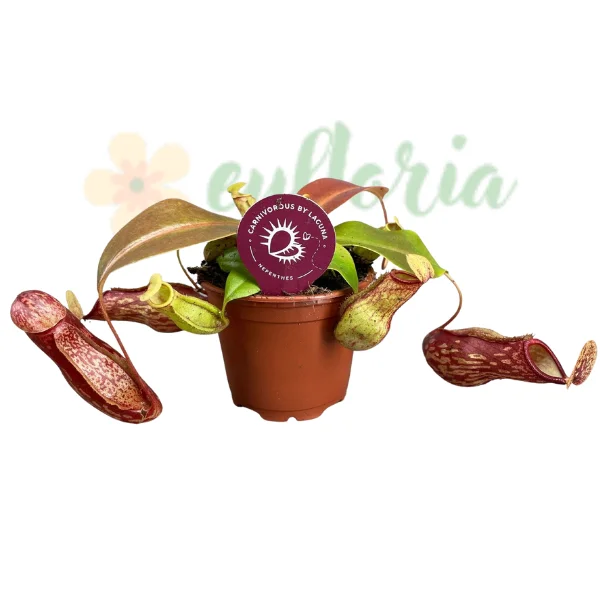
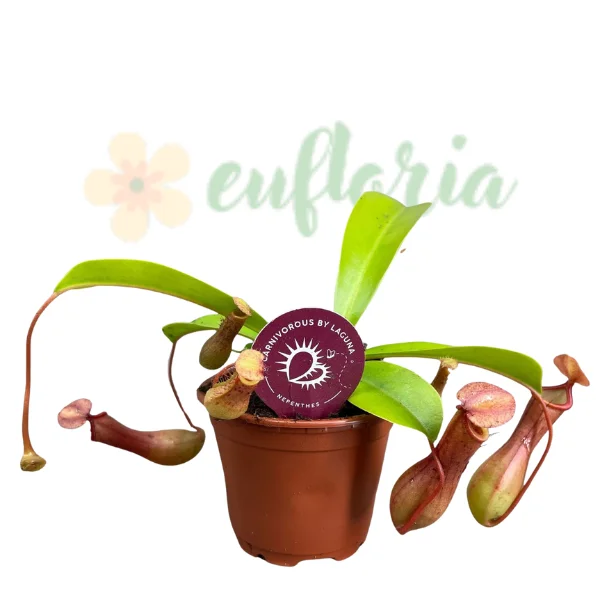
Nepenthes × hookeriana is a natural hybrid between N. ampullaria and N. rafflesiana, with colorful pitchers in green, red, and purple. One of the most accessible carnivorous plants for indoor cultivation. Prefers warm temperatures, high humidity, and sphagnum substrate. Non-toxic plant.
Approx height (including pot): 15 cm
Pot diameter: 8.5 cm
- Description
- Characteristics
- Reviews (0)
- FAQ
🌿 Nepenthes × hookeriana – The Natural Hybrid from Borneo's Swamps
Nepenthes × hookeriana is a spectacular natural hybrid between Nepenthes ampullaria and Nepenthes rafflesiana, occurring spontaneously in the wild. It is one of the most popular carnivorous plants for indoor cultivation, thanks to its robustness and colorful, attractive pitchers that fascinate with their insect-trapping mechanism.
🌍 Origins & Botanical History
Nepenthes × hookeriana belongs to the Nepenthaceae family and is native to Southeast Asia, particularly Malaysia, Singapore, and Borneo. The hybrid was described as early as 1853 and bears the name of botanist Joseph Dalton Hooker. Being a hybrid between two lowland species, it tolerates a wider range of conditions than many highland Nepenthes.
🌿 Pitchers – The Colorful Traps of the Jungle
Nepenthes × hookeriana produces attractive pitchers with a form intermediate between its two parents. The lower pitchers are rounded (N. ampullaria influence), with an undulated peristome colored in shades of green, red, and purple. The upper pitchers are more elongated (N. rafflesiana influence), with a well-developed lid. The interior of the pitchers contains a digestive fluid that attracts and dissolves trapped insects.
🌱 Growth Habit & Development
Nepenthes × hookeriana is a relatively easy species to cultivate compared to other Nepenthes. It prefers warm temperatures (22-32°C daytime, 18-24°C nighttime), high humidity (60-80%), and bright but filtered light. The ideal substrate is a mix of sphagnum moss, perlite, and bark. No fertilization is needed – nutrients are obtained from captured insects. It is ideal for beginners in carnivorous plant cultivation.
Lungime: 15 cm
Greutate (kg): 0.25 Kg
Denumire: Nepenthes
Diametru: 8.5 cm
Cerințe lumină: Partial umbra
Tip plantă: Decorative
Utilizare: Interior
Tip suport: Ghiveci
Material Suport: Plastic
Is Nepenthes × hookeriana toxic to cats or dogs?
No. Nepenthes × hookeriana is non-toxic to cats, dogs, and other household pets. No commonly cultivated carnivorous plant has demonstrated serious toxicity to animals. The digestive fluid inside the pitchers is a mild enzymatic solution designed for small insects and poses no threat to mammals. The narrow pitcher openings on this hybrid make it even harder for pets to access the fluid inside. As with all Nepenthes, the greater concern is protecting the plant from curious cats – the plump, rounded pitchers may be particularly tempting targets for batting and chewing.
What makes Nepenthes × hookeriana different from other pitcher plants?
N. × hookeriana is special because it's a natural hybrid between two parent species with very different lifestyles. One parent, N. ampullaria, is famous for being one of the only pitcher plants to have evolved away from pure carnivory – it collects falling leaf litter and digests it using a community of beneficial microorganisms in its pitchers. The other parent, N. rafflesiana, is a classic insect predator with large, colorful traps. Hookeriana inherits traits from both: the plump, globular pitcher shape of ampullaria and the vivid coloration and effective insect-catching ability of rafflesiana. This also means each plant is visually unique, with highly variable coloring ranging from green with red speckles to deep burgundy.
Is Nepenthes × hookeriana suitable for beginners?
Yes, with one important caveat: temperature. N. × hookeriana is a lowland species that needs consistently warm conditions (20-30°C) and cannot tolerate cold. If you can provide warmth, humidity above 60%, and bright indirect light, it's a vigorous and forgiving grower that produces pitchers readily. It's especially well-suited for terrariums, vivariums, or warm bathrooms with natural light. If your home tends to be cool (below 18°C in winter), a highland hybrid like N. 'Gaya' or N. ventricosa may be a more appropriate first Nepenthes. But in warm environments, hookeriana is genuinely easy to grow and rewards with rapid, lush growth.
Why does my Nepenthes × hookeriana look different from others I've seen online?
This is completely normal and actually one of hookeriana's most appealing traits! Because it's a hybrid between two genetically diverse species, there is enormous natural variation between individual plants. Pitchers can range from nearly all green with subtle speckling, to vivid red-and-green stripes, to deep burgundy-purple. The shape can also vary from more rounded (ampullaria influence) to more elongated (rafflesiana influence). Light levels further affect coloring – plants in brighter light develop more intense red and purple pigmentation. Even plants grown from seed from the same parent cross can look strikingly different from each other.
Can I grow Nepenthes × hookeriana on a windowsill or does it need a terrarium?
You can grow it on a warm, bright windowsill if you supplement humidity through regular misting, a pebble tray, or a room humidifier. However, it will thrive most impressively in a terrarium, vivarium, or greenhouse where humidity stays consistently high (60-80%) and temperatures remain warm. The key factors are warmth (never below 16°C) and moisture – dry, drafty windowsills in winter can cause pitcher production to halt. If you choose a windowsill, an east or south-facing window with filtered light works best. Mist the developing tendrils and pitchers daily, and keep the soil consistently moist with pure water. Many growers find that a large glass cloche or bell jar over the plant creates a mini-greenhouse effect that significantly improves results.
Carnivorous care?
Strong light, distilled water, peat+perlite.
Water?
Distilled/rain only. No tap.
Feeding?
Not needed. Catch own insects.
Winter?
Dormancy 5-10°C.
Substrate?
Peat+perlite 1:1.
What is Nepenthes × hookeriana?
Nepenthes × hookeriana is a natural hybrid between Nepenthes rafflesiana and Nepenthes ampullaria, occurring spontaneously in tropical forests of Southeast Asia. It is one of the most popular carnivorous plants for beginners, thanks to its resilience and ability to form spectacular pitchers in household conditions.
How do I care for Nepenthes × hookeriana indoors?
Nepenthes × hookeriana needs bright indirect light, 60-80% humidity, temperatures of 22-30°C during the day and minimum 18°C at night. Water with distilled or rainwater, keeping the substrate moist but not waterlogged. A sphagnum and perlite substrate is ideal. It is more tolerant than other Nepenthes of imperfect conditions.
Does Nepenthes × hookeriana form large pitchers?
Yes, Nepenthes × hookeriana can form impressive pitchers up to 15-20 cm tall, inheriting the generous dimensions from its N. rafflesiana parent. The pitchers are usually green with reddish or purple spots. To encourage pitcher formation, maintain high humidity and ensure sufficient light.
Do I need to feed the plant with insects?
It is not necessary, but occasional feeding with small insects (flies, mosquitoes) can accelerate growth. Introduce insects directly into the pitchers, no more than one per pitcher per month. Do not use meat or fertilizers in the pitchers. The plant can survive without supplemental feeding if it has adequate light and humidity.
Is Nepenthes × hookeriana suitable for beginners?
Yes, Nepenthes × hookeriana is considered one of the best Nepenthes for beginners. It is more tolerant of humidity and temperature fluctuations than many other species. It adapts well to household conditions and can grow without a terrarium, although increased humidity encourages the formation of larger pitchers.
Recommendations