EN/
EN/ Romana
Nepenthes alata Ø8.5cm
![Nepenthes alata — Tropical Pitcher Plant with Winged Traps [0]](https://gomagcdn.ro/domains2/eufloria.ro/files/product/medium/nepenthes-alata-913407.webp "Nepenthes alata — Tropical Pitcher Plant with Winged Traps [0]")
![Nepenthes alata — Tropical Pitcher Plant with Winged Traps [1]](https://gomagcdn.ro/domains2/eufloria.ro/files/product/medium/nepenthes-alata-055951.webp "Nepenthes alata — Tropical Pitcher Plant with Winged Traps [1]")
![Nepenthes alata — Tropical Pitcher Plant with Winged Traps [1]](https://gomagcdn.ro/domains2/eufloria.ro/files/product/original/nepenthes-alata-913407.webp "Nepenthes alata — Tropical Pitcher Plant with Winged Traps [1]")
![Nepenthes alata — Tropical Pitcher Plant with Winged Traps [2]](https://gomagcdn.ro/domains2/eufloria.ro/files/product/original/nepenthes-alata-055951.webp "Nepenthes alata — Tropical Pitcher Plant with Winged Traps [2]")
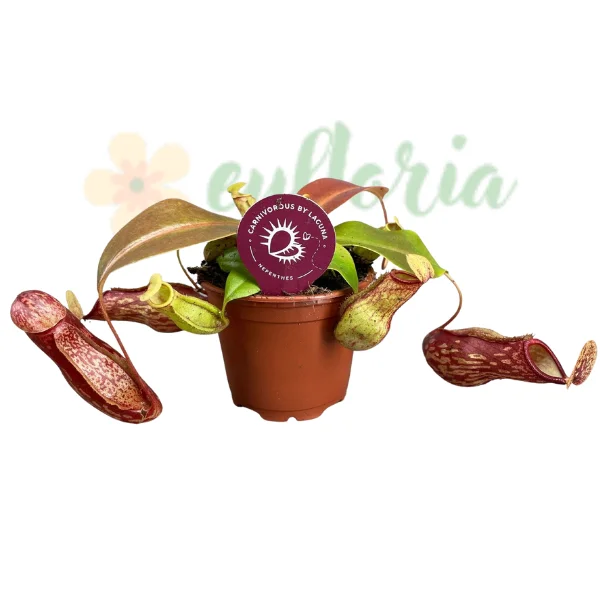
Nepenthes alata is the winged pitcher plant native to the Philippine archipelago, considered the most beginner-friendly Nepenthes species. Climbing stems and green-burgundy pitchers up to 20 cm tall make it a living focal point, ideal for hanging baskets and open terrariums.
Approx height (including pot): 20 cm
Pot diameter: 8.5 cm
- Description
- Characteristics
- Reviews (0)
- FAQ
🌿 Origin and Botanical History
Nepenthes alata is one of the world's most iconic and beloved carnivorous plants, native to the Philippine archipelago, where it inhabits forested mountain slopes from sea level up to 1,900 meters in altitude. Its scientific name comes from the Latin alatus, meaning "winged" — a direct reference to the distinctive serrated wings that line the front of every pitcher trap. The species was first described in 1837 and has since become a cornerstone of carnivorous plant collections worldwide thanks to its remarkable tolerance.
In the wild, Nepenthes alata grows on mountain ridges and altitudinal swamps, climbing through shrubs and ferns with vining stems that can reach several meters in length. Its adaptability to varied conditions of altitude, temperature, and humidity makes it the most forgiving species for indoor cultivation — a Nepenthes that pardons beginner mistakes. In modern indoor cultivation, the plant remains a collector favorite because it produces pitchers with a consistency rarely matched by other species in the genus, while its wild forms hybridize spectacularly with other Nepenthes, giving rise to ornamental cultivars used in horticulture today.
The genus Nepenthes belongs to the family Nepenthaceae and includes more than 170 described species, distributed from Madagascar through Australia but heavily concentrated in Southeast Asia. The Philippines alone host around 50 endemic species, many discovered in the past few decades. Nepenthes alata, however, has one of the broadest distributions across the archipelago, which explains both its high genetic variability and the ease with which it tolerates less-than-perfect culture conditions. For beginners, it is the ideal entry point into the fascinating world of carnivorous plants.
🌱 Distinctive Features and Morphology
The defining trait of this species is its pitchers — sophisticated traps that evolved from a modified leaf. Each pitcher begins as a tiny bud at the end of a leaf-stem extension (called a tendril), then slowly inflates into an elegant cup with an oval mouth ringed by a ribbed peristome. Young Nepenthes alata pitchers are bright green with deep burgundy veins and stripes that intensify under strong light, reaching 12-20 cm in height and 4-6 cm in width at maturity.
The plant produces two distinct morphological pitcher types: lower pitchers, stout and goblet-shaped, which sit on the substrate and capture ground-dwelling insects — ants, beetles, isopods — and upper pitchers, slimmer and funnel-shaped, that hang from climbing stems and catch flies, wasps, and moths in flight. This dimorphism is a remarkable evolutionary adaptation that lets the plant exploit two ecological niches simultaneously, capturing insects from different layers of the ecosystem.
The actual leaves, 15-25 cm long, are deep green with a prominent midvein extending beyond the leaf tip into a coiling tendril that supports the pitcher. Tendrils can measure up to 30 cm and instinctively wrap around nearby branches or supports, turning the plant into a true climbing vine. Mature plants develop long flower spikes — visually unimpressive but biologically fascinating — since Nepenthes alata is dioecious, with separate male and female plants.
Popular cultivars of Nepenthes alata include forms with bright red peristomes, those with extra-large pitchers (known as boschiana giant), and artificial hybrids such as Nepenthes × ventrata (alata × ventricosa) — even more forgiving in cultivation and extremely productive in pitcher output.
🦟 How the Carnivorous Mechanism Works
The pitcher trap operates through an elegant mechanism of attraction, slipping, and digestion. The pitcher's rim — the peristome — is coated with a microscopically structured waxy substance that, in the presence of dew or humidity, becomes extremely slippery to insect feet. The pitcher's inner surface is also coated with wax, while a few downward-pointing hairs prevent prey from climbing back out once they have fallen in.
At the bottom of the pitcher sits a digestive fluid — a mixture of accumulated rainwater and enzymes secreted by the plant (proteases, chitinases, phosphatases) that progressively break down the insect's body. Digestion takes anywhere from a few days to two weeks, and the plant absorbs nitrogen, phosphorus, and other essential nutrients directly through the inner walls of the pitcher. This is the key evolutionary adaptation that allows Nepenthes alata to thrive in poor, swampy soils where other plants would starve.
The faint sweet-bitter scent and nectar produced by glands along the peristome attract flying insects, while the contrasting coloration (green with red stripes) mimics flowers to pollinators — a visual trap layered with an olfactory one. In indoor cultivation, the plant naturally captures fruit flies, mosquitoes, and moths, providing surprisingly effective biological control of household pests. For enthusiasts of unusual plants, Nepenthes alata adds a new dimension alongside other carnivorous plants: a passive, vertical, year-round decorative trap.
🪴 How to Care for Nepenthes alata
Nepenthes alata is considered the most beginner-friendly species thanks to its tolerance of moderate temperatures and humidity — unlike montane species that demand cool conditions and humidity above 80%. Light: bright indirect, 4-6 hours of gentle morning sun or filtered light all day. Insufficient light halts pitcher formation — a classic sign that the plant needs more light. Water: only rainwater, distilled water, or reverse-osmosis water. Tap water contains minerals that build up in the substrate and slowly kill the plant.
The substrate must remain consistently moist but not waterlogged — let the surface dry slightly between waterings. Humidity: ideally 60-80%, although Nepenthes alata tolerates 50% for short periods. Placing it on a pebble tray with water raises local humidity, and grouping it with other tropical plants creates a favorable microclimate. Temperature: 18-29°C during the day, with a slight drop to 15-21°C at night. This thermal variation is important for pitcher formation — plants kept at constant temperature produce fewer pitchers.
Substrate: a specialized mix of sphagnum moss, perlite, and pine bark — never regular potting soil, which will kill the plant due to its mineral content. Fertilization: no soil feeding is needed; captured insects are the only source required. To stimulate growth, you can foliar-spray a very dilute (1/10 strength) fertilizer onto the leaves. Repotting: every 1-2 years in spring, into a slightly larger pot with excellent drainage.
🏡 The Ideal Spot in Your Home
Nepenthes alata is the centerpiece of an unusual plant collection — a living focal point that sparks conversations and fascinates children and adults alike. Place it in a hanging basket near a bright window, where the climbing stems can drape gracefully and the pitchers can sway like miniature lanterns. Bathrooms with windows, airy kitchens, and greenhouses are ideal locations thanks to their naturally higher humidity.
Combined with other humidity-loving tropical plants — ferns, orchids, or other carnivorous plants — it forms a living tropical corner, almost like an open terrarium. For carnivorous plant enthusiasts, Nepenthes alata is the ideal choice to begin a collection: tolerant, productive in pitchers, decorative year-round. The species also lends itself to dramatic terrarium setups, paired with live sphagnum moss and other small carnivores. At Eufloria we deliver across the EU via fast courier, with a guarantee of healthy condition on arrival and complete care instructions.
Lungime: 20 cm
Greutate (kg): 0.25 Kg
Denumire: Nepenthes
Diametru: 8.5 cm
Cerințe lumină: Partial umbra
Tip plantă: Decorative
Utilizare: Interior
Tip suport: Ghiveci
Material Suport: Plastic
Is Nepenthes alata toxic to cats or dogs?
No. Nepenthes alata is non-toxic to cats, dogs, and other household pets. No commonly cultivated carnivorous plant has demonstrated serious toxicity to animals. The digestive fluid in the pitchers is a mild enzymatic solution designed for tiny insects and poses no risk to mammals. In rare cases, ingesting plant material may cause minor stomach upset, but no lasting harm. The real concern is protecting the plant from your pets – cats in particular love to bat and chew at dangling pitchers, which can severely damage or destroy the plant. Hanging it out of reach is the best solution.
Why isn't my Nepenthes alata making pitchers?
The most common reason is insufficient light. Nepenthes alata needs bright, filtered light with some direct sun to produce pitchers – without it, the plant continues growing leaves but the tendrils at their tips fail to develop into traps. The second most common cause is low humidity: if ambient humidity drops below 50%, developing pitcher buds often dry out and abort. Move the plant to a brighter location (south or east-facing window), mist developing tendrils daily, and consider a humidity tray or room humidifier. New pitchers should begin forming within 2-4 weeks of improved conditions.
Why does my Nepenthes alata have different shaped pitchers?
This is completely normal and actually one of N. alata's most interesting features! Nearly all Nepenthes species produce two distinct types of pitchers during their lifetime. Lower pitchers (formed when the plant is young or at the base of the rosette) tend to be rounder, more bulbous, and often more colorful – these typically sit on the ground and target crawling insects like ants. Upper pitchers (formed as the vine elongates) become more elongated, tubular, and sometimes funnel-shaped – these hang from tendrils and target flying insects. The transition between the two forms is a sign that your plant is maturing. Both types are fully functional traps.
Can I use tap water for my Nepenthes alata?
It is strongly discouraged. While Nepenthes alata is more tolerant of mineral content than some carnivorous plants (like Venus flytraps or sundews, where tap water can be lethal), the dissolved minerals, chlorine, and fluoride in most tap water will gradually accumulate in the soil and damage the roots over time. This leads to yellowing leaves, browning pitcher edges, and declining health. Always use distilled water, collected rainwater, or reverse osmosis water. If you must use tap water in an emergency, let it sit uncovered for 24 hours to allow chlorine to evaporate – but this doesn't remove dissolved minerals, so it should only be a temporary solution.
How fast does Nepenthes alata grow and how big does it get?
Nepenthes alata is among the faster-growing Nepenthes species. Under good conditions – bright light, warm temperatures, adequate humidity, and regular feeding – it can produce a new leaf (with a potential pitcher) every 2-4 weeks during the growing season. Mature plants develop a vining stem that can reach 90 cm (3 feet) or more indoors, and considerably longer in greenhouse conditions. Individual pitchers can grow up to 20 cm (8 inches) tall on mature plants. The vine can be trained upward on a support, allowed to hang from a basket, or pruned back to encourage bushier growth and side shoots. Expect the first significant pitchers within a few months of receiving a young plant.
Carnivorous care?
Strong light, distilled water, peat+perlite.
Water?
Distilled/rain only. No tap.
Feeding?
Not needed. Catch own insects.
Winter?
Dormancy 5-10°C.
Substrate?
Peat+perlite 1:1.
What is Nepenthes alata and where does it come from?
Nepenthes alata is a tropical carnivorous plant native to the Philippines, where it grows in both highland and lowland areas. It is one of the most widespread and resilient Nepenthes species, ideal for indoor cultivation. The name 'alata' means 'winged', referring to the wings on its pitchers.
How do I care for Nepenthes alata at home?
Nepenthes alata is easy to care for: provide bright indirect light, 50-70% humidity, temperatures of 20-30°C, and regular watering with distilled or rainwater. The ideal substrate is sphagnum moss mixed with perlite. Do not let the substrate dry out completely, but also avoid waterlogging the roots.
How large do Nepenthes alata pitchers get?
Nepenthes alata pitchers can reach 10-20 cm in height under optimal growing conditions. They are usually green with reddish-purple spots or streaks. Lower pitchers are more rounded, while upper pitchers are more elongated and funnel-shaped. Pitcher formation is stimulated by high humidity and good light.
Is Nepenthes alata suitable for beginners?
Yes, Nepenthes alata is considered the best Nepenthes species for beginners. It tolerates ordinary household conditions well, including lower humidity than other species. It can grow successfully on a bright windowsill without a terrarium, although an open terrarium significantly improves pitcher formation.
How do I encourage pitcher formation in Nepenthes alata?
To encourage pitcher formation, ensure: high humidity (above 60%), bright indirect light, temperature difference between day and night, and avoid moving the plant frequently. Mist daily or place the plant on a tray with wet pebbles. Avoid cold drafts and dry air from heating radiators.
Recommendations
Ai nevoie și de un ghiveci decorativ?