EN/
EN/ Romana
Hoya panchoi D12
![Hoya panchoi — plant with oval fleshy glossy green leaves and cream flowers with pink-magenta corona [0]](https://gomagcdn.ro/domains2/eufloria.ro/files/product/medium/hoya-panchoi-iml0228-d12-282973.webp "Hoya panchoi — plant with oval fleshy glossy green leaves and cream flowers with pink-magenta corona [0]")
![Hoya panchoi — plant with oval fleshy glossy green leaves and cream flowers with pink-magenta corona [1]](https://gomagcdn.ro/domains2/eufloria.ro/files/product/medium/hoya-panchoi-iml0228-d12-440991.webp "Hoya panchoi — plant with oval fleshy glossy green leaves and cream flowers with pink-magenta corona [1]")
![Hoya panchoi — plant with oval fleshy glossy green leaves and cream flowers with pink-magenta corona [1]](https://gomagcdn.ro/domains2/eufloria.ro/files/product/original/hoya-panchoi-iml0228-d12-282973.webp "Hoya panchoi — plant with oval fleshy glossy green leaves and cream flowers with pink-magenta corona [1]")
![Hoya panchoi — plant with oval fleshy glossy green leaves and cream flowers with pink-magenta corona [2]](https://gomagcdn.ro/domains2/eufloria.ro/files/product/original/hoya-panchoi-iml0228-d12-440991.webp "Hoya panchoi — plant with oval fleshy glossy green leaves and cream flowers with pink-magenta corona [2]")
Hoya panchoi is a rare Philippine species scientifically described in 2010, remarkable for its oval fleshy 4–7 cm glossy green leaves and delicate cream-white flowers with an intense pink-magenta central corona. Blooms form in symmetrical umbels of 15–25 fragrant florets with sweet honey notes, more pronounced in the evening. A climbing epiphyte from the Apocynaceae family, it prefers bright indirect light, 55–75% humidity, and moderate watering. Non-toxic to pets according to ASPCA. A precious addition to any serious Hoya collection.
Approx height (including pot): 10 cm
Flowering state: No flowers
Country of origin: Netherlands
- Description
- Characteristics
- Reviews (0)
- FAQ
🌿 Hoya panchoi — Rare Philippine Hoya with Fleshy Leaves and Delicate Pink Flowers
Hoya panchoi is a rare and distinctive Hoya species, native to the Philippine islands, relatively recently described scientifically and considered one of the most elegant Hoyas for collectors who appreciate rare species with flowers in pastel shades. It stands out through its oval fleshy leaves with a slightly glossy texture, and through delicate flowers in cream-white shades with a pink-magenta corona, which form symmetrical umbels on long peduncles. It is a variety sought after by collectors due to its rarity in cultivation and its subtle beauty.
The species belongs to the special group of endemic Philippine Hoyas, a remarkable group noted for morphological diversity and the many new species described in recent years. Hoya panchoi stands out through the combination of compact foliage, moderate growth, and abundant flowering — an ideal combination for collectors seeking plants that offer decorative value through both leaves and flowers. Its succulent leaves also make it relatively tolerant of occasional neglect, an advantage for busy growers.
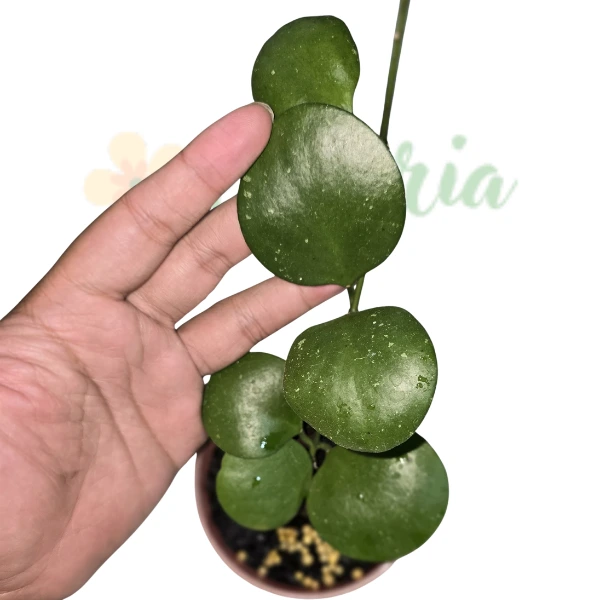
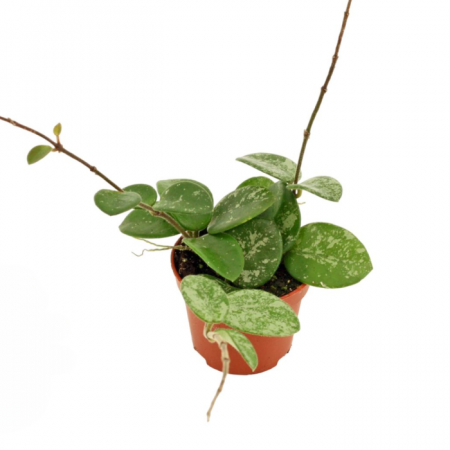
The leaves have an oval to elliptical shape, measuring approximately 4–7 centimetres in length and 2.5–4 centimetres in width. They are thick, fleshy, medium to deep green with a slight sheen, with discreet venation that becomes more visible on mature plants. The surface is smooth and slightly glossy, and the edges are slightly wavy. Some specimens develop a subtle reddish tint on the edges when exposed to brighter light, a sign of a healthy well-lit plant. The thickness of the leaves is a typical adaptation of tropical epiphytic species living in habitats with humidity variations.
Flowering in Hoya panchoi is a memorable moment for any collector. Flowers form in symmetrical umbels of 15–25 blooms, each flower measuring approximately 1–1.5 centimetres in diameter. The outer petals are a delicate cream-white, sometimes with pinkish reflections, creating a neutral background that highlights the central corona. This is an intense pink-magenta with darker accents, beautifully contrasting with the white petals. The fragrance is sweet and pleasant, with floral notes and slight honey accents, more pronounced in the evening and at night. A mature plant can bloom several times a year under optimal conditions.
🌍 Origin and Botanical History
The species Hoya panchoi is native to the Philippine islands, an archipelago hosting over 90 Hoya species, many of which are endemic and described only in recent decades. Its natural range is mainly concentrated on some specific islands of the archipelago, where it grows as an epiphytic plant on tree trunks in humid tropical forests at low to medium altitudes. The Philippines represent one of the most important centres of diversity for the Hoya genus in the entire world, and the discovery of new species continues today thanks to the efforts of local and international botanists.
The species was scientifically described relatively recently, in 2010, by botanists Dale Kloppenburg and George Ted Green, two of the most important experts in the taxonomy of the Hoya genus. The official description was published in specialty journals and the species was named in honour of a local person who contributed to research and documentation of Philippine flora. This description makes Hoya panchoi one of the newer additions to the Hoya family and explains why it remains relatively rare in cultivation, being propagated only through vegetative cuttings from original plants.
The genus Hoya was named in honour of English botanist Thomas Hoy (1750–1822), gardener to the Duke of Northumberland, who cultivated numerous tropical plants imported to Europe at the end of the 18th century. The genus today contains over 500 described species, many of which have been added in the last two decades as botanists explore tropical habitats in Southeast Asia and Oceania more thoroughly. Hoya panchoi is an excellent example of this modern wave of botanical discoveries. It belongs to the Apocynaceae family, the same that includes oleander, frangipani, and Stephanotis floribunda.
In European cultivation, Hoya panchoi has appeared only in recent years, spread through exchanges between passionate collectors and controlled vegetative propagation. Its rarity gives it a special status — you will not find it in ordinary garden centres, and each specimen in cultivation originates from vegetative propagation of original mother plants. The growing interest in rare Hoyas in recent years has made recently described species like panchoi gradually more accessible, but they still remain relatively rare and precious plants for collections.
🌱 Foliage and Visual Characteristics
What makes Hoya panchoi attractive to collectors is the harmonious combination of its beautiful leaves and delicate flowers. The leaves are oval, measuring 4–7 centimetres in length and 2.5–4 centimetres in width, with an elegant and symmetrical shape. The leaf surface is smooth, slightly glossy, an intense and uniform green that becomes richer in optimal light conditions. The edges are slightly wavy, and the tip is shortly pointed. The base of the leaf is rounded or slightly wedge-shaped, attaching to the stem through short petioles.
The considerable thickness of the leaves gives them a semi-succulent appearance — they are full of water and very resistant to variations in air humidity. This adaptation is typical of epiphytic species living in tropical forests, where humidity can vary significantly between day and night or between seasons. In cultivation, the thickness of the leaves makes Hoya panchoi tolerate occasional drying periods without suffering major damage, a useful feature for growers who cannot always ensure regular watering.
The dominant leaf colour is a medium to deep green, uniform and glossy. Young leaves are often lighter, almost yellow-green, and gradually darken as they mature. Under bright indirect light, some specimens develop a subtle reddish tint on the leaf edges, a phenomenon called "sun-stress" that is considered attractive by many collectors and indicates that the plant is receiving sufficient light. The venation is discreet, visible only on close inspection, which contributes to the clean and tidy appearance of the foliage.
The stems are thin but sturdy, green-brown in colour, and grow climbing or trailing depending on the support. Stem length can reach 80–150 centimetres in cultivation, with nodes appearing at intervals of 4–6 centimetres, each producing a pair of opposite leaves. Growth is moderate, which means the plant maintains its tidy shape without requiring frequent pruning. In mature nodes, flower peduncles ("spurs") develop, permanent structures essential for repeated flowering in subsequent years.
✨ Care and Growing Requirements
Hoya panchoi is a moderately easy species to care for, ideal for collectors with some experience in cultivating Hoyas. Its basic requirements include bright indirect light, moderate to high humidity, stable warm temperatures, and a very well-draining substrate. With these conditions met, the plant will grow healthy and bloom regularly, rewarding your effort with its subtle beauty and the spectacle of its delicate flowers.
Light is the most important factor for healthy development and flowering. Hoya panchoi requires bright indirect light, ideally 6–8 hours daily. An east-facing window is optimal, offering the gentle direct morning light without the stress of intense afternoon rays. West-facing windows work well with partial filtering, and south-facing windows mandatorily require filtering through a sheer curtain. Insufficient light causes the plant to grow elongated and never bloom.
- Light: Bright indirect, 6–8 hours daily. East ideal, west with filter, south mandatory filtered. No intense direct sun.
- Watering: Moderate. Let the top 2–3 cm of substrate dry between waterings. Every 5–7 days in summer, 10–14 days in winter. Do not leave standing water in the saucer.
- Temperature: 20–28°C during the growing season, minimum 16°C in winter. Does not tolerate cold below 15°C and cold drafts.
- Humidity: Moderate to high (55–75%). If room air is dry, use a humidifier or pebble tray with water. Occasional misting helps.
- Substrate: Very well-draining and airy. Epiphytic orchid mix combined with perlite, fine pine bark, and coconut fibres. Avoid compact substrates.
- Fertilising: Monthly during the growing season (April–September) with liquid fertiliser for flowering plants diluted to half strength. Do not fertilise in winter.
- Propagation: Through stem cuttings with 2–3 nodes. Roots appear in 4–8 weeks in moist sphagnum moss or in filtered water.
To stimulate flowering, provide the plant with sufficient bright light and a support to climb (moss pole, trellis, or mesh). Hoya panchoi blooms on permanent peduncles ("spurs") that emerge from mature nodes — never cut these peduncles after flowering, as the plant will bloom repeatedly from the same points in subsequent years. In the cold season, reduce watering but maintain air humidity as constant as possible to avoid stress.
⭐ Why Choose Hoya panchoi
Hoya panchoi is the ideal choice for collectors who appreciate recently described rare species and who seek plants with a modern botanical story. Its status as a species described only in 2010 and its relative rarity in cultivation make it a precious addition to any serious Hoya collection. The combination of compact, beautiful foliage and delicate pink-magenta flowers creates a balanced plant that offers consistent decorative value throughout the year.
An important advantage is that all Hoya species, including panchoi, are considered non-toxic to pets according to the ASPCA database. This makes it a safe choice for homes with cats, dogs, or curious small children. You can place it anywhere without worrying that it will be dangerous to your four-legged family members — a significant advantage over many other exotic ornamental plants that can be toxic.
Its moderate size and climbing form make it suitable for apartments, offices, or winter gardens, where it can be displayed on moss poles, trellises, or in hanging pots. The moderate growth means the plant does not become invasive and maintains its tidy shape without frequent intervention, an advantage for growers who prefer plants that "behave nicely". The fleshy leaves make it tolerant of small watering mistakes, making it more accessible than some more demanding Hoyas.
From Eufloria, you receive a healthy, well-rooted specimen, carefully selected for its decorative qualities and general health condition. Each plant is inspected before delivery and carefully packaged to arrive in perfect condition. With a little attention and adequate conditions, Hoya panchoi will reward your effort with years of subtle beauty, increasingly numerous and mature leaves, and the pleasant spectacle of its pink-magenta flowers that add a special note to your collection.
Lungime: 15 cm
Greutate (kg): 1 Kg
Denumire: Hoya
Diametru: 7 cm
Cerințe lumină: Partial umbra
Tip plantă: Decorative
Utilizare: Interior
Tip suport: Ghiveci
Material Suport: Plastic
How do I care for Hoya panchoi?
What makes Hoya panchoi special?
When does Hoya panchoi bloom?
Is Hoya panchoi toxic to pets?
How can I propagate Hoya panchoi?
Recommendations
Ai nevoie și de un ghiveci decorativ?